Samsung Heavy Industries and Tesser Atomics Partner on Nuclear LNG Carrier
South Korea's Samsung Heavy Industries and US-based Tesser Atomics have signed a strategic partnership to develop a demonstration transatlantic nuclear-powered LNG carrier.
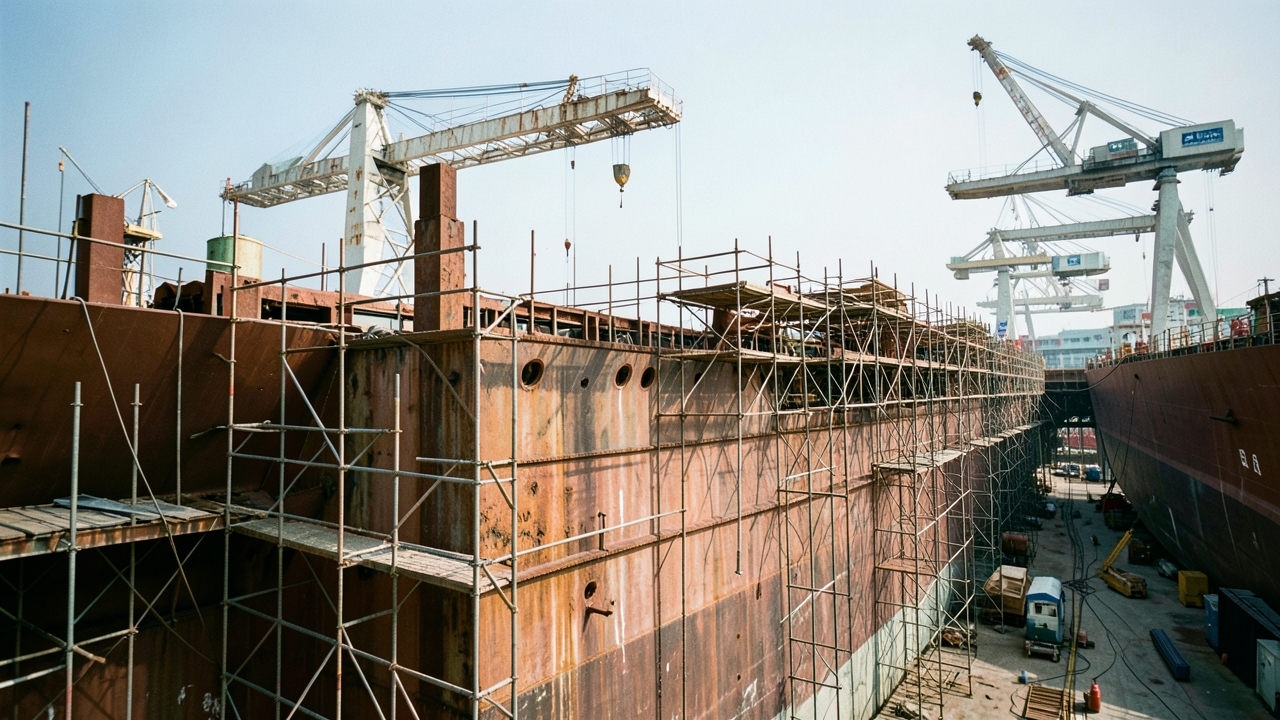
South Korean shipbuilder Samsung Heavy Industries and US nuclear technology company Tesser Atomics signed a memorandum of understanding on November 19, 2026, establishing an exclusive collaboration to develop a demonstration nuclear-powered liquefied natural gas (LNG) carrier. As reported by gCaptain and World Nuclear News, the agreement positions Samsung Heavy Industries as the exclusive shipbuilding partner and Tesser Atomics as the exclusive reactor partner for the demonstration project. The intended vessel is designed for commercial transatlantic service operating between the United States and Europe.
Project Architecture and Technical Specifications
At the center of the collaboration is Tesser’s Triton reactor, a compact fluoride-salt-cooled high-temperature reactor (FHR) developed specifically for marine applications. The system utilizes tri-structural isotropic (TRISO) fuel paired with low-pressure molten salt coolant and incorporates an online refueling design that allows fuel replenishment while the reactor operates. Texas-based Tesser Atomics, co-founded by CEO Per Peterson, is advancing the marine application alongside technology developed within Kairos Power.
According to the companies, the demonstration vessel originated from Norway's NuProShip research initiative and is currently being advanced under SFI SAINT, a research consortium led by the Norwegian University of Science and Technology (NTNU) Department of Ocean Operations and Civil Engineering and supported by the Research Council of Norway. SFI SAINT is targeting nuclear-powered vessel demonstrations in the early 2030s, including an LNG carrier initiative supported by shipowner Knutsen OAS.
Samsung Heavy Industries Executive Vice President Kyunghee Kim noted that demonstrating nuclear propulsion on an Atlantic LNG trade route could provide shipowners with the operational evidence needed to evaluate nuclear power for future fleet builds. Both companies emphasized that the current agreement is a technology development partnership rather than a firm shipbuilding contract, with no construction schedules, final vessel dimensions, or project financing disclosed.
Background in Nuclear Marine Concepts
Samsung Heavy Industries has previously pursued nuclear propulsion design concepts. In September 2025, the shipbuilder, alongside the Korea Atomic Energy Research Institute (KAERI), secured an Approval in Principle (AiP) from the American Bureau of Shipping (ABS) and the Liberian Registry for a 174,000-cubic-meter LNG carrier powered by a 100-megawatt-thermal (MWt) small modular molten salt reactor.
Additionally, classification society ABS has studied the viability of marine nuclear power. An October 2024 ABS study examined a high-temperature gas-cooled reactor on a 145,000-cubic-meter LNG carrier, noting typical LNG carrier energy requirements range between 30 and 75 MW. A subsequent ABS-supported study published in October 2026 evaluated the economic parameters, estimating that a nuclear-powered LNG carrier could require roughly 2.5 times the initial capital expenditure of a conventional carrier, while potentially reducing long-term voyage fuel costs.
Why It Matters
As the International Maritime Organization (IMO) pursues net-zero greenhouse gas targets for international shipping by or around 2050, deep-sea vessel operators are analyzing alternative energy sources to replace conventional fossil fuels. Traditional LNG carriers rely on dual-fuel engines burning boil-off gas or fuel oil, which produce carbon emissions during transit.
While high capital expenditures present financial hurdles, nuclear propulsion offers zero-emission operations and eliminates fuel reliance during long voyages. However, significant regulatory and operational barriers remain before commercial deployment can occur. These include licensing marine reactors, resolving insurance and third-party liability rules, securing port access permissions, and training specialized crew members. The IMO is currently working to revise its regulatory framework, aiming to adopt an updated Nuclear Code and amendments to SOLAS Chapter VIII by 2030.
Drafted with AI assistance and reviewed by the Maritime LNG Editorial Desk
Related articles
WinGD and Hanwha Engine Partner to Advance New Engine Roll-Out
WinGD and Hanwha Engine collaborate to advance commercial deployment of X-DF-HP high-pressure LNG engines and X-DF-P dual-fuel LPG technology.
Baker Hughes and McDermott Secure Subsea Contract for Ichthys LNG Phase
Baker Hughes and McDermott consortium awarded EPCI contract by Inpex for the next phase of the Ichthys LNG development offshore Western Australia.
Nord Gas Solutions Secures Excelerate Energy FSRU Retrofit Contract
Excelerate Energy has selected Nord Gas Solutions for an FSRU reliquefaction retrofit project in Brazil, scheduled for equipment delivery in late 2027.