FERC Approves Sabine Pass Stage 5: Three New Trains and Up to 20 Mtpa
FERC voted 5-0 on 19 November 2026 to authorise Cheniere's Sabine Pass Stage 5: three new liquefaction trains of up to about 20 mtpa peak and new feedgas pipelines. DOE non-FTA export approval and the final investment decision are still pending.
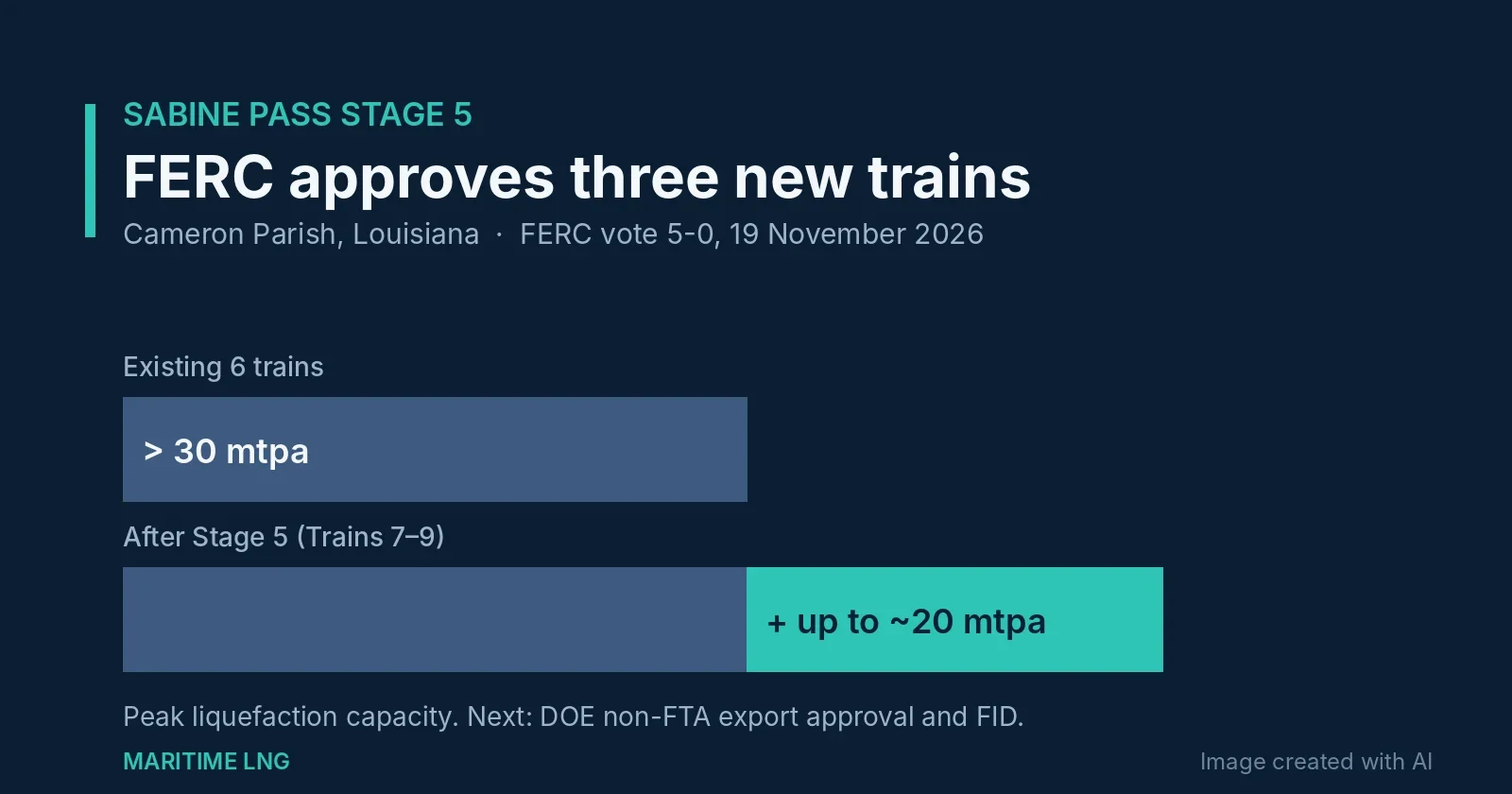
The Federal Energy Regulatory Commission (FERC) has authorised Cheniere Energy to expand its Sabine Pass LNG export terminal in Cameron Parish, Louisiana. On 19 November 2026, the Commission voted 5-0 to approve three additional liquefaction trains, Trains 7, 8 and 9, with an expected total peak production capacity of up to approximately 20 million tonnes per annum (mtpa). It also approved the feedgas pipeline expansions that would supply them.
The order clears the main federal siting approval for the project, known as Sabine Pass Stage 5 or the SPL Expansion Project. It is not yet a decision to build. Cheniere still needs a Department of Energy (DOE) authorisation to export the additional volumes to non-free trade agreement (non-FTA) countries, and it has not yet taken a final investment decision (FID).
What FERC authorised
- Applicants: Sabine Pass Liquefaction, LLC and Sabine Pass Stage V, LLC, both Cheniere subsidiaries, for the terminal. Cheniere Creole Trail Pipeline, L.P. for the pipeline facilities.
- Dockets: CP25-505-000 (terminal) and CP25-506-000 (pipeline).
- Decision: item C-1 on the consent agenda of FERC's 19 November 2026 open meeting, approved unanimously together with five other natural gas certificate items.
- Environmental review: FERC issued the final environmental impact statement (EIS) for the project in September 2026, according to Cheniere.
- Construction deadline: according to reporting on the order, the companies have 10 years to complete construction.
At the meeting, FERC Chairman Laura V. Swett said the Commission is realising the benefits of LNG exports "without raising natural gas prices for Americans", according to Daily Energy Insider. The Sierra Club opposed the expansion, arguing that more US export capacity has already been approved than world markets are expected to need. According to reporting on the order, FERC said the question of export demand is for DOE to decide.
Two phases, three trains
Cheniere plans to build the expansion in phases.
- Phase 1: a single train, Train 7, with an expected production capacity of over 6 mtpa, plus a boil-off gas (BOG) reliquefaction unit of about 1 mtpa, a compressor, tie-ins to the existing plant and associated facilities.
- Phase 2: Trains 8 and 9, each of about 6 mtpa peak, plus tie-ins, a ground flare system, three new BOG compressors and upgrades to the marine loading infrastructure. These upgrades would allow simultaneous LNG loading at two of the terminal's three berths.
Sabine Pass already operates six liquefaction trains with a total production capacity of over 30 mtpa. Adding up to about 20 mtpa would take the site to roughly 50 mtpa of peak capacity once both phases are complete. According to reporting on the order, the expansion corresponds to up to about 950 billion cubic feet of gas per year.
New feedgas pipelines
The same order covers two pipeline projects to bring gas to the new trains:
- Sabine Crossing Pipeline: 55.6 miles of 48-inch pipeline from Liberty County, Texas, across Sabine Lake to the terminal, with a new 210,000-hp compressor station and a capacity of up to 2.7 Bcf/d. Estimated cost: about $1.63 billion.
- Creole Trail Pipeline expansion: 900,000 Mcf/d of additional firm transportation on Cheniere's existing system, with a new 52,500-hp compressor station in Cameron Parish and 46,940 hp added at the existing Gillis Compressor Station in Beauregard Parish, Louisiana. Estimated cost: about $390 million.
Cheniere estimated the full Stage 5 expansion at $15 billion in a June 2025 filing with DOE, as reported by Oil & Gas Journal.
What still has to happen
- DOE export authorisation: Cheniere's third-quarter 2026 results list the DOE application to export LNG from the expansion to non-FTA countries as pending. Most major LNG importers, including the EU Member States, Japan and China, are non-FTA countries.
- Final investment decision: Cheniere has targeted FID on Phase 1 by early 2027. On the company's third-quarter earnings call, CEO Jack Fusco said Cheniere expected FERC approval by year-end and would reach FID very quickly afterwards. Cheniere states that a positive FID depends on regulatory approvals and acceptable commercial and financing arrangements.
- Financing: Cheniere has obtained commitments for a term loan sized to finance about 50% of the estimated cost of Phase 1, subject to a positive FID.
- Contracts: in October 2026, Sabine Pass and Corpus Christi signed long-term sale and purchase agreements with QatarEnergy for up to 4 mtpa in aggregate on a free-on-board (FOB) basis. Of this, 1 mtpa is subject to a positive FID on the Sabine Pass expansion.
- Construction: Bechtel holds a lump-sum turnkey EPC contract for Phase 1 and has been released for early engineering and procurement under a limited notice to proceed.
- Site preparation: on 24 November 2026, LNG Prime reported that Cheniere has asked FERC for approval to begin initial site preparation.
If the project goes ahead, initial LNG exports could begin in 2030, with commercial service potentially starting in mid-2031, according to Oil & Gas Journal.
What it means for LNG shipping
Sabine Pass was the first major liquefaction project in the contiguous United States and has been in production since 2016. Cheniere reports about 56 mtpa of liquefaction capacity in operation across Sabine Pass and Corpus Christi, and the company exported a quarterly record of 188 cargoes in the third quarter of 2026.
As an indicative estimate by Maritime LNG, assuming about 75,000 tonnes per cargo on a standard 174,000 m³ carrier, Phase 1 alone at 6 mtpa would correspond to roughly 80 cargoes a year. The full expansion at about 20 mtpa would correspond to roughly 260 to 270 cargoes a year. These are peak-capacity figures, not a production forecast.
Three points stand out for the shipping side:
- Berths: simultaneous loading at two of the three berths is a Phase 2 item. It should give the terminal more flexibility to schedule carriers as throughput grows.
- Boil-off gas: both phases add BOG handling. At an export terminal, BOG comes from storage tanks, rundown lines and vapour returned from carriers during loading.
- FOB sales: volumes sold on an FOB basis, such as the QatarEnergy agreements, are lifted by ships that the buyer provides. Additional FOB volumes add demand for buyers' and charterers' tonnage rather than the seller's.
For how FERC, DOE, the US Coast Guard and MARAD each approve a US export terminal, see our Technical Library guide US LNG Export Projects in Official Data: FERC, DOE and the Approval Path.
Note on sources: FERC voted on the project on 19 November 2026; the approval was reported in industry media in the following days, including by GIIGNL on 26 November 2026. Project data are taken from FERC's announcement and Cheniere's third-quarter 2026 results. Dockets, pipeline data, cost estimates and the construction deadline are as reported by Oil & Gas Journal, Daily Energy Insider and other media coverage of the order. Cargo numbers are Maritime LNG estimates.
Related news
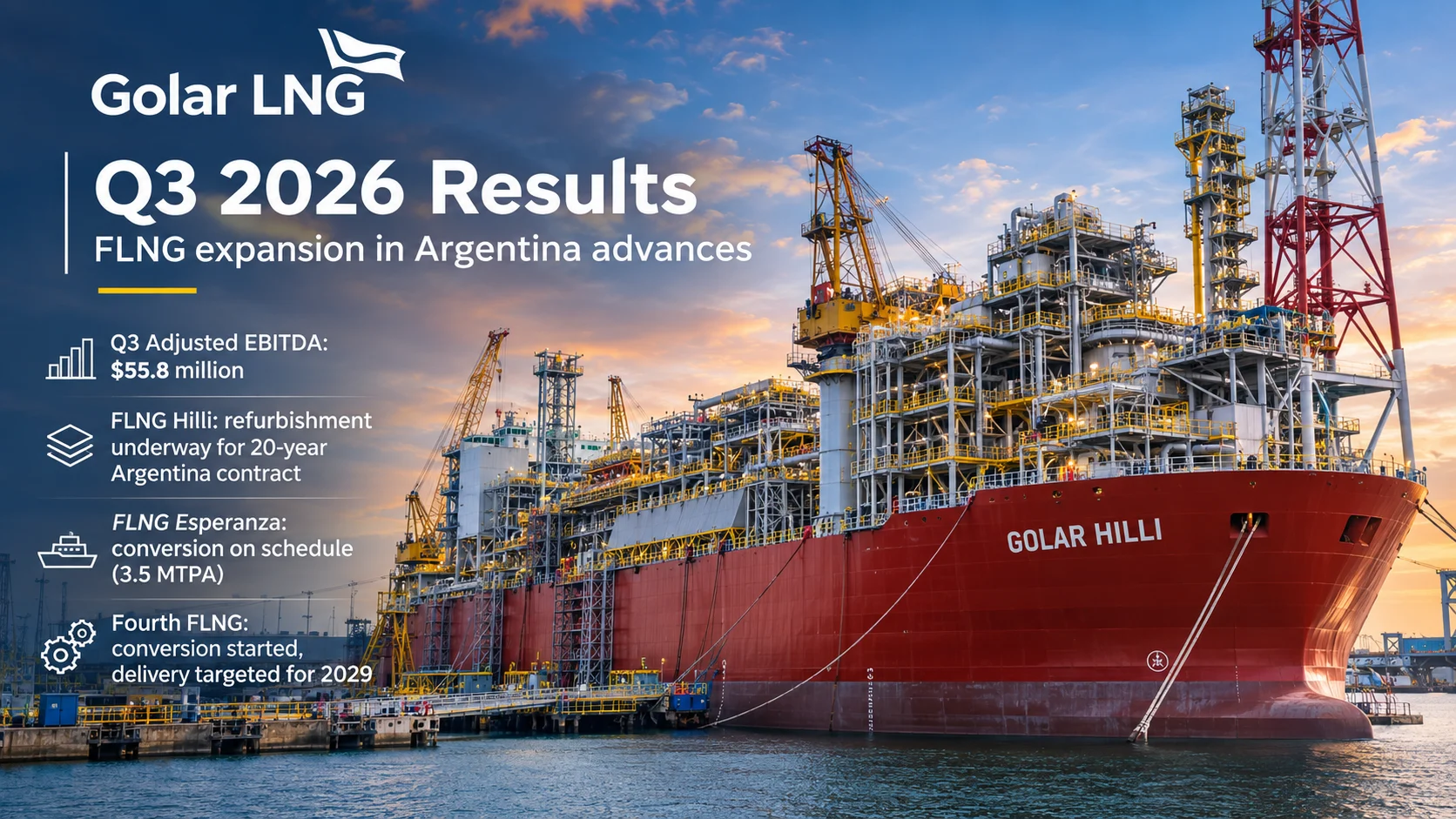
Golar LNG Reports Lower Q3 Earnings as FLNG Expansion in Argentina Advances
Golar LNG reports Q3 2026 results, advances FLNG Hilli and Esperanza projects in Argentina, and progresses its fourth FLNG conversion.

South Korea Asks Qatar to Prioritize LNG Supplies Once Production and Hormuz Shipping Normalize
South Korea has asked Qatar to prioritize LNG supplies once production and Strait of Hormuz shipping normalize, amid disruptions to Qatari exports.
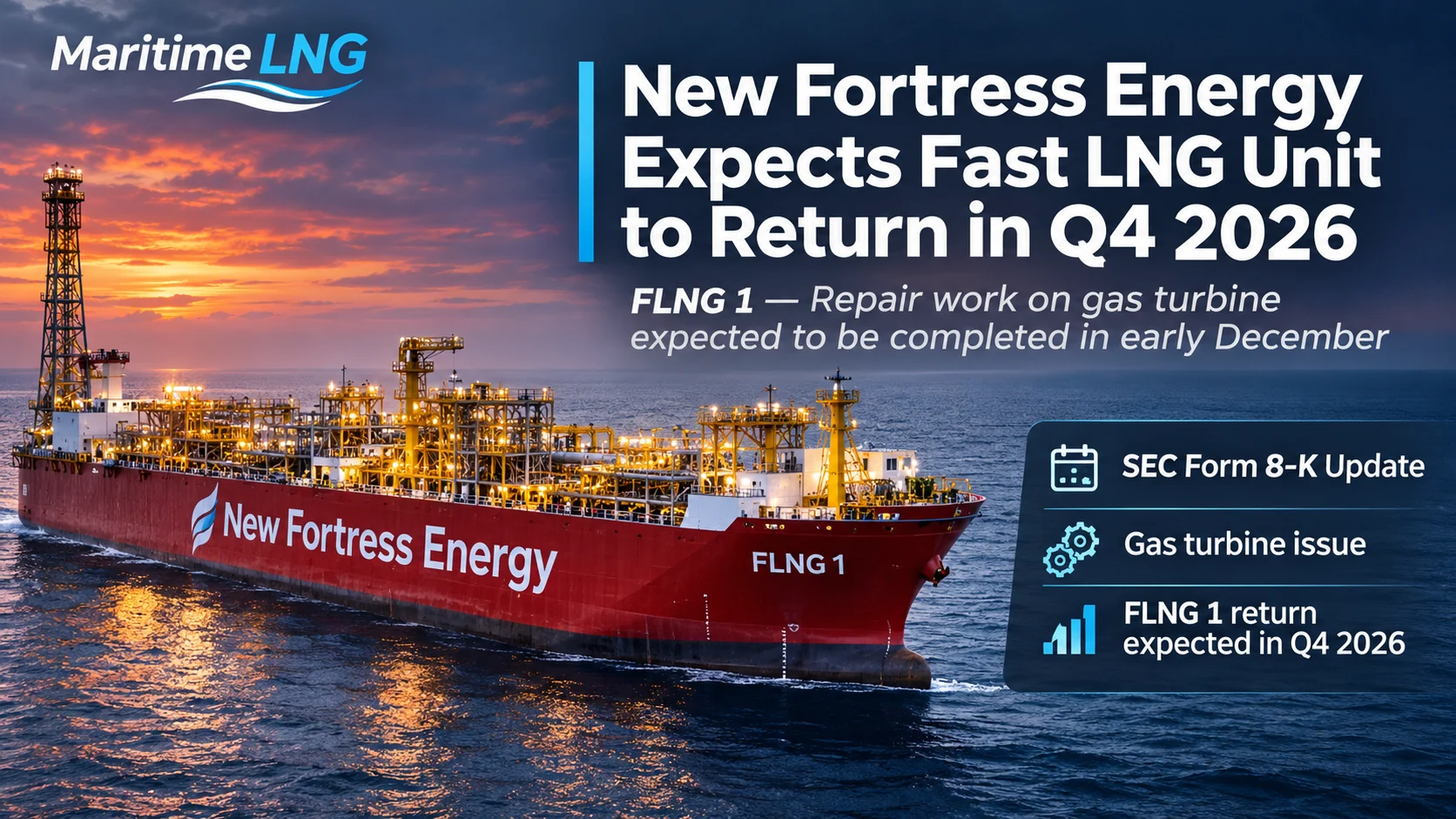
New Fortress Energy Expects Fast LNG Unit to Return to Service in Q4 2026
New Fortress Energy expects its FLNG 1 unit to return to service in Q4 2026 after a gas turbine failure. Read the latest SEC filing update.