CLEAN Report 2026-27: 68% of Japan's and 75% of Korea's LNG Now Under Top-Tier Methane Reporting
The third CLEAN Annual Report shows 68% of Japan's and 75% of Korea's 2025 LNG imports linked to OGMP 2.0 Level 4–5 reporting, 96% survey response from upstream projects, and a key caveat: better data is pushing reported methane intensity up, not down.
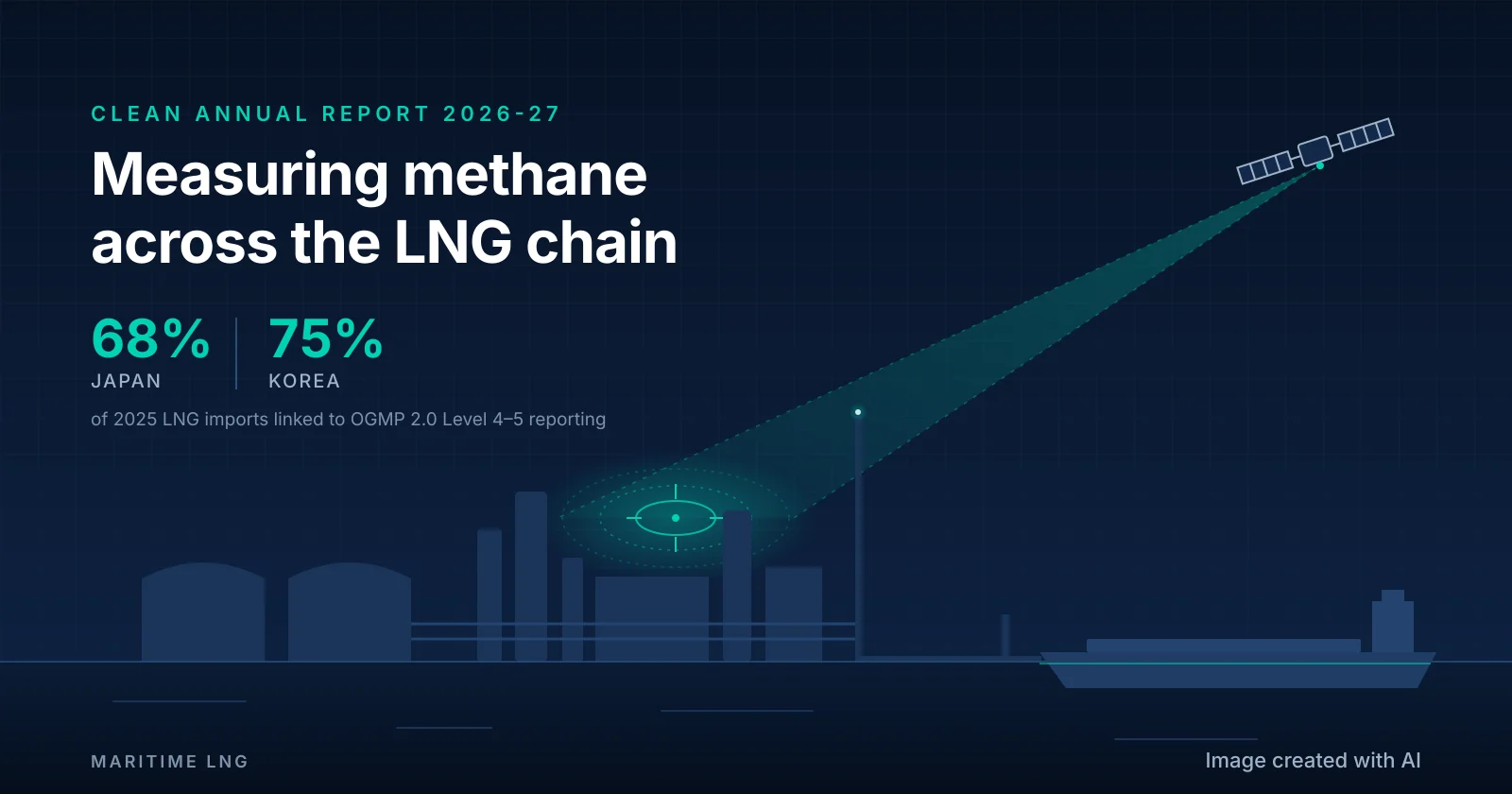
Measurement-based methane reporting is now the majority case for the LNG that Japan and South Korea import. According to the CLEAN Annual Report 2026-27, published in November 2026, 68% of Japan's 2025 LNG imports were associated with OGMP 2.0 Level 4 and Level 5 reporting at the exporting liquefaction plant, up from 42% in 2024. For the Republic of Korea, the share rose from 61% to 75%.
The report is the third annual edition of the Coalition for LNG Emission Abatement toward Net-zero (CLEAN), a buyer-led initiative launched in 2023 by JERA and KOGAS, with JOGMEC as secretariat. It combines a producer survey, eight project-level best practices, an independent OGMP 2.0 analysis by UNEP's International Methane Emissions Observatory (IMEO), and commentary from the World Bank and the International Gas Union (IGU). Its most important message is also its least intuitive: as data quality improves, reported methane intensity is going up.
A larger coalition and a fuller survey
CLEAN has grown from two founding companies in 2023 to 27 member companies as of October 2026. This year the World Bank's Global Flaring and Methane Reduction Partnership (GFMR) and ExxonMobil acknowledged the initiative, bringing the number of acknowledging institutions to 22: eight international and regional organisations and 14 upstream companies.
The CLEAN Survey 2026-27 questionnaire was sent on 3 July 2026, with a 31 July deadline, to 24 upstream projects that export LNG to Japan and Korea. Together they represent approximately 90% of the two countries' combined LNG demand.
- 23 projects (96%) responded as of 3 September 2026, covering approximately 85% of demand (previous year: 95%).
- 18 projects (75%) provided methane data, including methane intensity (previous year: 64%).
- 8 projects submitted best practices, two more than last year: Wheatstone, Gorgon, Ichthys, Pluto, North West Shelf, Das Island, Freeport and Sabine Pass Liquefaction.
- By region: 11 projects in Oceania, five in North America, four in the Middle East, two in Southeast Asia and one in Russia.
Among the 18 projects analysed, OGMP 2.0 was the most common initiative (12 projects). LDAR programmes were voluntary at 12 projects and regulatory at 9, with some reporting both. OGI cameras were the most used detection method (16 projects), followed by portable gas detectors and drones (13 projects each). Annual LDAR surveys were most common (7 projects), followed by semiannual (3). Twelve projects reported third-party verification or certification of emissions data, and 10 reported to regulators.
The top driver was corporate reputation and stakeholder trust (13 projects), followed by buyer demand for low-carbon LNG (9 projects). The most frequently selected challenge was a lack of skilled personnel and technical expertise (5 projects).
OGMP 2.0 coverage and data quality
IMEO's chapter combines Kpler-based import data supplied by JOGMEC with OGMP 2.0 reporting for each liquefaction plant. In 2025, Japan's LNG came from 32 liquefaction plants and Korea's from 38. The main supply source outside OGMP 2.0 scope for both was Sakhalin Energy.
2025 indicators
- LNG imports from plants within OGMP 2.0 scope: Japan 88% · Korea 94%
- Imports linked to Level 4–5 reporting (plant basis), 2024 → 2025: Japan 42% → 68% · Korea 61% → 75%
- Allocated supply-chain CH₄ emissions at Levels 4–5, 2024 → 2025: Japan 35% → 60% · Korea 49% → 57%
- Allocated emissions still estimated at Levels 1–3: Japan 40% · Korea 43%
- Emissions-weighted average reporting level (scale 1–5): Japan 3.8 · Korea 3.8
The average reporting level improved from 3.4 (Japan) and 3.5 (Korea) in 2024. The supply-chain figures include liquefaction plants and, where the link can be established, upstream feedgas assets and pipelines. LNG shipping emissions are excluded.
The forward outlook, based on companies' OGMP 2.0 implementation pathways and a constant 2025 supply mix, is indicative only:
Average reporting level (scale 1–5)
- Japan: 2.8 (2022) · 3.2 (2023) · 3.4 (2024) · 3.8 (2025) · 4.0 (2026, est.) · 4.4 (2027, est.) · 4.5 (2028, est.)
- Korea: 2.8 (2022) · 3.4 (2023) · 3.5 (2024) · 3.8 (2025) · 4.1 (2026, est.) · 4.5 (2027, est.) · 4.5 (2028, est.)
Values marked "est." (2026–2028) are an indicative scenario, not observed data.
Better data, higher numbers
The report calculates an indicative methane intensity for each import market: allocated OGMP-reported emissions divided by the corresponding LNG import volumes, on a mass basis.
Methane intensity (%)
- Japan: 0.088 (2022) · 0.087 (2023) · 0.082 (2024) · 0.094 (2025)
- Korea: 0.048 (2022) · 0.077 (2023) · 0.081 (2024) · 0.081 (2025)
- Japan + Korea: 0.070 (2022) · 0.082 (2023) · 0.082 (2024) · 0.088 (2025)
On average, intensity increased by approximately 2.4% per year for Japan and 22% per year for Korea over 2022–2025. IMEO is explicit that this should not be read as a deterioration in operating performance. Measurement-based methods are finding emissions that factor-based estimates missed, new OGMP members reported for the first time, and the supply mix changed. The report expects the rate of increase to slow as baselines mature, at which point mitigation should become visible in the data.
What the projects reported
Methane intensity figures were reported on different bases and are not directly comparable.
- Gorgon (Australia), Chevron: LNG 15.6 MTPA · methane intensity 0.04% · reasonable assurance, NGER audit (FY25)
- Wheatstone (Australia), Chevron: LNG 8.9 MTPA · methane intensity 0.08% · reasonable assurance, NGER audit (FY25)
- Ichthys (Australia), INPEX: LNG 9.3 MTPA · methane intensity <0.1% (by weight) · OGMP 2.0 Level 5, under assessment
- Pluto (Australia), Woodside: LNG 4.9 Mtpa · methane intensity 0.04% (by volume, 2025) · NGER-based: Level 4 6%, Level 3 30%, Level 2 64%
- North West Shelf (Australia), Woodside: LNG 14.3 MTPA · methane intensity 0.08% (by volume, 2025) · OGMP 2.0 Level 5
- Sabine Pass (USA), Cheniere: LNG >30 MTPA · methane intensity 0.022% (t CH₄/t LNG) · OGMP 2.0 Level 5, Gold Standard
- Freeport (USA): LNG 17 MTPA · methane intensity N/A · voluntary GHG certification, verified by Apex
From detection to repair
The best practices share one theme: detection only creates value when it leads to a repair.
- Chevron, Gorgon and Wheatstone: helicopter-based Gas Mapping LiDAR surveys. At Gorgon, a plume near one LNG train was traced with OGI and portable monitors to a pressure gauge bleed valve, which was isolated.
- INPEX, Ichthys: drone surveys of the onshore plant, CPF and FPSO, and quantitative OGI during 2025 LDAR campaigns. Site-level measurements came out significantly lower than the calculated source-level inventory. The <0.1% intensity target was met in 2025.
- Woodside, Pluto and Karratha: at Pluto, a flare tip replacement, a reconfigured air assist system, a gas chromatograph and VISR radiometric cameras. At Karratha, a layered LDAR model led by aerial Gas Mapping LiDAR screening.
- ADNOC Gas, Das Island: a drone-based Level 5 survey at a plant in operation since 1977. It found that drone measurements can underestimate emissions because of coverage limits.
- Cheniere, Sabine Pass: a measurement-informed target of ≤0.03% by 2027. Intensity was below 0.03% in 2024 and 2025, with OGMP 2.0 Level 5 Gold Standard for a second year. Cargo Emission Tags are issued on an FOB or Ex-Ship basis.
- Freeport LNG: bi-monthly OGI scans and annual EPA Method 21 FID scans at the liquefaction and pretreatment facilities.
Outside the survey, TotalEnergies reported cutting methane slip at its Barnett gas compressors from approximately 2 kt to 0.5 kt CH₄ per year by upgrading 389 compressors. It also installed 13,000 permanent sensors across its upstream operated assets in 2025.
Satellites, test centres and finance
- SEA METEC: PETRONAS, JOGMEC, JGC Corporation and TotalEnergies signed a Memorandum of Collaboration at Gastech 2026 in Bangkok on 13 September 2026. The centre is planned at INSTEP (Terengganu) and Universiti Teknologi PETRONAS (Perak) in Malaysia.
- GOSAT-GW: the satellite entered nominal operations on 9 October 2025, and TANSO-3 Level 1B products were released to general users on 23 July 2026. In June 2026, JOGMEC selected Mitsubishi Electric to verify a "Tip & Cue" workflow with GHGSat, in which wide-area satellite screening triggers targeted high-resolution observation.
- World Bank GFMR: an LDAR campaign at PT Badak LNG in Indonesia identified nearly 250 significant leaks in under two weeks. Nearly 100 were fixed on the spot, at a cost of $9 per tonne of methane abated.
Why it matters
Methane performance is becoming a commercial factor in LNG trade. In its commentary, IGU notes that jurisdictions accounting for approximately 67% of global natural gas production have adopted or proposed methane rules. It also notes that over 50% of the industry is now committed to near-zero emissions, up from less than 20% five years ago. Mark McCrory, IGU's Director of Policy and Analysis, writes that regional initiatives such as CLEAN show "excellent results can be achieved through collaboration".
For the maritime side of the chain, the boundary matters. CLEAN's supply-chain analysis stops at the liquefaction plant and excludes shipping. The voyage leg therefore sits outside these numbers, although Ex-Ship cargo emission tags such as Cheniere's already extend a supplier's methane figure to the delivery point.
Note on figures: all values are taken from the CLEAN Annual Report 2026-27. Korea's 2025 Level 4–5 share is given as 75% in the report's executive summary and Section 3.2.1, and as 74% in the summary of the IMEO chapter.
Related news
Fluxys Offers Regasification and Truck Loading Slots at Zeebrugge Terminal
Belgian operator Fluxys offers new regasification and LNG truck loading slots at the Zeebrugge import terminal in Europe.
Germany Completes Federal Floating LNG Terminal Program with Stade Commissioning
Deutsche Energy Terminal commissions its fourth floating LNG terminal in Stade using the FSRU Energos Force, completing Germany's federal energy security program.