FuelEU Maritime, EU ETS, CII and EEXI: What They Mean for LNG Carriers
LNG carriers trading to Europe answer to four carbon regimes. This guide explains what FuelEU Maritime, the EU ETS, CII and EEXI each require, and where LNG carriers are treated differently, based on IMO and EU official texts.
An LNG carrier trading to Europe now answers to four carbon regimes at once. Two are European: FuelEU Maritime and the EU Emissions Trading System (EU ETS). Two are global, under IMO's MARPOL Annex VI: the Energy Efficiency Existing Ship Index (EEXI) and the Carbon Intensity Indicator (CII). They measure different things, cover different gases and carry different consequences. This guide sets out what each one requires and where LNG carriers are treated differently from other ships.
Regulatory status checked on 24 November 2026.
The four regimes at a glance
- FuelEU Maritime (EU): limits the greenhouse gas intensity of the energy used on board, measured well-to-wake. It covers CO2, methane and nitrous oxide, and has applied since 1 January 2025.
- EU ETS (EU): requires companies to surrender emission allowances. It has covered CO2 since 2024, and methane and nitrous oxide from 2026.
- CII (IMO): gives each ship an annual operational carbon intensity rating from A to E, based on CO2 emissions per unit of capacity and distance.
- EEXI (IMO): a technical design index for existing ships, which must meet a required value. It has applied since 1 January 2023.
FuelEU Maritime
Scope and targets
FuelEU Maritime, Regulation (EU) 2023/1805, applies to ships above 5,000 gross tonnage carrying cargo or passengers for commercial purposes, regardless of flag. It covers:
- all energy used on voyages between EU ports and during stays in EU ports;
- half of the energy used on voyages between an EU port and a port outside the EU.
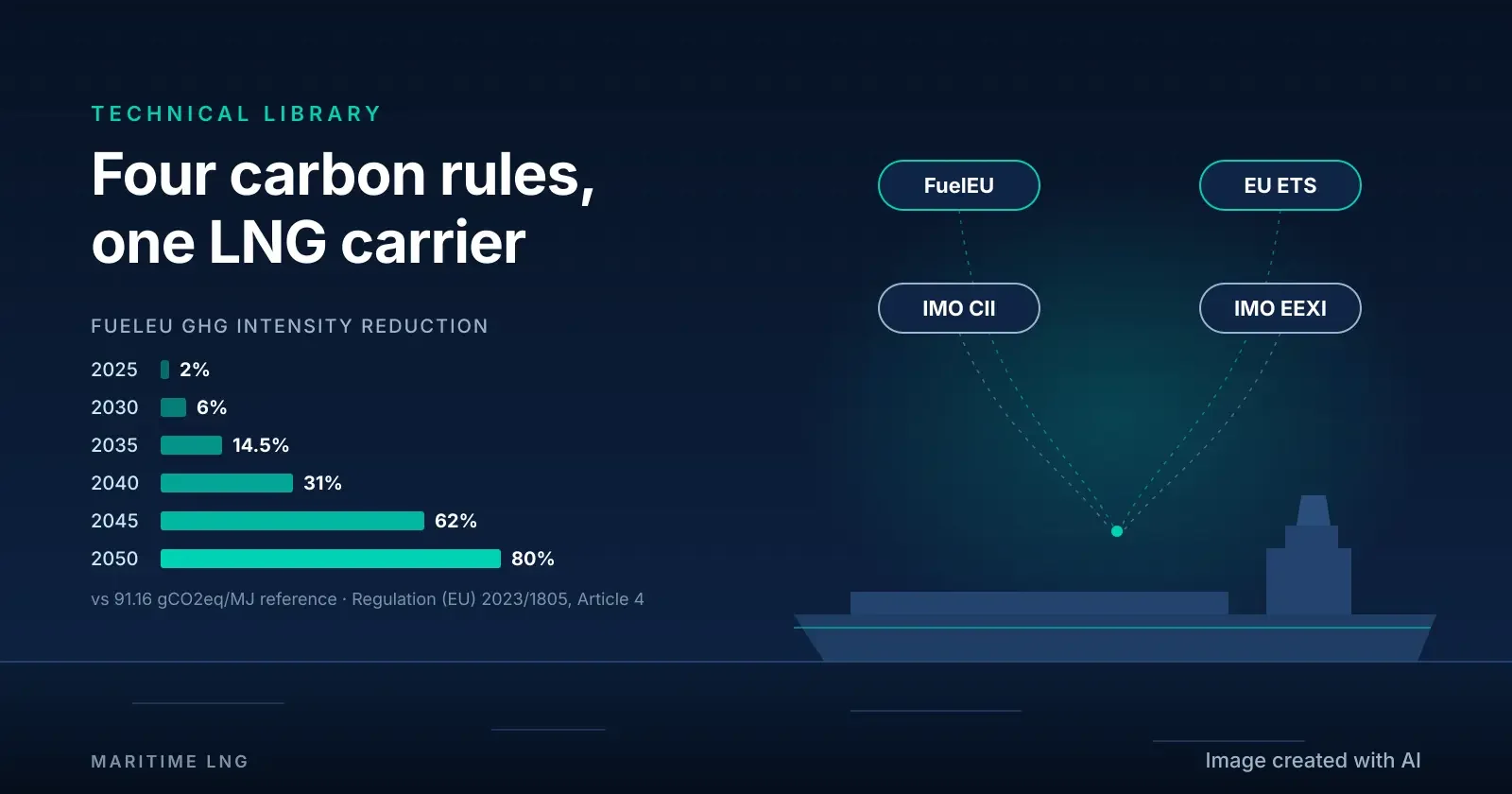
Article 4 sets a reference value of 91.16 gCO2eq/MJ. The limit on the yearly average GHG intensity is reduced by:
- 2% from 1 January 2025
- 6% from 1 January 2030
- 14.5% from 1 January 2035
- 31% from 1 January 2040
- 62% from 1 January 2045
- 80% from 1 January 2050
How LNG is counted
For fossil LNG, Annex II sets a lower calorific value of 0.0491 MJ/g and a well-to-tank factor of 18.5 gCO2eq/MJ. Methane slip is added through default Cslip values that depend on the engine type, from 0.2% for slow-speed LNG Diesel engines to 3.1% for medium-speed LNG Otto engines. Our Technical Library guide on methane slip covers these values and how to replace them with measured ones.
In its FuelEU questions and answers, the Commission notes that oil fuels alone would not allow compliance for 2025–2029, while LNG may still allow compliance, depending on the energy system used. In its simplified example, a dual-fuel medium-speed LNG ship is only marginally compliant for 2025.
The Commission's Q&A does not address questions specific to LNG carriers, such as excess boil-off gas burned in a gas combustion unit. Operators should check those points with their verifier.
Flexibility, penalties and deadlines
- Banking: a compliance surplus can be carried over to the same ship's next reporting period.
- Borrowing: a deficit can be covered by an advance surplus from the next period. It is repaid multiplied by 1.1, is capped at 2% of the GHG intensity limit multiplied by the ship's energy use, and cannot be used in two consecutive periods.
- Pooling: two or more ships can pool their compliance balances, provided the pool's total balance is positive.
- Penalty: EUR 2,400 per tonne of VLSFO equivalent, at 41,000 MJ per tonne. For consecutive years of deficit, the penalty is multiplied by 1 + (n − 1)/10, where n is the number of consecutive reporting periods.
- Deadlines: the FuelEU report is due by 31 January, verification results are recorded by 31 March, and the FuelEU document of compliance must be held by 30 June.
Two other provisions are worth knowing. Renewable fuels of non-biological origin (RFNBOs) count with a reward factor of 2 until the end of 2033. If their share is below 1% in 2031, a 2% RFNBO sub-target applies from 2034, subject to the conditions in Article 5. The obligation to use shore power at berth from 2030 applies only to containerships and passenger ships, so it does not cover LNG carriers.
EU ETS and EU MRV
The EU ETS covers ships of 5,000 gross tonnage and above, regardless of flag. It applies to:
- 100% of emissions on voyages between two EU ports and while ships are in EU ports;
- 50% of emissions on voyages that start or end outside the EU.
CO2 has been covered since 2024. Methane and nitrous oxide are covered from 2026. Surrender obligations are being phased in:
- 2024 emissions: allowances surrendered for 40%.
- 2025 emissions: allowances surrendered for 70%.
- From 2027 onwards: allowances surrendered for 100% of reported emissions.
For an LNG-fuelled ship, this means 2026 is the first year in which methane slip carries an allowance cost, and it is covered in full.
The data comes from the EU MRV Maritime Regulation. Ships have reported methane and nitrous oxide emissions, in addition to CO2, since 1 January 2024. The Commission describes FuelEU Maritime and the EU ETS as complementary: the ETS puts a price on reported emissions, while FuelEU sets a technology-neutral limit on the GHG intensity of energy used on board. The two require separate monitoring plans, but FuelEU calculations use the MRV data.
CII: the annual carbon intensity rating
Who it applies to
Under regulation 28 of MARPOL Annex VI, ships of 5,000 GT and above in the listed ship types, including LNG carriers, must calculate their attained annual operational CII for each calendar year. They must report it to the Administration or a recognised organisation within three months of the end of the year. The CII links a ship's CO2 emissions to its capacity and the distance it travels. Methane slip is therefore not part of the CII, even though it counts under FuelEU Maritime and the EU ETS.
Reference lines for LNG carriers
The IMO reference line takes the form a × Capacity^(−c), with capacity measured in deadweight. Resolution MEPC.353(78) sets three bands for LNG carriers:
- 100,000 DWT and above: a = 9.827, c = 0.000
- 65,000 DWT and above, but below 100,000 DWT: a = 14479E10, c = 2.673
- Below 65,000 DWT: capacity fixed at 65,000, a = 14779E10, c = 2.673
Rating boundaries
Ratings A to E are set by multiplying the required CII by four boundary factors (d1 to d4), defined in resolution MEPC.354(78):
- LNG carriers of 100,000 DWT and above: 0.89, 0.98, 1.06 and 1.13
- LNG carriers below 100,000 DWT: 0.78, 0.92, 1.10 and 1.37
Annual reduction factors
The required CII tightens each year relative to the 2019 reference line. Resolution MEPC.400(83), adopted on 11 April 2025, sets the factors through 2030:
- 2023: 5%
- 2024: 7%
- 2025: 9%
- 2026: 11%
- 2027: 13.625%
- 2028: 16.250%
- 2029: 18.875%
- 2030: 21.500%
Corrections and consequences
The 2022 Interim Guidelines on correction factors and voyage adjustments for CII calculations (G5), resolution MEPC.355(78), allow electrical consumption for cargo cooling or reliquefaction systems on gas carriers and LNG carriers to be deducted from the calculation. They also provide voyage adjustments for situations that may endanger safe navigation and for ice-classed ships sailing within the ice edge.
A ship rated D for three consecutive years, or rated E in any one year, must develop a corrective action plan to reach rating C or better. The plan goes in a revised SEEMP, due no later than one month after the attained CII is reported. IMO encourages Administrations, port authorities and other stakeholders to provide incentives for ships rated A or B. In April 2025, MEPC 83 completed Phase 1 of the review of these short-term measures.
EEXI: the design efficiency requirement
Since 1 January 2023, ships of 400 GT and above have had to calculate their attained EEXI, which reflects the ship's technical or design efficiency. Under regulation 25 of MARPOL Annex VI, LNG carriers of 10,000 DWT and above must achieve an attained EEXI at least 30% below the EEDI reference line.
The 2022 EEXI calculation guidelines, resolution MEPC.350(78), contain provisions specific to LNG carriers:
- Propulsion: the standard formula may not apply to ships with diesel-electric or turbine propulsion, but LNG carriers are an explicit exception.
- Main engine power: for LNG carriers with steam turbine or diesel-electric propulsion, the main engine power used in the calculation is 83% of the limited installed power. For diesel-electric systems, this is divided by the electrical efficiency.
- Boil-off gas: the power from burning excess natural boil-off gas in the engines or boilers should be deducted from the main engine power, with the verifier's approval.
How the four fit together for an LNG carrier
- Different gases. FuelEU Maritime and the EU ETS count methane and nitrous oxide as well as CO2. The CII and EEXI are CO2-based, so methane slip affects EU compliance but not the IMO rating.
- Different perspectives. FuelEU looks at the full well-to-wake intensity of the energy used. The EU ETS prices reported emissions. The CII rates operational performance each year. The EEXI checks design efficiency.
- Different consequences. FuelEU deficits lead to penalties unless they are covered by banking, borrowing or pooling. The EU ETS requires allowances. A poor CII rating requires a corrective action plan. EEXI compliance is a technical requirement.
- The framework is still changing:
- The IMO Net-Zero Framework, a global fuel standard and GHG pricing mechanism approved at MEPC 83, has not been adopted. MEPC 85 is scheduled for 30 November to 3 December 2026, and the Second Extraordinary Session is due to resume on 4 December 2026, subject to confirmation by MEPC 85.
- In July 2026, the European Commission proposed amending the MRV and FuelEU regulations in COM(2026) 620, alongside a separate ETS proposal, COM(2026) 616. Among other changes, the MRV proposal would extend monitoring to LNG carriers and other ship types of 400 to under 5,000 GT from 2029. These are proposals and have not been adopted.
Official sources
- Regulation (EU) 2023/1805 (FuelEU Maritime) — EUR-Lex
- European Commission (DG MOVE), FuelEU Maritime questions and answers
- European Commission (DG CLIMA), Reducing emissions from the shipping sector
- EMSA, EU ETS extension to maritime
- Council of the EU, document 12074/26 transmitting COM(2026) 620
- IMO, Resolution MEPC.328(76), 2021 Revised MARPOL Annex VI (regulations 25 and 28)
- IMO, EEXI and CII frequently asked questions
- IMO, Resolution MEPC.350(78), 2022 EEXI calculation guidelines
- IMO, Resolution MEPC.353(78), CII reference lines guidelines (G2)
- IMO, Resolution MEPC.354(78), CII rating guidelines (G4)
- IMO, Resolution MEPC.355(78), CII correction factors and voyage adjustments (G5)
- IMO, Resolution MEPC.400(83), CII reduction factors (G3) for 2027–2030
- IMO, MEPC 83 and MEPC 84 meeting summaries
This guide was prepared with AI assistance from the official sources listed above and reviewed by the Maritime LNG Editorial Desk.
Related guides
LNG Safety and International Regulations: IMO, IGC Code and IGF Code
A structured guide to the IMO framework for LNG at sea: SOLAS, the IGC Code for gas carriers, the IGF Code for gas-fuelled ships, STCW training, MARPOL Annex VI and the role of class and industry guidance.