Methane Slip in LNG Shipping: Sources, Engine Technologies and Regulation
Methane slip is the unburned methane that leaves LNG-fuelled ships. This guide explains where it comes from, why engine technology matters, and how FuelEU Maritime, the EU ETS and IMO guidelines now count and measure it.
When LNG is used as fuel, a small share of it can leave the ship without being burned. This unburned methane, known as methane slip, now carries a direct regulatory cost. It is counted in FuelEU Maritime from 2025, included in the EU Emissions Trading System from 2026, and covered by IMO guidelines that set out how to measure it on a test bed or on board.
This guide explains what methane slip is, why engine technology makes such a difference, and how the main regulatory frameworks count and measure it.
Regulatory status checked on 24 November 2026.
What methane slip is
FuelEU Maritime captures methane slip through a parameter called Cslip, the non-combusted fuel coefficient. Annex I of the Regulation defines it as the share of the fuel mass used by an engine or other fuel consumer that is not combusted, expressed as a percentage. It covers two things:
- Slipped emissions: fuel that passes through the engine without burning.
- Fugitive emissions: fuel that never reaches the combustion chamber, or that is vented or leaked.
The issue is not limited to fossil LNG. IMO's 2026 measurement guidelines apply to any "methane-containing fuel", defined as natural gas, bio-methane, e-methane and mixtures of these. FuelEU Maritime applies the same default slip values to fossil LNG, bio-LNG and e-LNG. Under the IMO guidelines, methane from the pilot fuel is included in the slip value rather than counted separately.
Why engine technology matters
The Fourth IMO GHG Study 2020 shows how the problem grew. In 2012, most LNG used as marine fuel was burned by LNG carriers in steam boilers. Between 2012 and 2018, LNG carriers moved towards internal combustion engines and other ship types began using LNG as fuel. The study distinguishes low-pressure injection, Otto-cycle engines from high-pressure injection, Diesel-cycle engines, and found that:
- Low-pressure injection engines emit more unburned methane than high-pressure injection engines.
- Both engine technologies emit more methane than steam turbines.
- LNG use rose by 28–30% over 2012–2018, while estimated methane emissions rose by 151–155%, depending on the allocation method.
The study attributes most of that increase to the change in machinery mix, with a significant increase in dual-fuel machinery that has higher specific methane emissions in the exhaust.
Default slip values under FuelEU Maritime
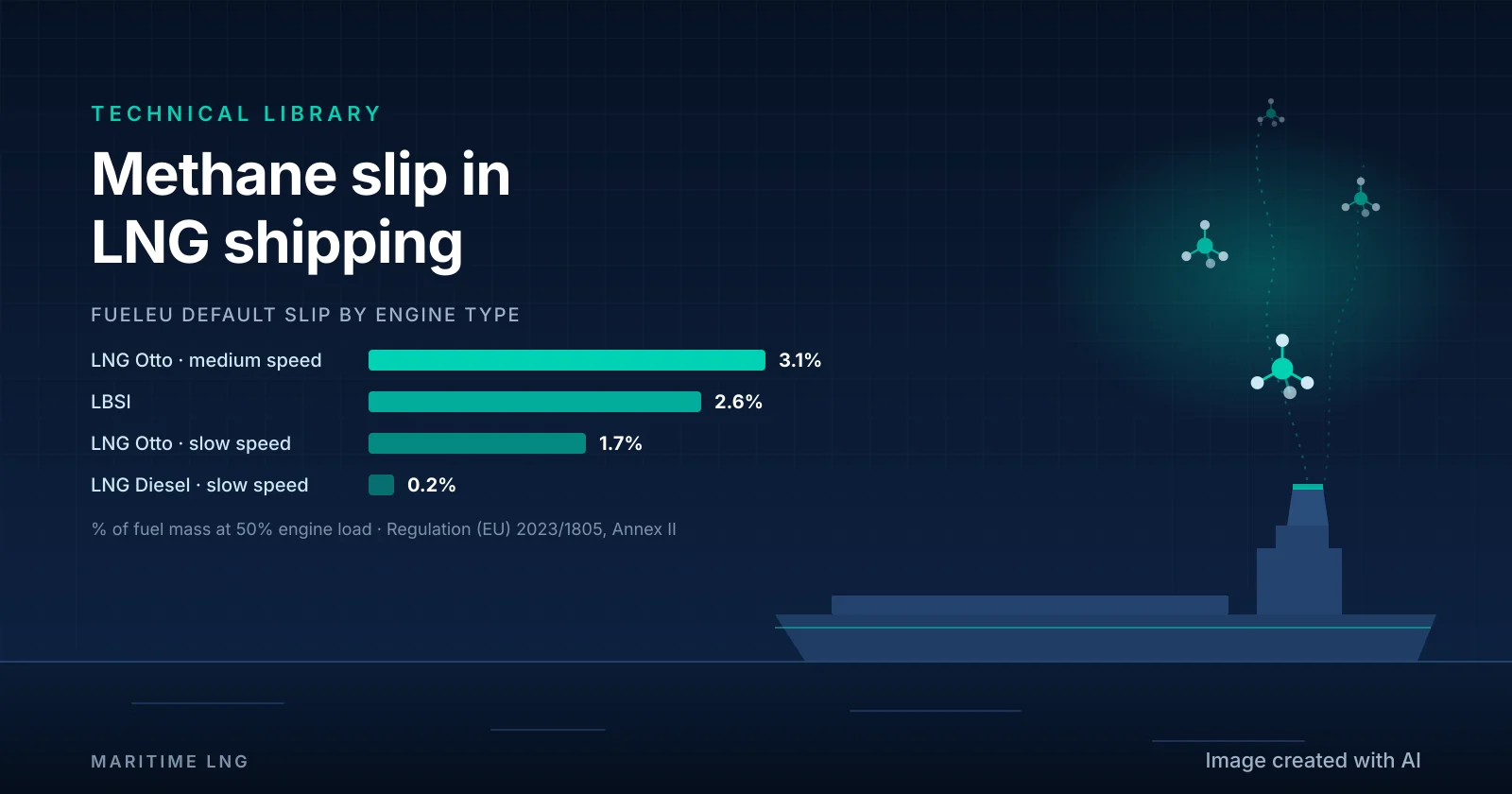
Annex II of FuelEU Maritime sets default Cslip values by engine type. They are calculated at 50% of full engine load and expressed as a percentage of the fuel mass:
- LNG Otto, dual fuel, medium speed: 3.1%
- LBSI (lean-burn spark-ignited): 2.6%
- LNG Otto, dual fuel, slow speed: 1.7%
- LNG Diesel, dual fuel, slow speed: 0.2%
On these default values, a medium-speed Otto-cycle engine is assigned more than fifteen times the slip of a slow-speed Diesel-cycle engine. For a ship owner, the engine class alone sets the starting point for every compliance calculation.
Engine load
The default values assume one load point, but real operation does not. An EU Horizon Europe research call on methane slip states that some engine loading conditions and some engine types can significantly increase methane slip. It also notes that robust data on the existing LNG fleet was lacking. Both the IMO and EU measurement protocols reflect this: they require a measurement at the 10% load point, or at the lowest load at which the engine runs on gas.
How the rules count methane slip
FuelEU Maritime
FuelEU Maritime, Regulation (EU) 2023/1805, has applied since 1 January 2025 to ships above 5,000 gross tonnage calling at European ports, regardless of flag. It limits the yearly average greenhouse gas intensity of the energy used on board. The limit is set on a well-to-wake basis and includes methane and nitrous oxide.
The required reduction starts at 2% in 2025 and reaches 80% by 2050, measured against a 2020 fleet reference value. Methane slip enters the tank-to-wake part of the calculation through Cslip, converted to CO2 equivalent using the 100-year global warming potentials defined in the Renewable Energy Directive, Directive (EU) 2018/2001. Annex II defaults apply unless a company uses an actual value certified under Article 10(5) by laboratory testing or direct emissions measurement.
EU MRV and the EU Emissions Trading System
Under the EU MRV Maritime Regulation, ships have reported methane and nitrous oxide emissions, in addition to CO2, since 1 January 2024.
The EU ETS covers ships of 5,000 gross tonnage and above, regardless of flag. It covers 100% of emissions on voyages between two EU ports and in EU ports, and 50% of emissions on voyages that start or end outside the EU. Methane and nitrous oxide are included from 2026.
Surrender obligations are being phased in:
- 2024 emissions: allowances surrendered for 40%.
- 2025 emissions: allowances surrendered for 70%.
- From 2027 onwards: allowances surrendered for 100% of reported emissions.
This means 2026, the first year in which methane counts under the EU ETS, is also the first year in which emissions are covered in full.
IMO
The 2024 IMO Guidelines on life cycle GHG intensity of marine fuels (2024 LCA Guidelines), resolution MEPC.391(81), cover carbon dioxide, methane and nitrous oxide. They set the framework for default emission factors and allow actual emission factors, subject to third-party verification and certification.
The IMO Net-Zero Framework would add a global fuel standard based on GHG fuel intensity, calculated on a well-to-wake basis, and a GHG pricing mechanism. It was approved at MEPC 83 in April 2025 but has not been adopted. MEPC 85 is scheduled for 30 November to 3 December 2026. The Committee's Second Extraordinary Session is due to resume on 4 December 2026, subject to confirmation by MEPC 85.
Measuring actual methane slip
Default values can be replaced by measured ones. Two sets of official documents now describe how.
IMO measurement guidelines
IMO adopted guidelines for test-bed and onboard measurement of methane and nitrous oxide from marine diesel engines in April 2025, in resolution MEPC.402(83). On 1 May 2026, MEPC 84 replaced them with the 2026 Guidelines, resolution MEPC.414(84). Their main points:
- Application is voluntary. Member States are invited to encourage their use.
- Method: measurements follow the NOx Technical Code 2008, except where the guidelines specify otherwise.
- Low load: for the E2 and E3 test cycles, emissions must also be measured at the 10% load point, or at the lowest load point at which gas fuel is used.
- Scope of results: onboard measurements may be accepted for an individual engine, or for an engine group represented by its parent engine. They should not be accepted for a whole engine family without further justification. Test-bed measurements may be accepted for an engine family. Engine families and groups are defined by NOx criteria, which cannot be assumed to apply equally to methane.
- Verification: the Administration verifies the applicant's file and issues a Statement of emission values.
At the same session, MEPC 84 also adopted guidelines on engine load monitoring and the calculation of emission values, resolution MEPC.415(84), and guidelines on continuous emission monitoring systems for methane and nitrous oxide, resolution MEPC.416(84).
European Commission guidelines for FuelEU Maritime
The European Commission's Guidelines for Reporting and Verification of Actual Methane Slip Tank-to-Wake Emission Factors from Marine Diesel Engines under FuelEU Maritime are dated 8 October 2025 (first version). The document is not legally binding and is described as an interim solution until international standards and certification references are developed. Its legal basis is Article 10(5) of FuelEU Maritime, and it builds on the IMO protocol in resolution MEPC.402(83). The main requirements are:
- Methane File: prepared under the IMO protocol and approved by the flag Administration or a recognised organisation. The FuelEU verifier then checks the file, the monitoring procedures and the annual data.
- Low-load point: measurements that do not include the 10% load point, or the lowest load point on gas, are not allowed.
- Load monitoring: engine load is monitored for each engine and averaged over 30-minute intervals. The ship's actual load profile replaces the standard weighting factors of the NOx Technical Code.
- Calculation: the weighted Cslip is the total mass of methane emitted divided by the total mass of fuel used, multiplied by 100.
- Records: a record book of any changes that could increase methane slip, and a maintenance record for any methane abatement device.
- Timing: an actual value applies to a reporting period only if the measurements were completed before the end of the period, the engine components and settings affecting slip remained unchanged, and load monitoring was in place from the start of the period. Otherwise, it applies only from the date all three conditions are met.
The Commission has said it will revise the guidelines to reflect IMO's work on continuous emissions monitoring. The guidelines refer to resolution MEPC.402(83), which IMO superseded in May 2026, so operators should check for the latest version of the Commission guidance before starting a measurement campaign.
What this means for LNG carrier operators
Read together, the official texts point to five practical issues:
- Engine class sets the baseline. Under FuelEU Maritime, the default slip value depends only on the engine type. The range runs from 0.2% for slow-speed Diesel-cycle engines to 3.1% for medium-speed Otto-cycle engines.
- Low-load operation matters. Both the IMO and EU protocols require data at low load, and the EU method uses the ship's actual load profile.
- Configuration control is part of compliance. Under the Commission guidelines, a change to engine components or settings that affect slip can delay the date from which a measured value applies.
- Engines are not the only source. Cslip includes fugitive emissions, so fuel that is vented or leaked counts as well as fuel that passes through the engine unburned.
- The framework is still moving. IMO is scheduled to resume work on the Net-Zero Framework in December 2026, and the Commission has signalled updates to its methane slip guidelines.
Official sources
- Regulation (EU) 2023/1805 (FuelEU Maritime), Annexes I and II — EUR-Lex
- European Commission (DG MOVE), Guidelines for Reporting and Verification of Actual Methane Slip Tank-to-Wake Emission Factors from Marine Diesel Engines, 8 October 2025
- European Commission (DG MOVE), FuelEU Maritime
- European Commission (DG CLIMA), Reducing emissions from the shipping sector
- EMSA, EU ETS extension to maritime
- IMO, Resolution MEPC.414(84), 2026 Guidelines for test-bed and onboard measurements of CH4 and/or N2O emissions from marine diesel engines
- IMO, Resolution MEPC.402(83), MEPC 83 report, Annex 7
- IMO, MEPC 84 meeting summary
- IMO, Life cycle GHG intensity of marine fuels (2024 LCA Guidelines, MEPC.391(81))
- IMO, Fourth IMO GHG Study 2020, Executive Summary and Full Report
- European Commission (CORDIS), Horizon Europe call HORIZON-CL5-2021-D5-01-12
This guide was prepared with AI assistance from the official sources listed above and reviewed by the Maritime LNG Editorial Desk.
Related guides
LNG Carrier Cooldown Operations — Engineering, Procedures and Safety
Explore LNG carrier tank and cargo-line cooldown principles, thermal stress, vapour management, ship-shore coordination, monitoring and operational safeguards.
LNG Shipping: Complete Industry Guide
A practical guide to LNG shipping for owners, operators and technical managers: carrier types, the cargo cycle from gas-up to warm-up, chartering structures, crewing and regulation.