LNG Shipping Chokepoints in 2026: Hormuz, Bab el-Mandeb, Suez and Panama in Official Data
The 2026 Hormuz disruption, renewed Red Sea attacks and Panama Canal draft limits changed LNG shipping routes. Official data from EIA, IEA, IMO, JMIC and the Panama Canal Authority, the current status and what it means for LNG carriers.
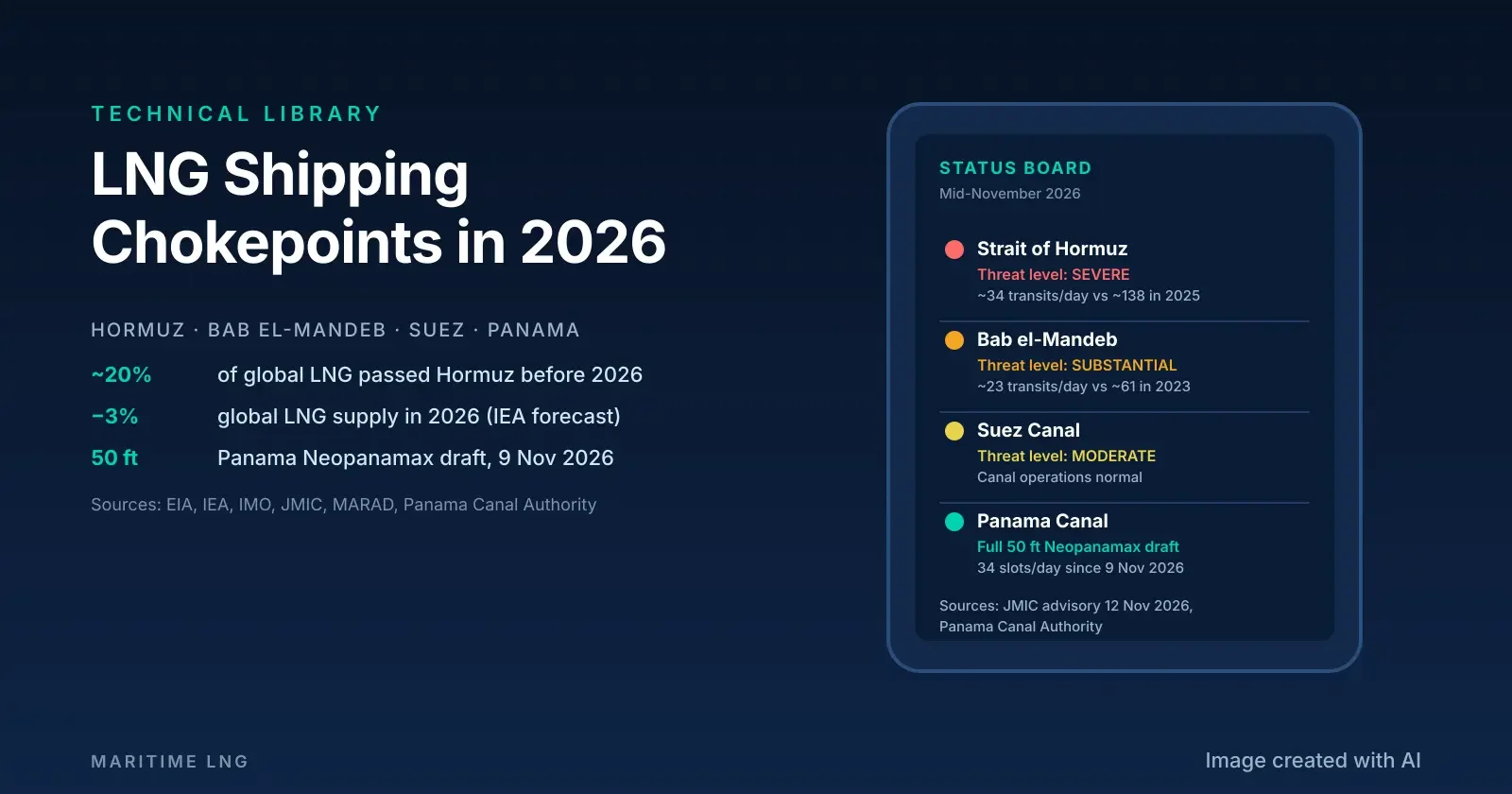
A large share of seaborne LNG passes through a few narrow sea routes: the Strait of Hormuz, the Bab el-Mandeb Strait with the Red Sea and the Suez Canal, and the Panama Canal. When these routes are closed or restricted, ships take the long way round the Cape of Good Hope. In 2026 all of them changed in the same year. The conflict in the Middle East that began on 28 February 2026 disrupted shipping through Hormuz, Houthi attacks on ships resumed in the Red Sea, and the Panama Canal reduced ship drafts when rainfall fell short.
This guide sets out what official sources show about each chokepoint, where things stand now, and what it means for LNG carriers.
Status checked on 26 November 2026. Security conditions in the Strait of Hormuz and the Red Sea change daily. Before any voyage, check the latest JMIC and UKMTO advisories and your flag State's instructions.
The chokepoints before 2026
- Strait of Hormuz: the US Energy Information Administration (EIA) puts LNG flows through the strait at 10.5 billion cubic feet per day (Bcf/d) in 2024 and 11.4 Bcf/d in the first half of 2025. The IEA notes that about 93% of Qatar's and 96% of the UAE's LNG exports pass through the strait, around 19% of global LNG trade, and that there is no other export route for their LNG. At its narrowest point the strait is 21 nautical miles wide, with 2-mile-wide inbound and outbound lanes and a 2-mile buffer zone between them.
- Bab el-Mandeb and Suez: before the Red Sea attacks that began in late 2023, Bab el-Mandeb carried about 8% of global LNG trade. EIA data show LNG flows through the strait fell from 4.2 Bcf/d in 2023 to zero in 2024 and in the first half of 2025. LNG through the Suez Canal fell from 4.1 Bcf/d in 2023 to 0.5 Bcf/d in 2024, and almost all of the remaining flows go to Egypt or Jordan.
- Cape of Good Hope: LNG flows around the Cape rose from 2.1 Bcf/d in 2023 to 7.8 Bcf/d in 2024, then eased to 5.7 Bcf/d in the first half of 2025. EIA estimates a typical tanker voyage from the Persian Gulf to North-West Europe at about 19 days through Suez and nearly 35 days around the Cape.
- Panama Canal: since June 2018 the Neopanamax locks have accepted ships up to 51.25 metres in beam, which opened the canal to Q-Flex LNG carriers. EIA reports that LNG cargoes through the canal fell to less than 0.3 Bcf/d in fiscal year 2025, from around 2.5 Bcf/d in fiscal year 2021, after drought restrictions and a shift to the Cape route.
Strait of Hormuz: the 2026 disruption
Timeline from official sources
- 28 February 2026: the conflict began. EIA dates the closure of the strait from this day.
- 4 March: QatarEnergy declared force majeure. EIA reports, citing Kpler data, that no laden LNG carrier is known to have crossed the strait between 1 March and 24 April.
- 11 March: the UN Security Council adopted resolution 2817 (2026) by 13 votes to none, with China and Russia abstaining. As the IMO Council later recalled, the resolution condemns attacks on merchant ships and any attempt to close or obstruct navigation through the strait.
- 18–19 March: an extraordinary session of the IMO Council condemned the attacks on ships and the purported closure of the strait. It called for a safe maritime framework to evacuate merchant ships confined in the Gulf.
- May: the Marine Environment Protection Committee adopted resolution MEPC.406(84) on pollution risks in the region on 1 May. The Maritime Safety Committee adopted resolution MSC.582(111) on 21 May. The MSC resolution calls for the removal of sea mines and for unhampered transit passage, and urges States to keep ships supplied and to make crew changes possible.
- Mid-June: the United States and Iran reached an interim agreement. The IEA reports that LNG carrier transits rose afterwards, but only to a fraction of pre-conflict levels.
- 23–26 June: an evacuation coordinated by IMO moved 136 ships and an estimated 2,900 seafarers out of the Gulf. The plan was then paused after an attack and remains paused.
- 6–10 July: the IMO Council stressed that any arrangement between the coastal States must guarantee all ships non-discriminatory and unimpeded transit passage through the traffic separation scheme adopted by IMO in 1968, free of tolls and charges.
- 28 August: IMO reported at least 70 verified attacks on shipping and 19 seafarers killed since the conflict began.
Where things stand now
- Security: the Joint Maritime Information Center (JMIC) advisory of 12 November 2026 rates the threat in the Strait of Hormuz as SEVERE, with attacks considered highly likely. It reports about 34 transits a day assisted by US forces, against a 2025 average of about 138 ships a day, and about 211 commercial ships at anchor east of the strait.
- LNG exports: the EIA's November 2026 Short-Term Energy Outlook says attacks on tankers and logistical disruptions continue to keep LNG exports through the strait well below pre-war levels.
- Lost volumes: the IEA reports that LNG loadings from Qatar and the UAE fell by more than 60 billion cubic metres (bcm) year on year between March and October 2026. Higher output from other suppliers offset about two-thirds of the loss.
- Outlook: the IEA expects global LNG supply to fall by 3% (almost 20 bcm) in 2026, the steepest annual decline on record, assuming flows through Hormuz stay largely disrupted until at least the end of 2026. It estimates cumulative losses of 150 bcm over 2026–2030, including the effects of damage at Ras Laffan in Qatar.
- Europe: EU gas storage entered the 2026/27 winter at its lowest level since 2013. In a cold winter with continued disruption, IEA simulations show storage falling below 10% of capacity by the end of March 2027. See our guide to EU LNG import terminals.
Bab el-Mandeb, the Red Sea and Suez
- Renewed attacks: US Maritime Advisory 2026-013, in effect from 23 September 2026 to 22 March 2027, states that the Houthis have resumed attacks on commercial ships. It records that they declared a blockade of Saudi-affiliated shipping through Bab el-Mandeb on 20 July 2026, and that two tankers were struck by missiles off Yanbu on 24 August 2026.
- Higher-risk ships: the advisory treats ships with Israeli, US, UK or Saudi links, and ships in fleets that have called at Saudi ports, as being at higher risk.
- Threat level: JMIC rates the southern Red Sea, Bab el-Mandeb and the Gulf of Aden as SUBSTANTIAL. It describes Bab el-Mandeb as open but volatile, with about 23 transits a day in early November 2026 against about 61 a day in 2023.
- Suez Canal: JMIC reports that canal operations remain normal and rates the northern Red Sea and Suez as MODERATE.
- Two chokepoints on one route: LNG from the Persian Gulf to Europe through Suez must pass both Hormuz and Bab el-Mandeb, so this route depends on both being safe.
Panama Canal
- Water management: the Panama Canal Authority (ACP) has used water-saving measures at the locks since December 2025 because of the risk of El Niño. During 2026 it reduced the maximum Neopanamax draft in several steps, to 48 feet (14.63 metres), and postponed a planned further cut to 47.5 feet.
- Recovery: after better rainfall, the ACP raised the draft to 49 feet (14.94 metres) on 28 September 2026 and increased capacity to 33 slots a day from 15 October. On 9 November 2026 it restored the full Neopanamax draft of 50 feet (15.24 metres) and raised capacity to 34 slots a day.
- Booking: the ACP offers long-term slot allocation (LoTSA) and a dedicated booking system for LNG carriers. It states that a booking is the only way to guarantee a transit date.
- Next test: the ACP is offering long-term slot allocations for transits between 3 January and 3 April 2027, to help customers plan for the 2027 dry season.
What it means for LNG carriers
- Hormuz is a security decision first. Use the latest JMIC advisory notes, report to UKMTO, and follow your flag State's instructions and Best Management Practices for Maritime Security. JMIC warns masters to expect radio hails directing them to another route and to watch for possible mining in and near the traffic separation scheme.
- The Red Sea is open, but not back to normal. LNG carriers have largely avoided Bab el-Mandeb since 2024. A ship that does transit should apply the routing, AIS and reporting measures in the MARAD advisory and JMIC notes. On a typical voyage between the Persian Gulf and North-West Europe, going round the Cape adds more than two weeks.
- Panama is back to full draft for now. Book early through the LNG booking system or LoTSA, and plan for possible new limits in the 2027 dry season.
- Supply has moved, and so have the ships. With Gulf loadings down, more LNG comes from new projects in other regions, and cargoes from the US Gulf Coast to Asia must use Panama, Suez or the Cape. See our guides to global LNG trade and fleet numbers and US LNG export projects.
- Seafarers come first. IMO Council decisions and resolutions call on States to keep ships in the region supplied, keep crews in contact with their families and make crew changes possible. IMO's Middle East page lists regional contact points for ships and crews.
This guide was prepared with AI assistance from the official sources listed above and reviewed by the Maritime LNG Editorial Desk.
Spotted an error or an outdated figure? Report an error · Corrections policy
Related guides
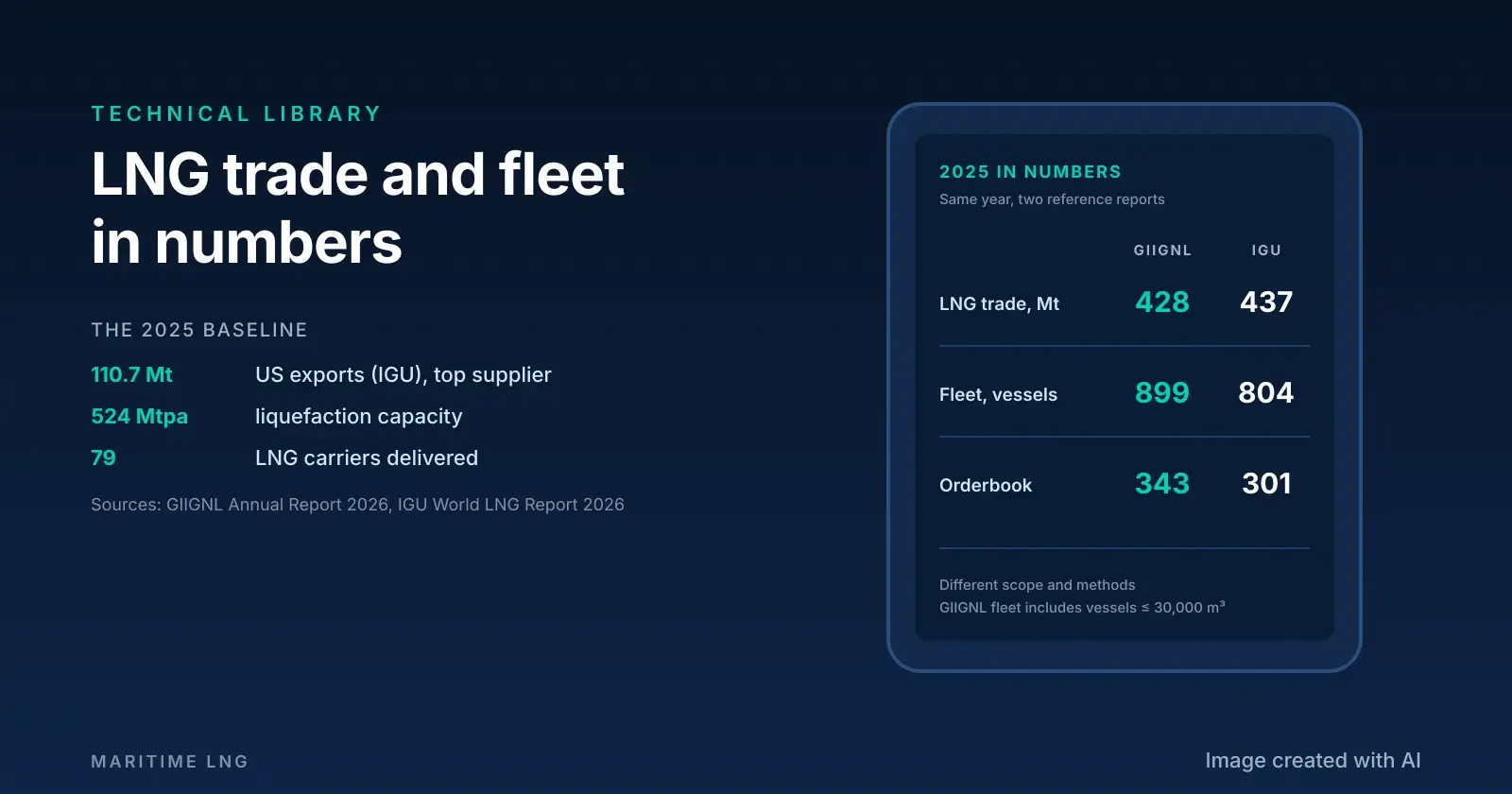
Global LNG Trade and Fleet in Numbers: 2025 Data from GIIGNL and IGU
Global LNG trade, exporters, importers, capacity and the LNG carrier fleet in 2025, from the GIIGNL and IGU 2026 reports, and why their figures differ.
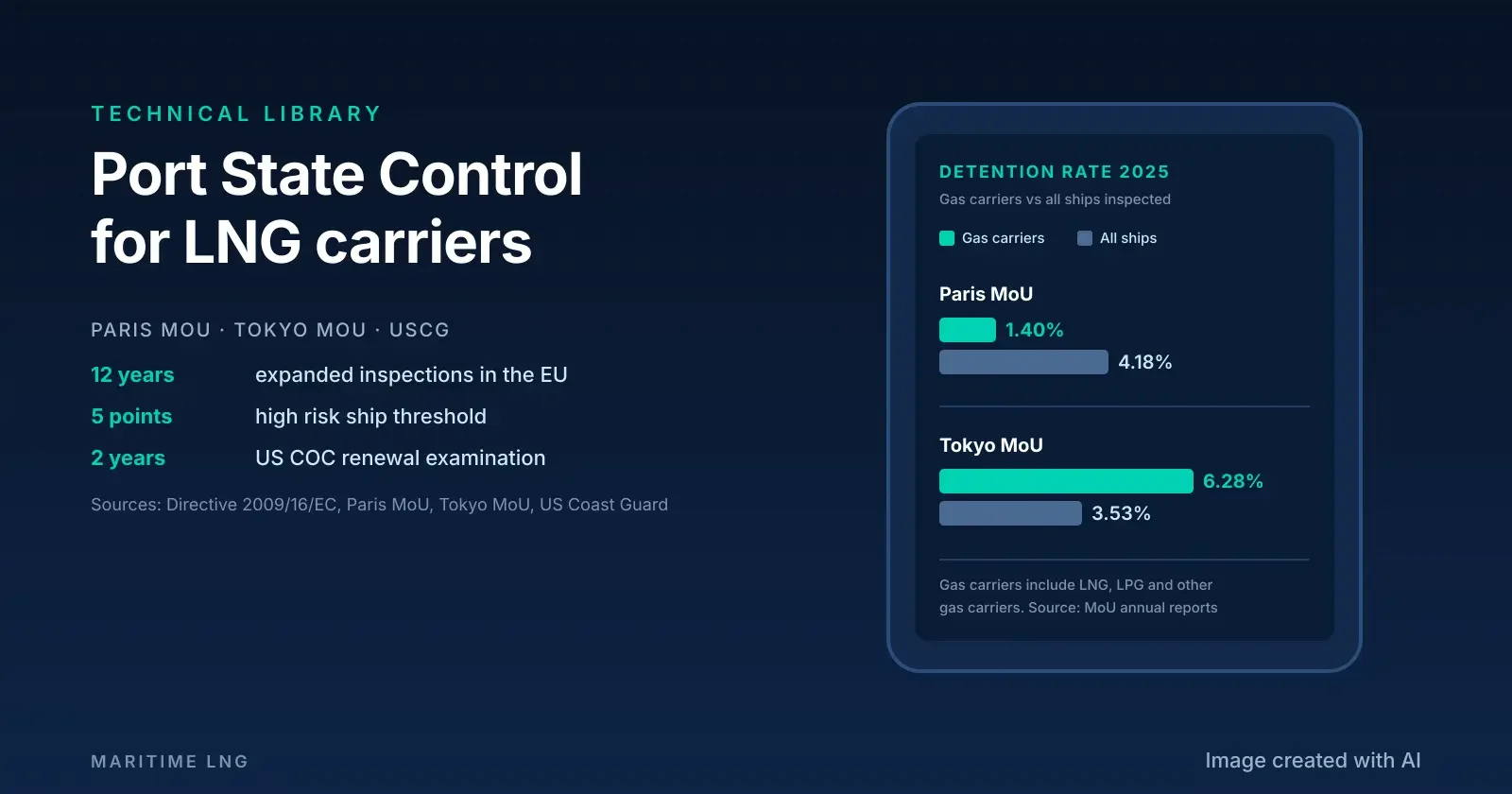
Port State Control for LNG Carriers: Targeting, Inspections and 2025 Detention Data
How LNG and gas carriers are targeted and inspected by the Paris MoU, Tokyo MoU and US Coast Guard, with 2025 detention rates and new COC rules.
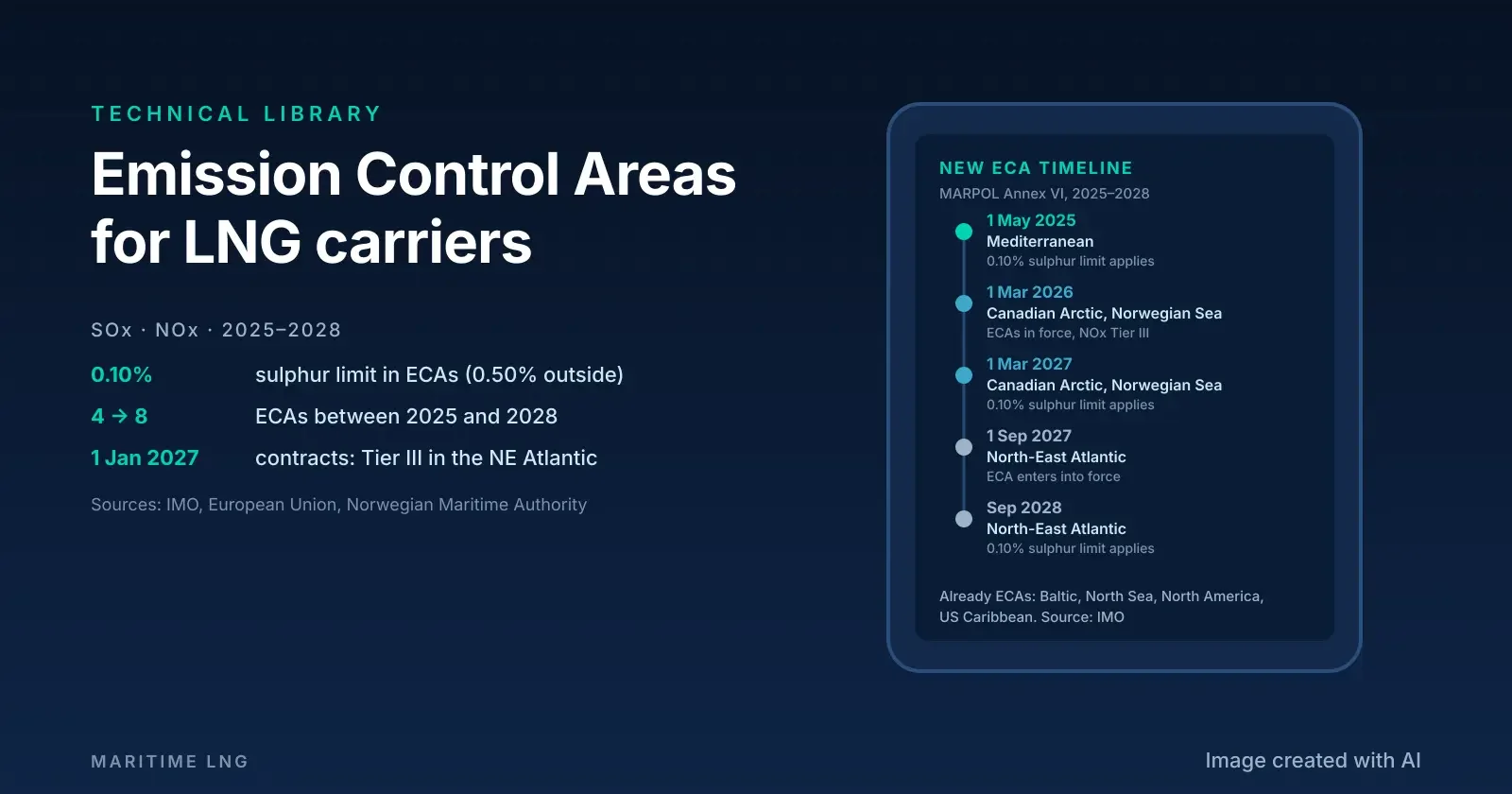
Emission Control Areas 2025–2028: What the New ECAs Mean for LNG Carriers
Official guide to the new ECAs: Mediterranean, Canadian Arctic, Norwegian Sea and North-East Atlantic dates, sulphur and NOx Tier III rules for LNG carriers.