Emission Control Areas 2025–2028: What the New ECAs Mean for LNG Carriers
The number of ECAs doubles from four to eight between 2025 and 2028. Dates, sulphur and NOx Tier III rules for the Mediterranean, Canadian Arctic, Norwegian Sea and North-East Atlantic, and what they mean for LNG carriers.
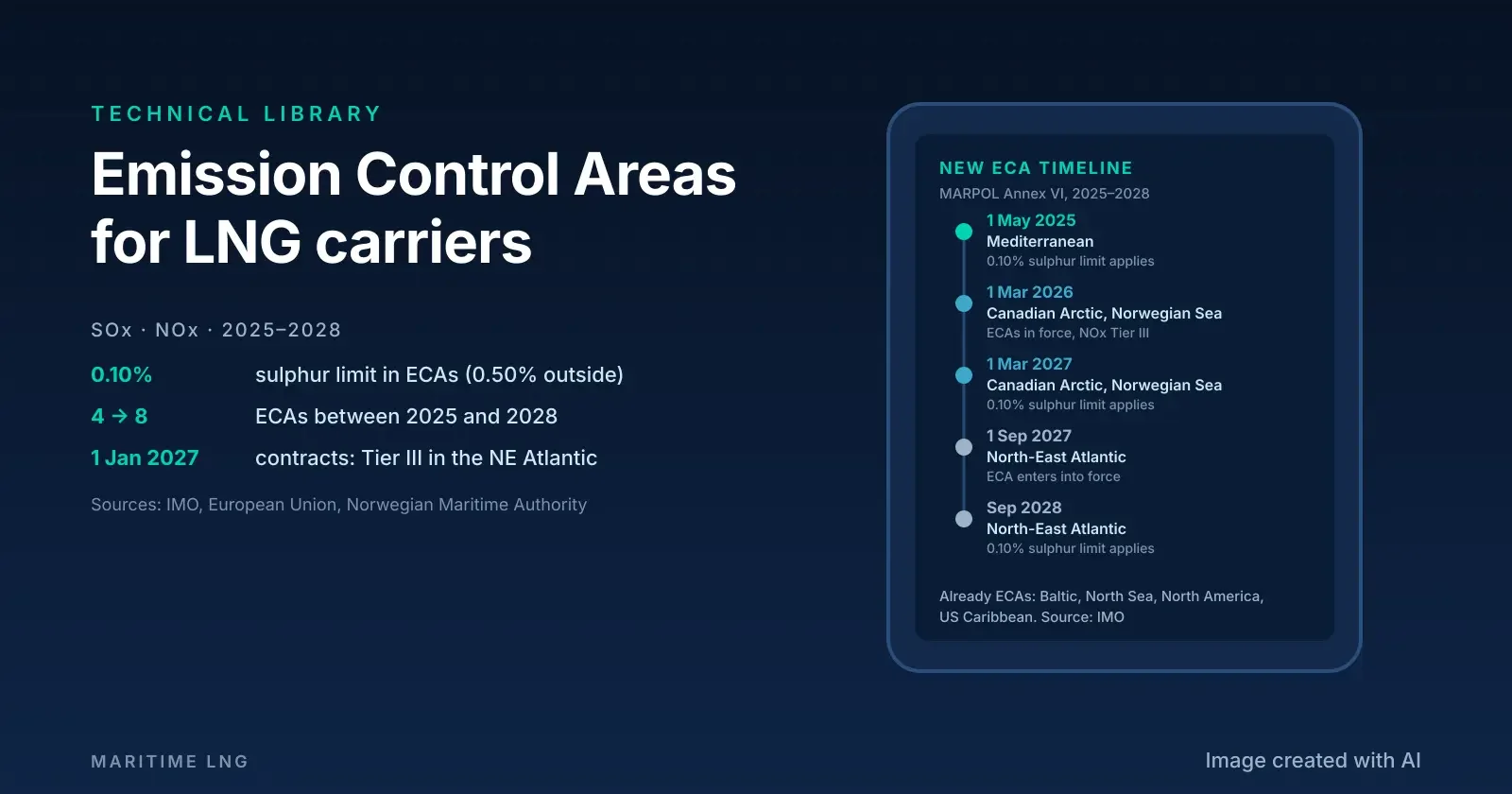
Emission Control Areas (ECAs) are sea areas where MARPOL Annex VI sets stricter limits on sulphur oxides (SOx), particulate matter and, in some areas, nitrogen oxides (NOx) from ships. Between 2025 and 2028 their number doubles, from four to eight. Once the new areas apply, LNG carriers trading between North America and Europe will load and discharge inside ECAs at both ends of the voyage.
This guide sets out where the ECAs are, when their limits apply, what they require on board, and how the rules apply to LNG carriers.
Rules checked on 26 November 2026. The North-East Atlantic ECA has been adopted but is not yet in force.
What an ECA requires
- Sulphur: inside a SOx ECA, the sulphur content of fuel oil used on board must not exceed 0.10% by mass, against 0.50% outside ECAs. MARPOL defines fuel oil as any fuel used for propulsion or operation on board, including gas, distillate and residual fuels.
- Equivalent methods: under regulation 4 of MARPOL Annex VI, a flag State can approve alternatives, such as exhaust gas cleaning systems, if they are at least as effective in reducing emissions.
- Nitrogen oxides: inside a NOx ECA, marine diesel engines of more than 130 kW must meet the Tier III limit if the ship was constructed on or after the date set for that area. Ships built before that date keep their existing tier, although Tier III can also apply to engines that undergo a major conversion.
- Records: a ship that changes fuel to enter or leave an ECA must carry a written changeover procedure and record the volume of low-sulphur fuel in each tank, with the date, time and position of the changeover. Ships with engines certified to more than one tier must record the tier and on or off status of each engine on entering and leaving a NOx ECA.
The eight ECAs and their dates
Existing ECAs
- Baltic Sea and North Sea: sulphur limit of 0.10% since 1 January 2015. NOx Tier III applies to ships constructed on or after 1 January 2021.
- North American ECA and United States Caribbean Sea ECA: sulphur limit of 0.10% since 1 January 2015. NOx Tier III applies to ships constructed on or after 1 January 2016.
- Mediterranean Sea: a SOx and particulate matter ECA only, designated by resolution MEPC.361(79). The 0.10% sulphur limit has applied since 1 May 2025. There is no NOx Tier III requirement.
Canadian Arctic and Norwegian Sea (in force since 1 March 2026)
Resolution MEPC.392(82), adopted on 4 October 2024, designated two new ECAs for NOx, SOx and particulate matter:
- Canadian Arctic: extends the North American ECA to all Canadian Arctic waters. NOx Tier III applies to ships constructed on or after 1 January 2025.
- Norwegian Sea: extends the North Sea ECA across the Norwegian exclusive economic zone to the Russian border. NOx Tier III applies to ships with a building contract placed on or after 1 March 2026, or without a contract, keel laid on or after 1 September 2026, or delivered on or after 1 March 2030.
- Sulphur: the Norwegian Maritime Authority confirms that the 0.10% sulphur limit applies in both areas from 1 March 2027.
North-East Atlantic (adopted, not yet in force)
MEPC 84 adopted resolution MEPC.407(84) on 1 May 2026, designating the largest ECA so far:
- Area: the territorial seas and exclusive economic zones, up to 200 nautical miles from the baselines, of Greenland, Iceland, the Faroes, Ireland and the mainlands of the United Kingdom, France, Spain and Portugal. The North Sea area is excluded because it is already an ECA.
- Dates: the amendments are deemed accepted on 1 March 2027 unless enough Parties object, and enter into force on 1 September 2027. IMO states that the ECA limits take effect 12 months later, in September 2028.
- NOx Tier III: applies to ships with a building contract placed on or after 1 January 2027, or without a contract, keel laid on or after 1 July 2027, or delivered on or after 1 January 2031.
How the rules apply to LNG carriers
- Every fuel counts. The sulphur limit covers all fuel used on board, including the pilot fuel of dual-fuel engines and any fuel oil burned in boilers or generators. LNG itself contains very little sulphur, and EMSA notes that using LNG can cut SOx emissions by up to 90%.
- Steam turbine ships: NOx limits under regulation 13 apply only to marine diesel engines of more than 130 kW. On a steam turbine LNG carrier, this means the diesel generators, not the boilers.
- New ships: an LNG carrier contracted from 1 January 2027 needs Tier III engines to operate in the North-East Atlantic ECA, and one contracted from 1 March 2026 needs them in the Norwegian Sea ECA.
- Existing ships: the new ECAs do not require Tier III retrofits on ships built before the relevant dates, but the sulphur limits apply to all ships.
The EU layer: ships at berth and boil-off gas
Directive (EU) 2016/802 applies the ECA sulphur limit in Member States' waters to ships of all flags. It also limits the sulphur content of fuel used by ships at berth in EU ports to 0.10%, unless the ship is due to stay less than two hours or switches off all engines and uses shore-side electricity.
For LNG carriers, Annex II of the Directive lists a mixture of marine fuel and boil-off gas as an approved emission abatement method, under the criteria of Commission Decision 2010/769/EU:
- Why it exists: the Decision notes that LNG carriers are often fitted with dual-fuel boilers that burn boil-off gas and heavy fuel oil.
- What it allows: at berth, an LNG carrier may burn a mixture of boil-off gas and fuel oil instead of 0.10% sulphur fuel, provided that the resulting sulphur emissions are no higher than with 0.10% fuel alone.
- How it is checked: compliance is calculated with a formula based on the mass and energy content of the boil-off gas and fuel oil consumed at berth.
What it means for LNG carriers
- Both ends of the Atlantic trade are in ECAs. Once the North-East Atlantic ECA applies, a voyage from the US Gulf Coast to Europe will start in the North American ECA and end in the North-East Atlantic, North Sea or Mediterranean ECA, with only the open-ocean passage outside. See our guide to US LNG export projects.
- Keep compliant fuel on board. Even a ship that burns mostly boil-off gas needs 0.10% fuel for pilot fuel, generators and any fuel oil burned in ECAs.
- Check newbuilding dates. Contract dates from 1 March 2026 (Norwegian Sea) and 1 January 2027 (North-East Atlantic) decide whether Tier III engines are needed there.
- Keep the records right. Changeover procedures and logbook entries are routine port State control checks. See our guide to port State control.
- Different rules, same voyage. ECAs cover air pollutants. Greenhouse gases are covered separately by FuelEU Maritime, the EU ETS and the CII. See our guide to FuelEU Maritime, the EU ETS, CII and EEXI.
This guide was prepared with AI assistance from the official sources listed above and reviewed by the Maritime LNG Editorial Desk.
Spotted an error or an outdated figure? Report an error · Corrections policy
Related guides
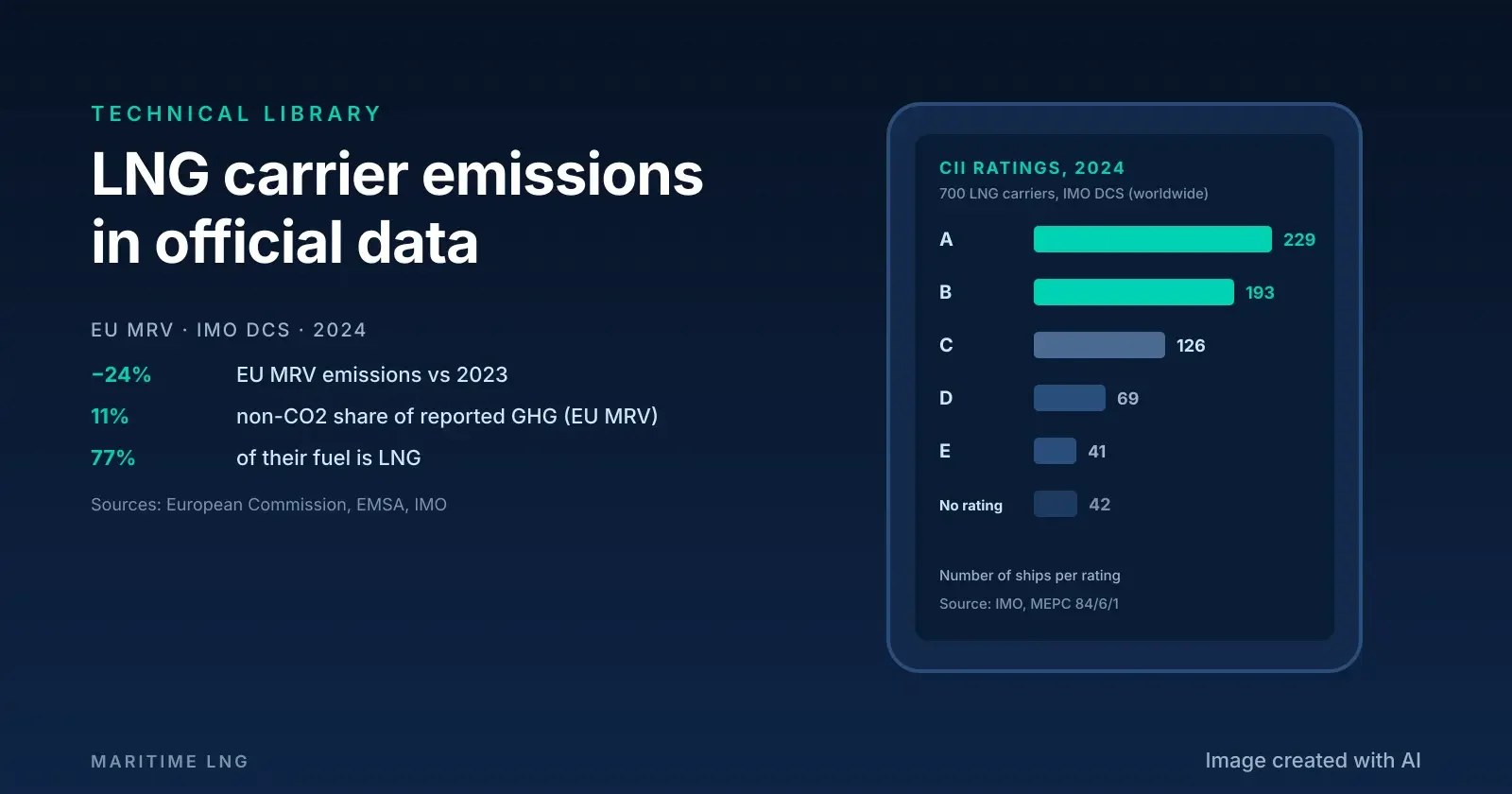
LNG Carrier Emissions in Official Data: What EU MRV and IMO DCS Show
Official 2024 data on LNG carrier emissions: EU MRV CO2 and methane figures, IMO DCS fuel use and CII ratings, and where to find ship-level data.
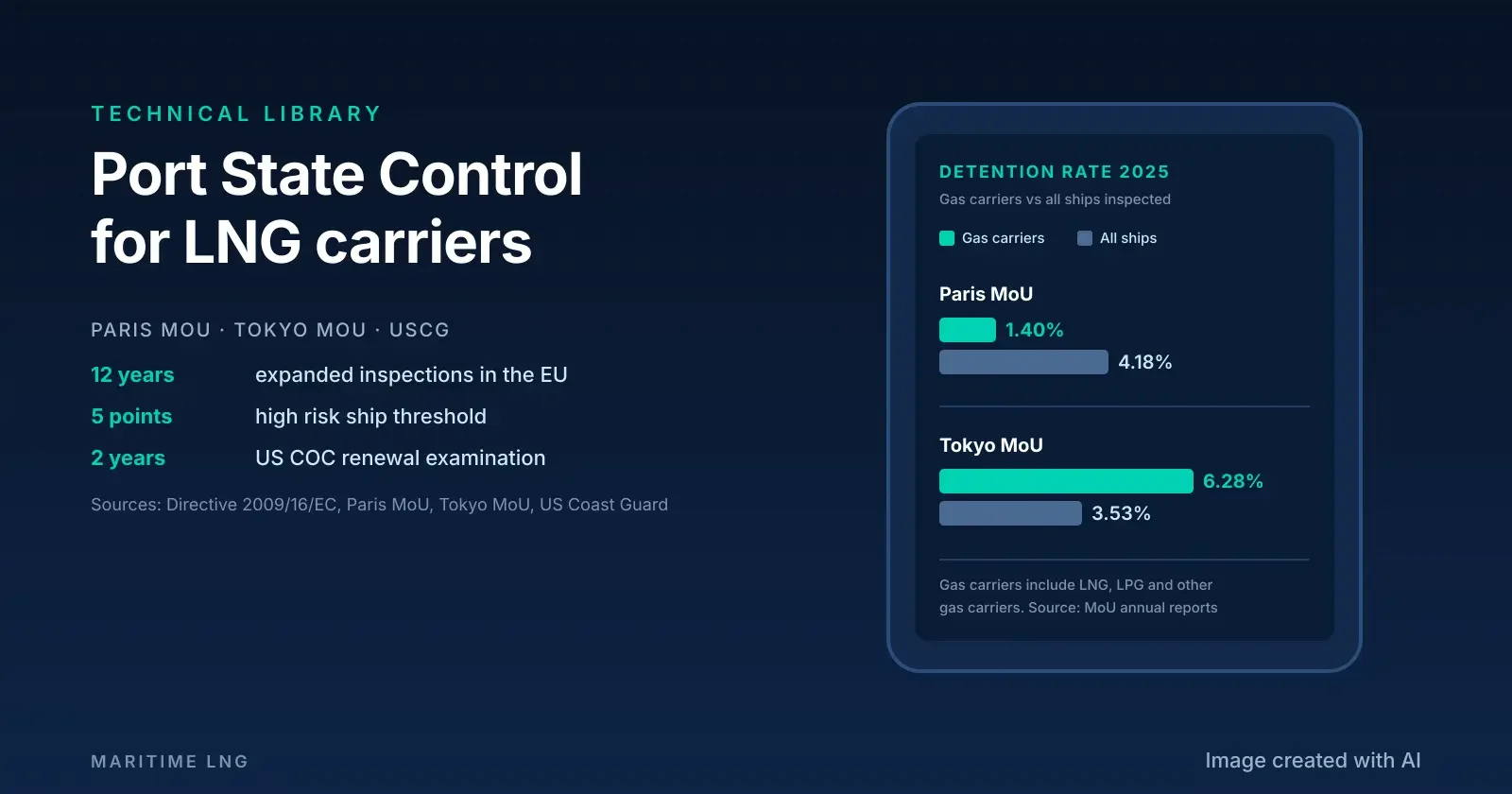
Port State Control for LNG Carriers: Targeting, Inspections and 2025 Detention Data
How LNG and gas carriers are targeted and inspected by the Paris MoU, Tokyo MoU and US Coast Guard, with 2025 detention rates and new COC rules.
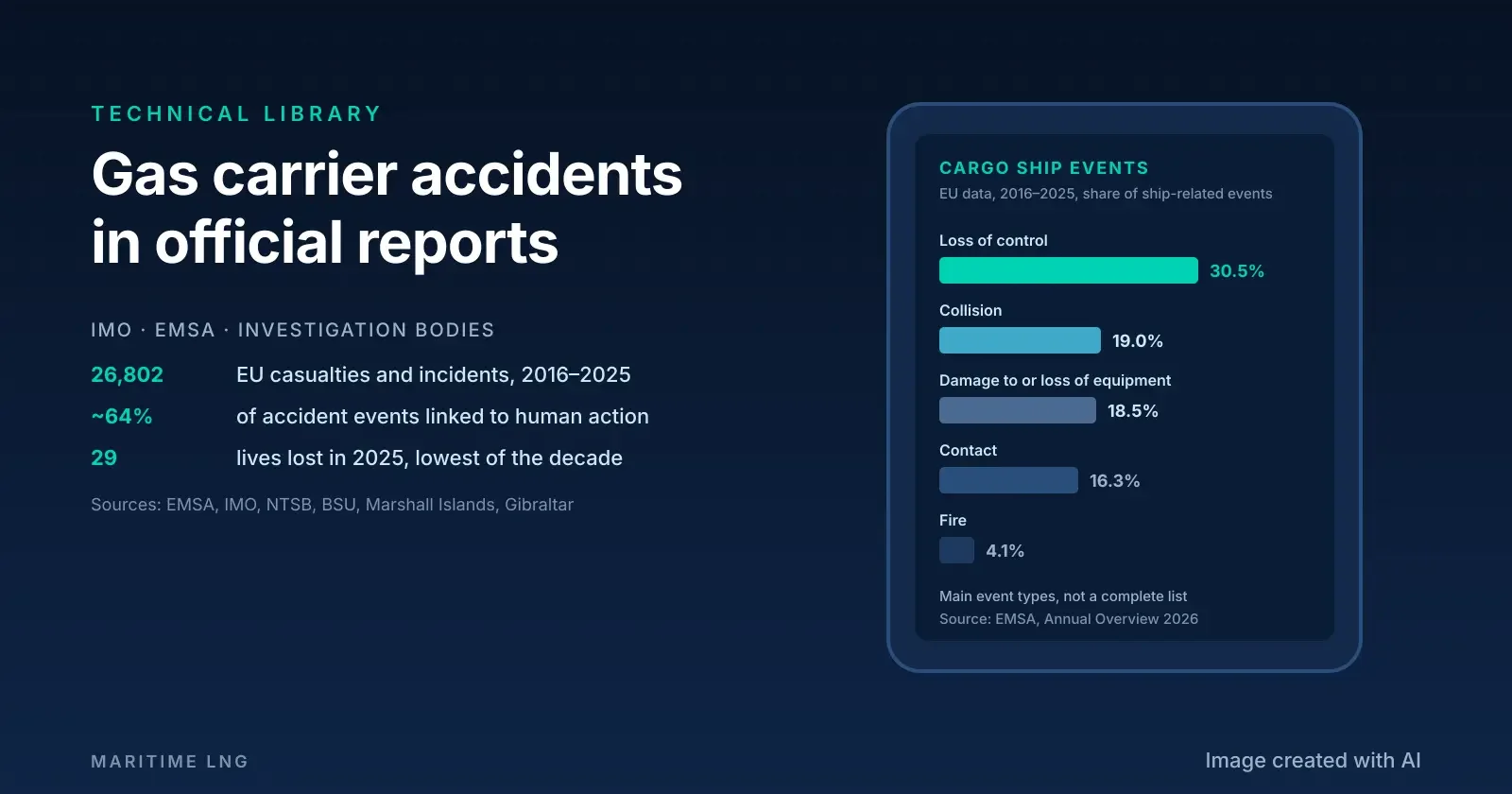
Gas Carrier Accidents in Official Investigation Reports: Data and Lessons
Official data on gas carrier accidents: the IMO Casualty Investigation Code, EMSA statistics for 2016–2025 and lessons from four investigation reports.