Port State Control for LNG Carriers: Targeting, Inspections and 2025 Detention Data
How port State control targets and inspects LNG carriers under IMO rules, the Paris and Tokyo MoUs and the US Coast Guard, with 2025 gas carrier detention data and the changes coming in 2026 and 2027.
Port State control (PSC) is the inspection of foreign ships in a country's ports to check that they meet international safety, security and pollution prevention rules. For an LNG carrier, it is a regular part of trading: the ship's certificates, condition, equipment and crew can be checked in almost every port it calls at, and a detention can delay a cargo and damage the operator's record.
This guide explains how PSC works under IMO rules, how gas carriers are targeted in Europe and the United States, and what the 2025 inspection data show for gas carriers.
Rules and data checked on 25 November 2026. PSC statistics group all gas carriers together, so the figures below cover LPG and other gas carriers as well as LNG carriers.
The IMO framework
IMO describes PSC as a second line of defence against substandard shipping, after the flag State. Its procedures follow three steps:
- Initial inspection: the PSC officer checks that the ship holds valid certificates and other relevant documents.
- More detailed inspection: if there are clear grounds to believe that the ship, its equipment or its crew do not substantially meet the requirements, the officer carries out a more detailed inspection. Crew unfamiliarity with essential procedures can also be clear grounds.
- Detention: where deficiencies are found, the ship may be delayed or detained until they are corrected. Detentions are reported to IMO, and the flag State must report on the action taken.
The current guidance is the Procedures for Port State Control, 2025, IMO resolution A.1206(34), adopted by the IMO Assembly in December 2025. It replaces resolution A.1185(33), and IMO updates the procedures every two years.
PSC is organised regionally. IMO lists nine regional regimes, eight memoranda of understanding (MoUs) and the Viña del Mar Agreement in Latin America. The US Coast Guard runs its own national regime.
PSC is a regulatory inspection by a government authority. It is separate from commercial vetting, such as the inspections described in our guide to SIRE 2.0 for LNG carriers.
Europe: the Paris MoU and EU law
In EU ports, PSC is governed by Directive 2009/16/EC and carried out in line with the Paris MoU. Inspection results are held in THETIS, the database run by the European Maritime Safety Agency (EMSA).
Ship risk profile
Every eligible ship has a ship risk profile, based on criteria such as its type and age, which sets how often and how thoroughly it is inspected. A ship is either a high risk ship (HRS), a standard risk ship (SRS) or a low risk ship (LRS). The Paris MoU sets these inspection windows:
- High risk ships: between 5 and 6 months after the last inspection in the Paris MoU region.
- Standard risk ships: between 10 and 12 months.
- Low risk ships: between 24 and 36 months.
Gas carriers are one of the ship types that count towards a high risk profile. Under the amended design of the risk profile in Directive (EU) 2024/3099, the ship type adds one weighting point, an age above 12 years adds one, and a new environmental parameter adds one when an inspection in the previous 36 months recorded more than two deficiencies under conventions such as MARPOL or the Ballast Water Management Convention. A ship with five or more weighting points is high risk. In the earlier version of the directive, the ship type carried two weighting points.
Expanded inspections
Expanded inspections are reserved for high risk ships and for passenger ships, oil tankers, gas carriers, chemical tankers and bulk carriers older than 12 years. For a gas carrier, crossing the 12-year mark is therefore enough to make its periodic inspections expanded ones.
Refusal of access
National authorities may refuse port access to ships that have been detained more than twice within the previous two to three years. Shipowners and operators may appeal against a detention or a refusal of access.
Changes coming in 2027
Directive (EU) 2024/3099, which amends the PSC directive, entered into force on 5 January 2025. Member States must transpose it by 6 July 2027. Besides the environmental parameter, it promotes the use of electronic certificates and:
- adds NLS tankers and ships subject to a refusal of access order to the list of ships eligible for expanded inspections;
- requires expanded inspections to be carried out, as far as possible, by at least two PSC inspectors.
In May 2026, the Paris MoU Committee said it is working towards a start date aligned with the amended directive. The changes also cover how flag State and recognised organisation performance is calculated.
2025 results: Paris MoU
Across the Paris MoU region in 2025:
- Inspections: 16,474, of which 9,879 found deficiencies.
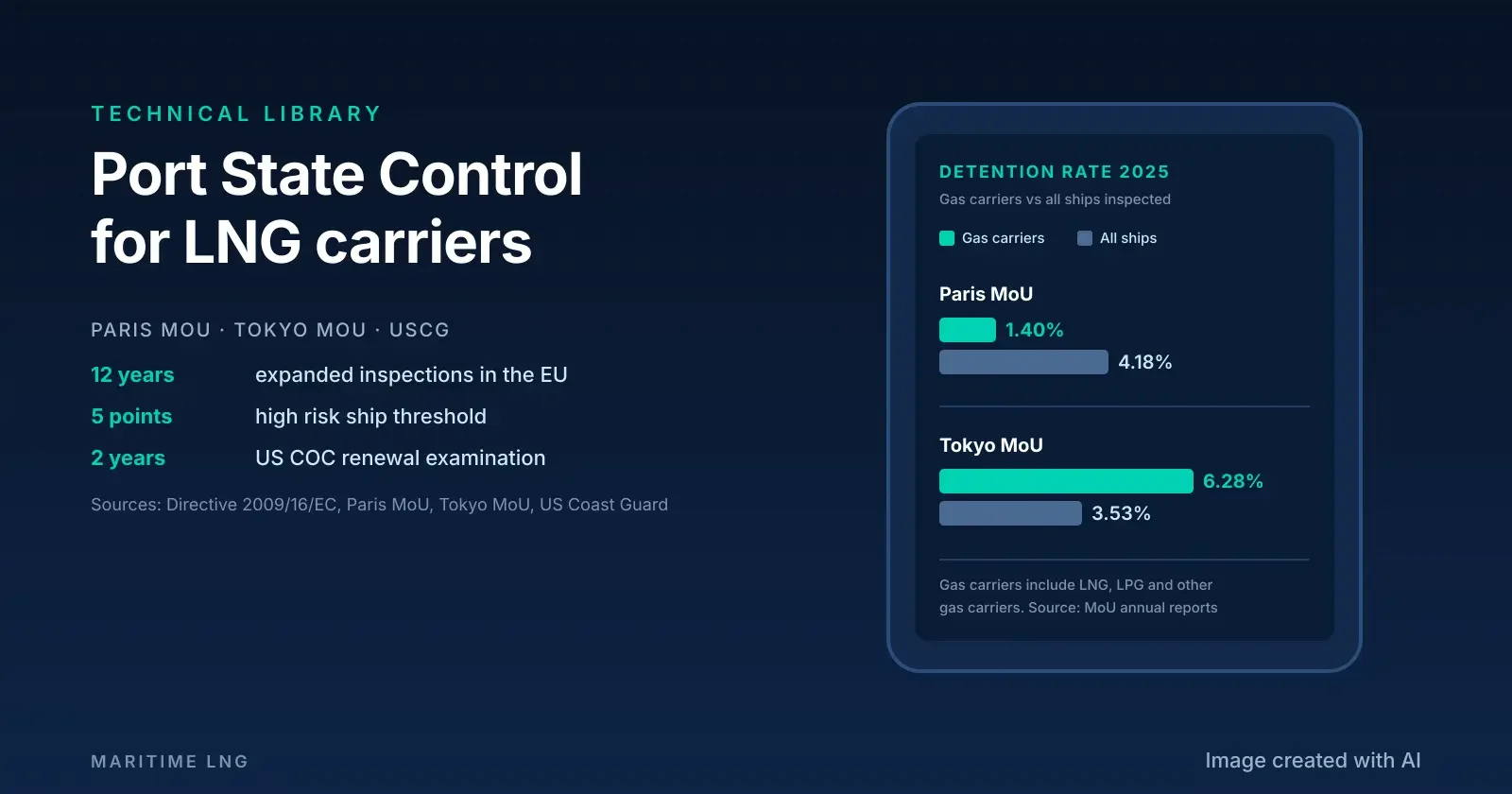
- Detentions: 688, a detention rate of 4.18%, up from 4.03% in 2024.
- Refusals of access: 19.
For gas carriers:
- Inspections: 499, covering 463 individual ships.
- Inspections with deficiencies: 223, or 44.7%.
- Detentions: 7, a detention rate of 1.40%, compared with 1.09% in 2024 and 1.58% in 2023.
- Comparison: 2.77 percentage points below the 2025 average for all ships.
2025 results: Tokyo MoU
The Tokyo MoU covers the Asia-Pacific region. In 2025:
- Inspections: 35,546, the highest number in its history, of which 23,230 found deficiencies.
- Detentions: 1,255, a detention rate of 3.53%.
For gas carriers:
- Inspections: 1,019, of which 700 found deficiencies.
- Detentions: 64, a detention rate of 6.28%, above the regional rate of 3.53%.
The two regions therefore show different pictures for 2025. In the Paris MoU region, gas carriers were detained at about a third of the average rate. In the Tokyo MoU region, they were detained more often than the average ship. The annual reports do not explain the difference.
United States: the Certificate of Compliance
In 2025, the US Coast Guard carried out 8,999 SOLAS safety examinations of foreign ships, with 77 detentions. The annual detention rate fell from 0.94% to 0.85%.
Gas carriers need a Certificate of Compliance
A foreign-flag gas carrier trading to the United States needs a Certificate of Compliance (COC), issued by the Coast Guard after the ship has been examined and found to comply with US regulations, including 46 CFR Part 154 for ships carrying bulk liquefied gases. US law requires tank vessels to be inspected or examined at least once a year. The COC is valid for two years, with an annual examination in between and a full renewal examination every two years.
The Coast Guard's Liquefied Gas Carrier National Center of Expertise handles applications for initial, annual and renewal COC examinations. The examinations are carried out by specially qualified Foreign Gas Carrier Examiners. A COC is not issued if major non-conformities or detainable deficiencies are found.
The performance-driven COC schedule
In May 2026, the Coast Guard announced a Performance-Driven COC Examination Schedule for foreign tank vessels. It is set out in work instruction CVC-WI-021(3), revised on 14 May 2026, and is based on section 7312 of the National Defense Authorization Act for Fiscal Year 2026, which amended 46 U.S.C. 3714.
- What changes: the annual mid-period examination no longer has to be a physical inspection on board. When the annual COC application is received, the local Officer in Charge, Marine Inspection (OCMI) reviews the ship's record and either schedules an examination or credits the annual requirement.
- What does not change: the comprehensive two-year renewal examination remains mandatory for all tank vessels.
- Evidence of credit: a vessel credited by the OCMI receives a formal letter, which must be kept on board with the COC.
- Automatic disqualification: a ship cannot be credited if, in the previous 36 months, it was detained by the US Coast Guard, a Coast Guard violation was found proved against its owner or operator, or it had a marine casualty involving safe operation.
- User fees: in September 2026, the Coast Guard confirmed that the user fees in 46 CFR 2.10 still apply when the annual examination is credited by letter.
The schedule does not change COC requirements for passenger ships or mobile offshore drilling units.
Concentrated inspection campaigns
The Paris and Tokyo MoUs run a joint concentrated inspection campaign (CIC) each autumn, with an extra questionnaire added to routine PSC inspections.
- 2025, Ballast Water Management: in the Tokyo MoU region, 6,930 inspections included the CIC questionnaire, and 30 ships were detained for CIC-related deficiencies. According to the preliminary results, three of them were gas carriers. The Paris MoU Committee concluded that compliance with core documents was generally high, but that the main finding was a gap between formal compliance and practical operation, including the operational status of systems and crew familiarity with procedures.
- 2026, Cargo Securing: from 1 September to 30 November 2026, focused on the securing of cargo units and cargo transport units.
- 2027, Enclosed Space Entry: confirmed by the Paris MoU Committee as the next joint campaign. LNG carriers have many enclosed spaces, such as cofferdams, void spaces and the spaces around the cargo tanks, so this campaign will be directly relevant to them.
What this means for LNG carrier operators
- Ship type and age drive targeting. In the Paris MoU, a gas carrier counts towards a high risk profile by type alone, and from 12 years of age its periodic inspections are expanded inspections.
- Environmental deficiencies will matter more. From 2027, deficiencies under MARPOL, the Ballast Water Management Convention and related conventions feed directly into the EU risk profile.
- Regional records differ. Gas carriers were detained well below average in the Paris MoU in 2025 and above average in the Tokyo MoU.
- In the United States, the record now decides the format of the annual examination. A clean three-year history can replace the annual on-board COC examination with a performance review, but the two-year renewal examination stays.
- Practical operation is what inspectors test. The 2025 ballast water campaign found that documents were generally in order, while the gaps were in how systems worked and how well crews knew the procedures.
This guide was prepared with AI assistance from the official sources listed above and reviewed by the Maritime LNG Editorial Desk.
Spotted an error or an outdated figure? Report an error · Corrections policy
Related guides
Ballast Water Management for LNG Carriers: D-2, Port Rules and the 2026 IMO Review
IMO BWM Convention, D-2, the 2026 G4 guidelines, 2025 inspection results and US and Australian ballast water rules for LNG carriers at export terminals.
Gas Carrier Accidents in Official Investigation Reports: Data and Lessons
Official data on gas carrier accidents: the IMO Casualty Investigation Code, EMSA statistics for 2016–2025 and lessons from four investigation reports.
Emission Control Areas 2025–2028: What the New ECAs Mean for LNG Carriers
Official guide to the new ECAs: Mediterranean, Canadian Arctic, Norwegian Sea and North-East Atlantic dates, sulphur and NOx Tier III rules for LNG carriers.