Ballast Water Management for LNG Carriers: D-2, Port Rules and the 2026 IMO Review
LNG carriers discharge ballast where they load cargo. This guide covers the IMO BWM Convention and its 2026 review, what inspectors found in 2025, and the US and Australian rules at export terminals.
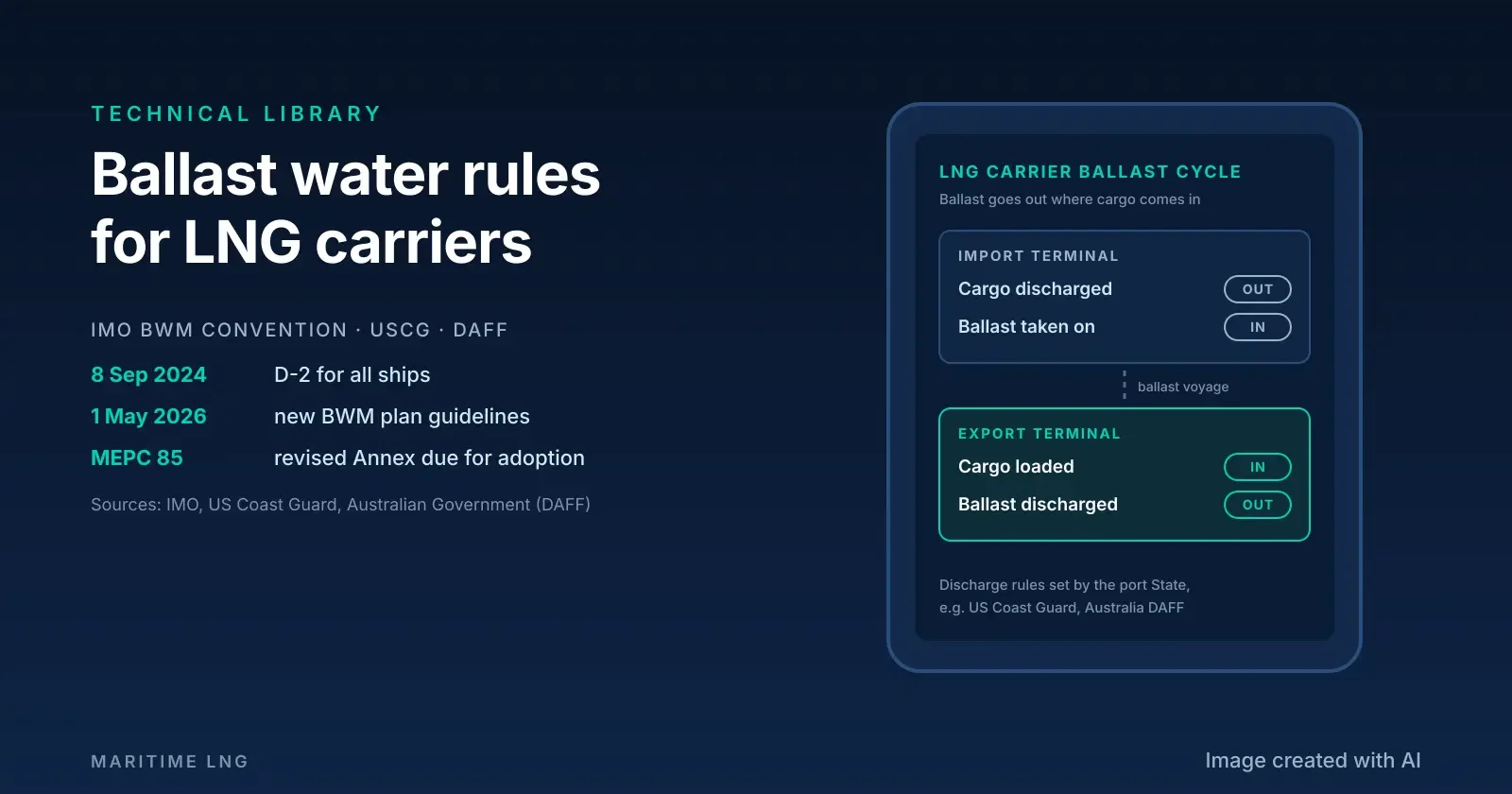
An LNG carrier takes on ballast water when it discharges its cargo and discharges ballast when it loads. Most of its ballast discharge therefore takes place at liquefaction terminals, so the rules of exporting countries such as the United States and Australia matter as much as the international convention. When a ballast water management system fails at a loading berth, the problem quickly becomes a cargo problem.
This guide explains the IMO Ballast Water Management (BWM) Convention, the changes in progress at IMO in 2026, what port State control inspectors found in 2025, and the national rules that apply where LNG carriers deballast.
Rules checked on 25 November 2026. IMO's Marine Environment Protection Committee (MEPC 85, 30 November to 3 December 2026) is due to consider a revised Annex to the BWM Convention for adoption, and this guide will be updated after the session.
The IMO BWM Convention
The International Convention for the Control and Management of Ships' Ballast Water and Sediments was adopted on 13 February 2004 and entered into force on 8 September 2017. It applies to ships flying the flag of a Party that take up and use ballast water on international voyages.
Every ship covered by the Convention must carry:
- a ship-specific ballast water management plan;
- a ballast water record book;
- an International Ballast Water Management Certificate, for ships of 400 gross tonnage and above.
The Convention sets two standards:
- D-1, ballast water exchange: at least 95% of the ballast water by volume is exchanged far from the coast.
- D-2, ballast water performance: the discharge must stay below set limits for living organisms and indicator microbes. These include fewer than 10 viable organisms per cubic metre that are 50 micrometres or larger, and limits for E. coli and intestinal enterococci.
Compliance with D-2 was phased in ship by ship, linked to renewal surveys, with a final deadline of 8 September 2024. Since that date, all ships covered by the Convention must meet D-2, which in most cases means operating an approved ballast water management system (BWMS). Regulation D-3 sets the approval requirements, and the BWMS Code contains the test and performance specifications for type approval.
The 2026 review of the Convention
After the Convention entered into force, IMO started an experience-building phase in three stages: data gathering, data analysis and a review of the Convention. The review is now reaching its final steps:
- Amendments approved: MEPC 84, held from 27 April to 1 May 2026, approved a package of amendments covering regulations and appendices in the Annex to the Convention.
- Adoption pending: MEPC 85 is due to consider a consolidated revised Annex to the Convention for adoption. The entry into force date will be determined at adoption.
- BWMS Code: work on amendments to the mandatory BWMS Code is continuing.
New guidelines for ballast water management plans
MEPC 84 also adopted the 2026 Guidelines for ballast water management and development of ballast water management plans (G4), resolution MEPC.409(84), on 1 May 2026. Member Governments are invited to apply them as soon as possible. The earlier G4 guidelines will be revoked when the Convention amendments enter into force. For ship operators, the main points are:
- Contingency measures: the plan must set out suitable contingency measures for when the ship cannot manage its ballast water to the D-2 standard, with reference to the IMO guidance in circular BWM.2/Circ.62.
- Challenging water quality: the plan should include ship-specific measures for challenging water quality conditions, with reference to resolution MEPC.387(81).
- System failures: failures and malfunctions of the BWMS must be recorded in the ballast water record book, and the plan should include maintenance procedures referring to the system's operation, maintenance and safety manual.
- Records: every ballast operation and any exemption must be recorded. Voluntary tank-by-tank records can help when completing port reporting forms.
- Crew training: officers and crew must be trained in the ship's ballast water practices, treatment system, safety, record keeping and sediment handling.
- Sediments: sediments should preferably be removed in port or in dry dock. Disposal at sea should take place only more than 200 nautical miles from land and in water deeper than 200 metres.
- Port communication: the plan must describe how the ship coordinates ballast discharges with the authorities of the coastal State.
What inspectors found in 2025
From 1 September to 30 November 2025, the Paris and Tokyo MoUs ran a joint concentrated inspection campaign (CIC) on ballast water management, and other regional regimes took part.
- Tokyo MoU: 6,930 inspections included the campaign questionnaire. Of the ships inspected, 184 were detained (2.66%), and 30 detentions resulted directly from ballast water deficiencies (0.43%). According to the preliminary results, three of those 30 ships were gas carriers.
- Paris MoU: the Port State Control Committee concluded that compliance with core documents was generally high. The main finding was a gap between formal compliance and practical operation, including the operational status of systems and crew familiarity with procedures.
- Black Sea MoU: 16 ships were detained as a direct result of the campaign, a detention rate of 2.56% for ballast water deficiencies. The operability of ballast water management systems was the most significant area of concern.
Australia's Department of Agriculture, Fisheries and Forestry reported similar findings from its own inspections. These included crews ignoring BWMS alarms, discharging in bypass mode, changing alarm settings and not following the ballast water management plan.
Where LNG carriers deballast: national rules
The United States supplied about a quarter of global LNG trade in 2025, and Australia is one of the three largest exporters (see our LNG trade and fleet numbers guide). Both countries apply their own ballast water rules.
United States
The US Coast Guard has stated that the United States is not a signatory to the BWM Convention. Ballast water discharged in US waters is governed by US Coast Guard regulations in 33 CFR Part 151, Subpart D, which apply to all non-recreational vessels, US and foreign, that are equipped with ballast tanks and operate in US waters.
- Approved methods: use a BWMS approved by the US Coast Guard under 46 CFR Part 162; use water from a US public water system; do not discharge ballast in US waters; or discharge it to a facility onshore or to another vessel for treatment.
- Exchange: ballast water exchange 200 nautical miles from shore is allowed only until the vessel's compliance date for a Coast Guard-approved BWMS. The Coast Guard has stated that a BWM Convention endorsement for sequential exchange is not an acceptable US method for a vessel past its compliance date without an extension.
- Alternate management systems: a foreign-approved system accepted by the Coast Guard as an alternate management system, and installed before the vessel's compliance date, may be used for no more than five years from that date.
- Discharge standard: fewer than 10 organisms per cubic metre of 50 micrometres or larger, fewer than 10 organisms per millilitre between 10 and 50 micrometres, and limits for indicator microbes: E. coli below 250 cfu per 100 ml, intestinal enterococci below 100 cfu per 100 ml and toxicogenic Vibrio cholerae below 1 cfu per 100 ml.
- System failure: if the BWMS stops working properly during a voyage, the problem must be reported to the nearest Coast Guard Captain of the Port or District Commander as soon as practicable.
- Reporting and records: for most US ports, a ballast water report must be sent to the National Ballast Information Clearinghouse no later than six hours after arrival or before departure, whichever is earlier. A signed copy must be kept on board for two years.
The Vessel Incidental Discharge Act (VIDA) will change the legal framework. The Environmental Protection Agency (EPA) published national standards of performance, including requirements for ballast tanks, on 9 October 2024. They become enforceable through Coast Guard implementing regulations, which the EPA said in June 2026 were still being developed. Until those regulations are final and effective, vessels remain subject to the existing Coast Guard ballast water regulations and the EPA's 2013 Vessel General Permit.
Australia
In Australia, ballast water is regulated under the Biosecurity Act 2015 and explained in the Australian Ballast Water Management Requirements.
- Standard: since 8 September 2024, all relevant vessels should comply with the D-2 standard.
- Reporting: a ballast water report must be submitted through the Maritime and Aircraft Reporting System (MARS) when a vessel intends to discharge ballast water in Australian territorial seas.
- Records: entries in the ballast water record book are cross-referenced with the MARS report and checked against BWMS logs where a system is fitted.
- Inspections: biosecurity officers check how the BWMS was operated and maintained, how alarms were handled, whether any uptake or discharge took place in bypass mode, and whether spare parts and treatment chemicals match the system's type approval and are in date.
- Consequences: a vessel may be directed not to discharge ballast water, which can delay cargo operations, and discharging ballast that was not managed in line with the ship's plan is an offence under the Biosecurity Act.
What this means for LNG carrier operators
- The BWMS is part of the cargo operation. An LNG carrier must discharge ballast to load, so a system failure or a direction not to discharge can delay loading at the terminal.
- Contingency measures must be ready before arrival. IMO's 2026 guidelines and Australian practice expect a documented contingency plan for when the system cannot meet D-2, and US rules require a system failure to be reported to the Coast Guard.
- Records must tell one consistent story. Inspectors compare the ballast water record book, BWMS data logs and port reports, and the 2026 guidelines require system failures to be recorded.
- US calls need US compliance. An IMO type approval or a BWM Convention certificate does not on its own meet US requirements. Compliance depends on a Coast Guard-approved system, an accepted alternate management system or one of the other US methods.
- Operation is now the focus. The 2025 campaign showed that documents are generally in order, and inspectors are now looking at whether systems work and whether crews know how to run them.
This guide was prepared with AI assistance from the official sources listed above and reviewed by the Maritime LNG Editorial Desk.
Related guides
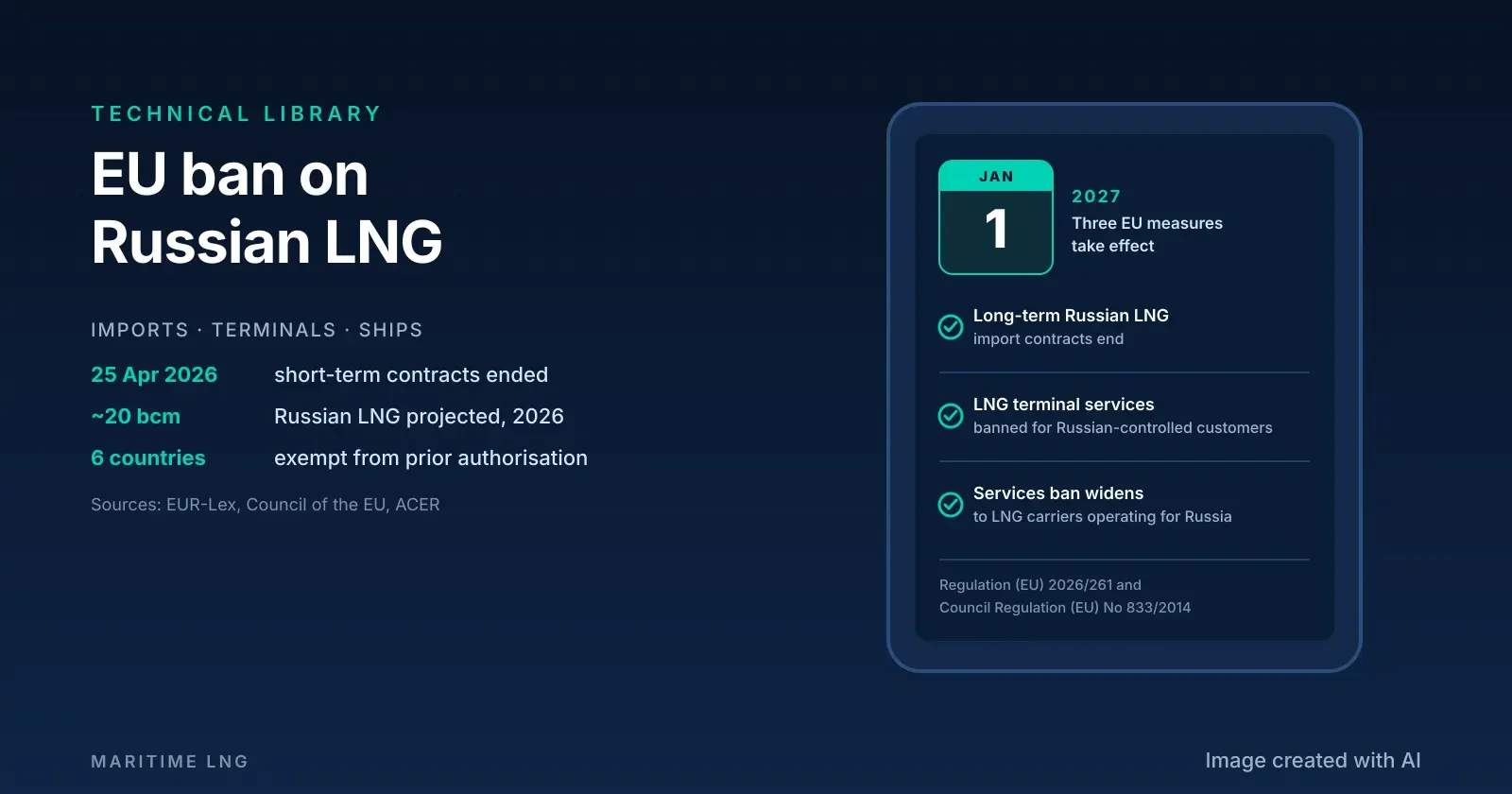
EU Ban on Russian LNG: What Changes on 1 January 2027 for Imports, Terminals and Ships
What changes on 1 January 2027: Regulation (EU) 2026/261, sanctions on LNG terminal services and LNG carriers, proof-of-origin rules and ACER data.
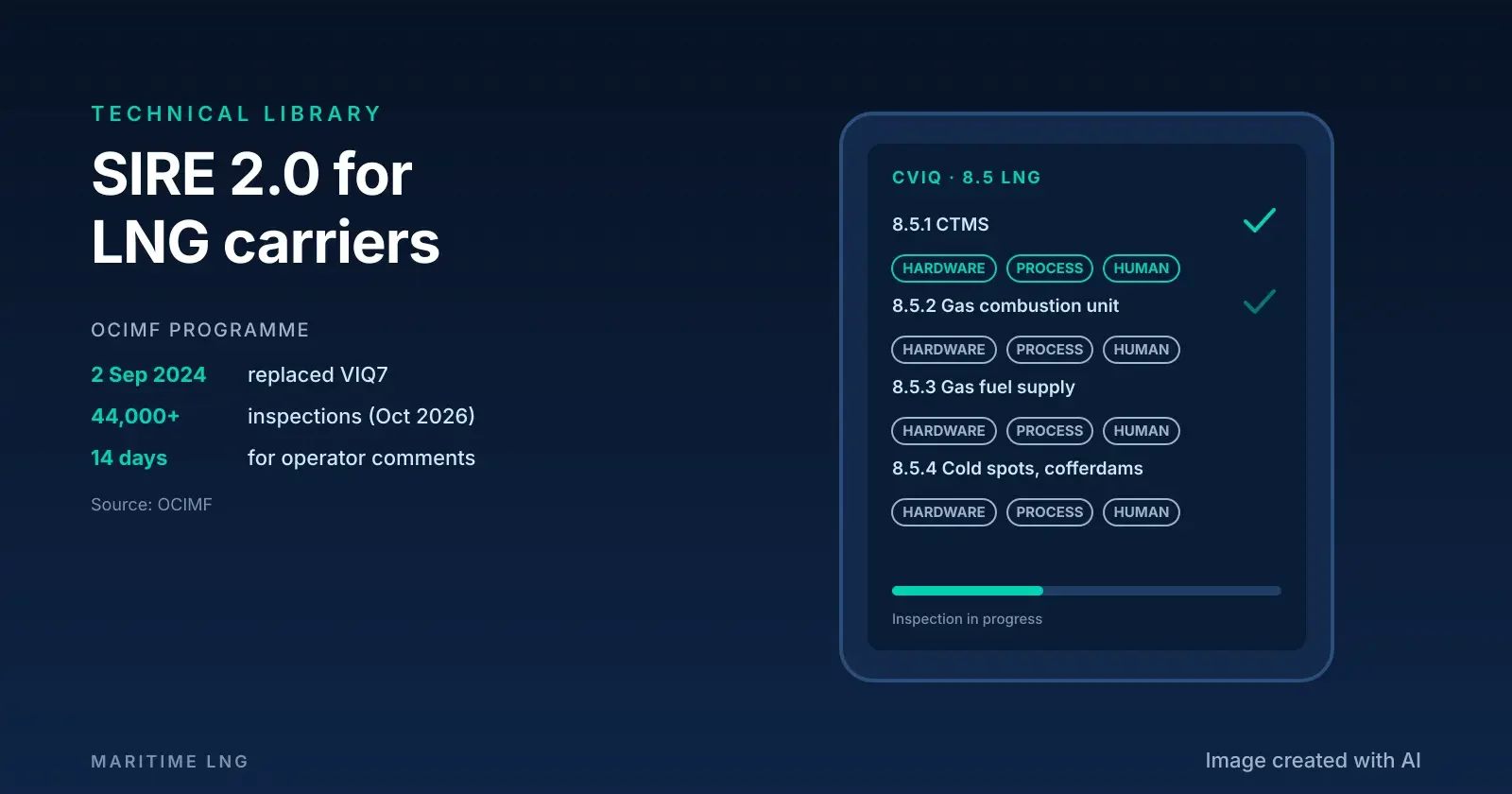
SIRE 2.0 for LNG Carriers: How the OCIMF Inspection Regime Works
How OCIMF's SIRE 2.0 works for LNG carriers: HVPQ, PIQ, the CVIQ, core and rotational questions, LNG-specific questions and report timelines.
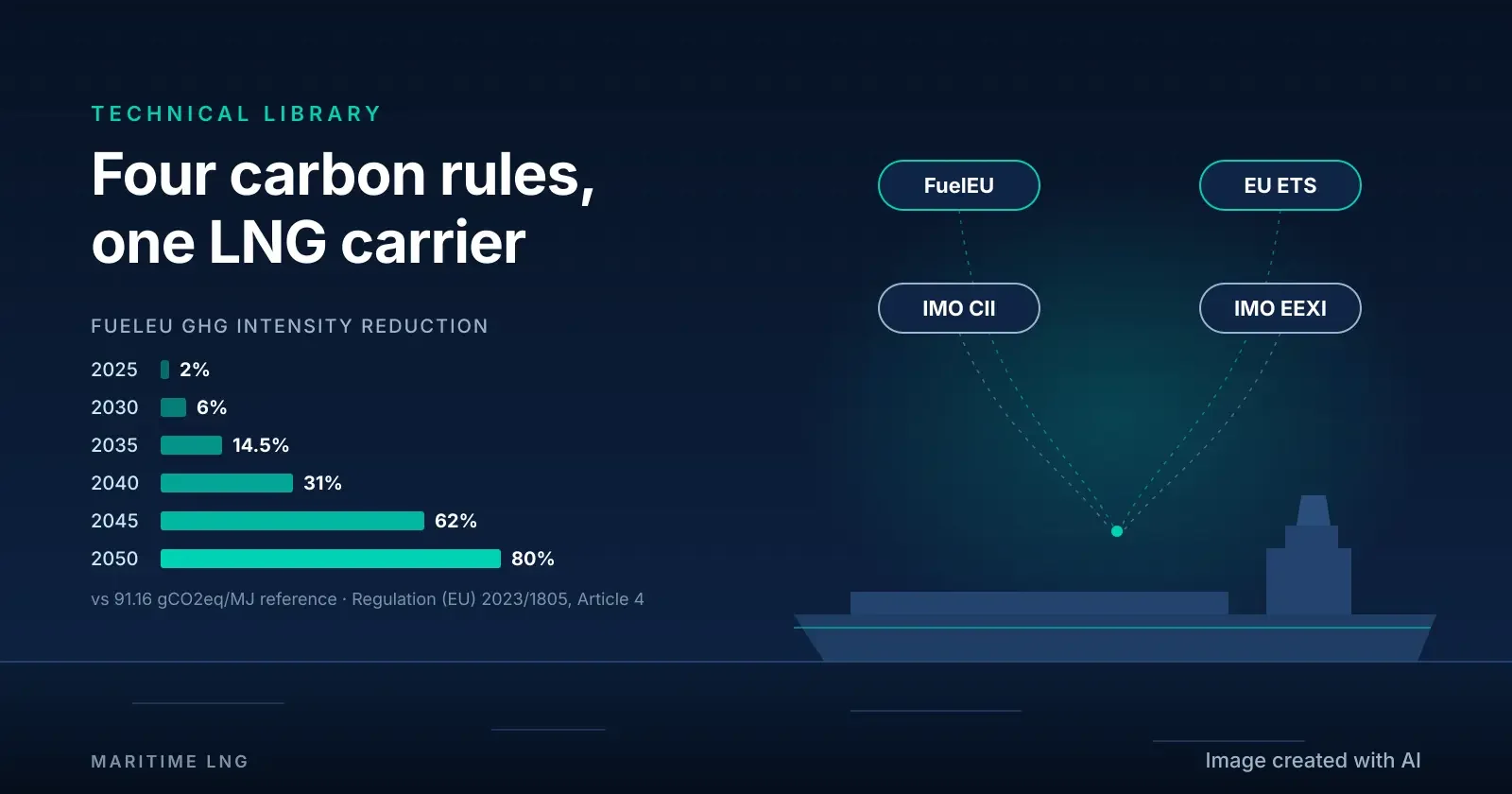
FuelEU Maritime, EU ETS, CII and EEXI: What They Mean for LNG Carriers
How FuelEU Maritime, the EU ETS, IMO CII and EEXI apply to LNG carriers: targets, LNG-specific rules, penalties, ratings and what changes next.