SIRE 2.0 for LNG Carriers: How the OCIMF Inspection Regime Works
SIRE 2.0 replaced VIQ7 on 2 September 2024. This guide explains how OCIMF's digital, risk-based inspections work, from the HVPQ and PIQ to the published report, and which questions are specific to LNG carriers.
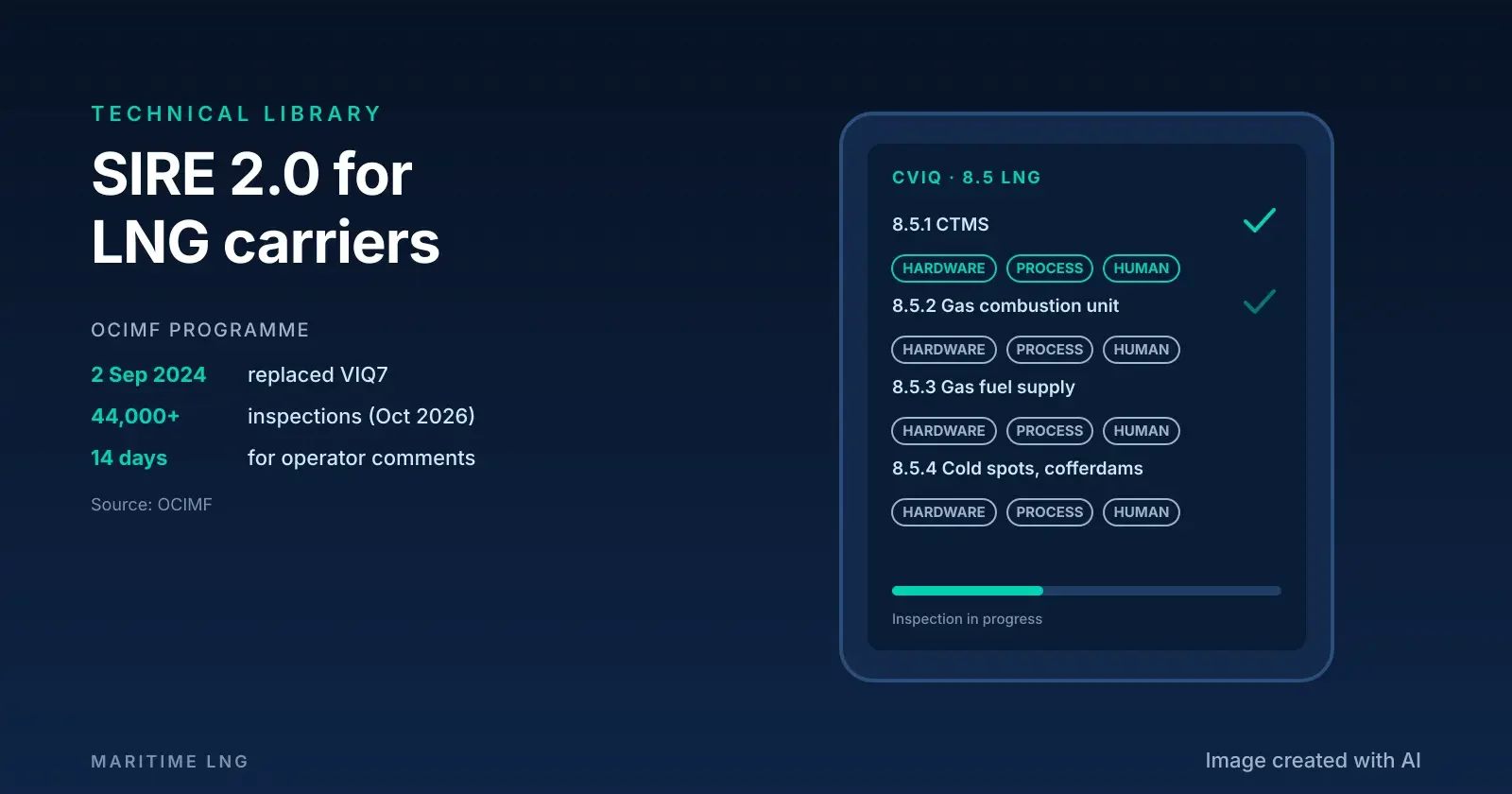
SIRE, the Ship Inspection Report Programme run by the Oil Companies International Marine Forum (OCIMF), is the standard inspection tool used to vet tankers, including LNG carriers. Since 2 September 2024, inspections have been carried out under SIRE 2.0, a digital, risk-based programme that replaced the earlier Vessel Inspection Questionnaire (VIQ7). SIRE is not a statutory regime: it is an industry programme whose reports are used by charterers, terminals and other programme recipients when assessing a vessel.
This guide explains how SIRE 2.0 works, from the information the operator provides before the inspection to the published report, and which questions are specific to LNG carriers.
Programme status checked on 25 November 2026.
SIRE 2.0 in numbers
- Launch: OCIMF launched SIRE 2.0 on 2 September 2024, after a phased roll-out, and withdrew the option to request a VIQ7 inspection from that date.
- First year: by September 2025, more than 22,000 inspections had been completed in 2,100 ports by 460 accredited inspectors. Only 0.2% of inspections needed the paper-based contingency process.
- Second year: the programme passed its second anniversary in September 2026. In its October 2026 newsletter, OCIMF reported more than 44,000 SIRE 2.0 inspections completed.
Who takes part
The programme's Conditions of Participation identify four groups:
- Submitting companies: the companies that request inspections.
- Vessel operators: the companies whose ships are inspected.
- Inspectors: SIRE 2.0 accredited inspectors.
- Programme recipients: organisations that access the reports.
According to OCIMF, access to SIRE reports is available at a nominal cost to OCIMF members, bulk oil terminal operators, port and canal authorities, and oil, power and industrial companies that charter tankers or barges as part of their normal business.
Before the inspection: the operator's information
Before each inspection, the vessel operator provides information through four elements:
- Harmonised Vessel Particulars Questionnaire (HVPQ): the vessel's particulars. OCIMF has released HVPQ6.
- Pre-Inspection Questionnaire (PIQ): further pre-inspection information and declarations from the operator.
- Certificate Repository: the vessel's certificates.
- Photograph Repository: a standard set of photographs of the vessel.
The operator then makes an Inspection Declaration that the information is accurate. For the photographs, OCIMF recommends a refresh about every six months, and whenever the vessel's condition changes materially. Photographs may be kept for up to a year if the operator is confident they are still representative. If photographs are missing, the inspector records a negative observation.
The inspection questionnaire
Instead of a fixed questionnaire, each inspection uses a Compiled Vessel Inspection Questionnaire (CVIQ). An inspection compiler generates it once the operator has declared the pre-inspection information complete. The questions are drawn from the SIRE 2.0 Question Library based on the HVPQ and PIQ, not on the vessel's previous inspection results, and the CVIQ is not shared with the operator in advance.
OCIMF ranked each question using risk assessment models, known as bowties, developed with its members. The questions fall into four types:
- Core: questions on fundamental risks, asked on every relevant inspection.
- Rotational: other questions, assigned occasionally and unpredictably. The compiler avoids repeating them, but a repeat on consecutive inspections cannot be ruled out.
- Campaign: questions added to every inspection for a fixed period, in response to an incident or an industry trend.
- Conditional: questions triggered by the vessel's operational history or the operator's declarations.
By assigning fewer questions to each inspection, OCIMF expects inspectors to take the time to examine and report more accurately on the hardware, process and human aspects of each one.
How inspectors report
Inspectors complete the CVIQ in real time on a tablet. For each question, they use three response tools:
- Hardware: the condition of equipment and structure.
- Process: the procedures and documents on board.
- Human: a task-based assessment of how the crew carry out the work.
A negative observation is linked to a subject of concern and a nature of concern. For human observations, the inspector also selects Performance Influencing Factors from a list. Positive observations are possible only for human tasks that exceed expectations, not for hardware or process. In an anonymised example report published by OCIMF, a typical hardware entry reads "Free from obvious deterioration or deficiency", while process entries record that the expected procedure or document was present.
What LNG carriers are asked
The SIRE 2.0 Question Library is published in two parts. Part 2, chapters 8 to 12 (version 1.0, January 2022, the version listed on OCIMF's SIRE 2.0 page), contains the questions most relevant to gas carriers. Chapter 8, Cargo and Ballast Systems, has a section specific to LNG carriers:
- 8.5.1 Custody transfer measurement system (CTMS): whether officers know the procedures for operating, testing and calibrating the CTMS, and whether it is in satisfactory condition. The inspector checks the test and calibration records and the calibration certificate, and the guidance refers to the GIIGNL LNG Custody Transfer Handbook.
- 8.5.2 Gas combustion unit (GCU): procedures, inspection, maintenance and test records including alarms, and the officers' knowledge of automatic and manual operation. Assigned only where a GCU is fitted.
- 8.5.3 LNG gas fuel supply system: the safety arrangements for supplying boil-off gas to engine-room consumers, including the double-wall annular space, leak detection and gas detection.
- 8.5.4 Cold spots and cofferdam heating: protection of the hull against brittle fracture if the containment or insulation fails, including temperature monitoring, alarm settings and cofferdam heating where fitted.
Section 8.6 applies to all ships under the IGC Code. Its questions include:
- cargo tank overfill alarms, cargo transfer emergency shutdown (ESD), and cargo tank and liquid line relief valves;
- the cargo system operation manual, cargo system alarm management, and the atmosphere in interbarrier and hold spaces;
- the reliquefaction plant, cargo heaters, vaporisers and condensers, and submerged motor electric cargo pumps;
- filling and loading limits, manifolds and portable pipework, emergency discharge, and pipeline insulation;
- IGC safety, rescue and protective equipment, the vent mast fire suppression system, and leakage into hold or insulation spaces.
Chapter 11 compares the vessel's condition with its standard photographs, with additional questions for LNG membrane-type ships (11.1.70 to 11.1.72) and Moss-type ships (11.1.80 to 11.1.82). Chapter 10 includes a section on LNG bunkering management (10.6).
Our Technical Library guides on LNG custody transfer and on LNG cargo machinery cover the systems behind several of these questions.
After the inspection
- Validation: the submitting company sees the report first, validates it and then releases it to the operator.
- Operator comments: the operator has 14 days to comment on each negative observation. Otherwise, the report is published without comments. Operators can also add comments after publication.
- Master's comments: the master can comment on a printed Observation Declaration if a wireless printer is available.
- Changes: the report can be amended until it is submitted, and all changes are tracked.
- Availability: OCIMF states that reports remain active on the database for 12 months.
What comes next
In its October 2026 newsletter, OCIMF reported the decisions of its Programmes Committee:
- positive feedback on the first redesigned SIRE 2.0 inspector course, with more group work and practical exercises;
- a broader roll-out of OPERA and other structured tools for writing observations;
- a technology modernisation roadmap, including multilingual capability and more risk-centred questions;
- a planned simplification of SIRE defect reporting.
OCIMF's Engineering Expert Group also plans to incorporate its revised guidance on safety critical equipment and spare parts into SIRE 2.0. The decisions will feed a work programme with focused priorities for 2027. Programme users can submit feedback through the SIRE 2.0 Suggestions for Improvement portal.
This guide was prepared with AI assistance from the official sources listed above and reviewed by the Maritime LNG Editorial Desk.
Related guides
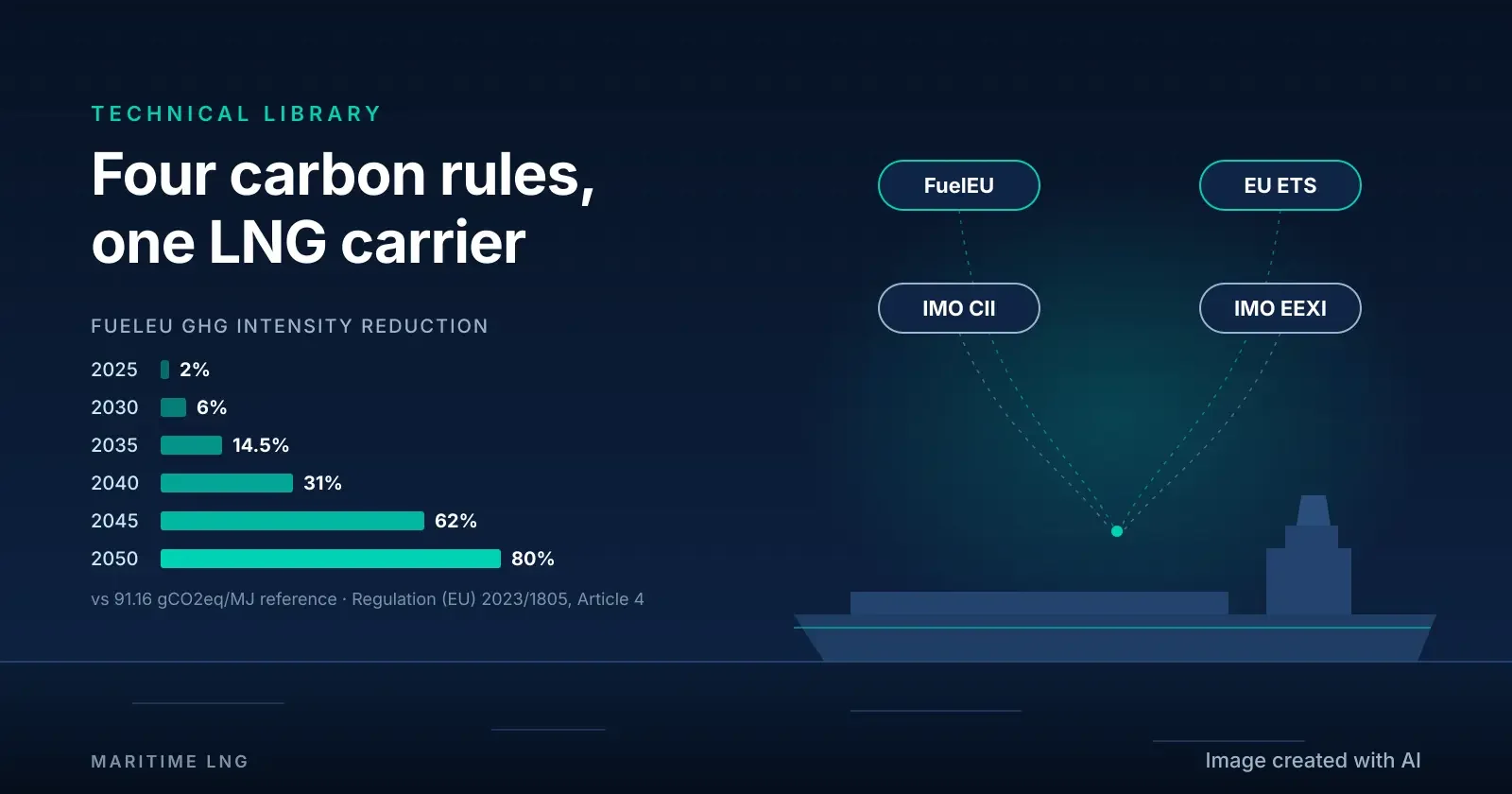
FuelEU Maritime, EU ETS, CII and EEXI: What They Mean for LNG Carriers
How FuelEU Maritime, the EU ETS, IMO CII and EEXI apply to LNG carriers: targets, LNG-specific rules, penalties, ratings and what changes next.
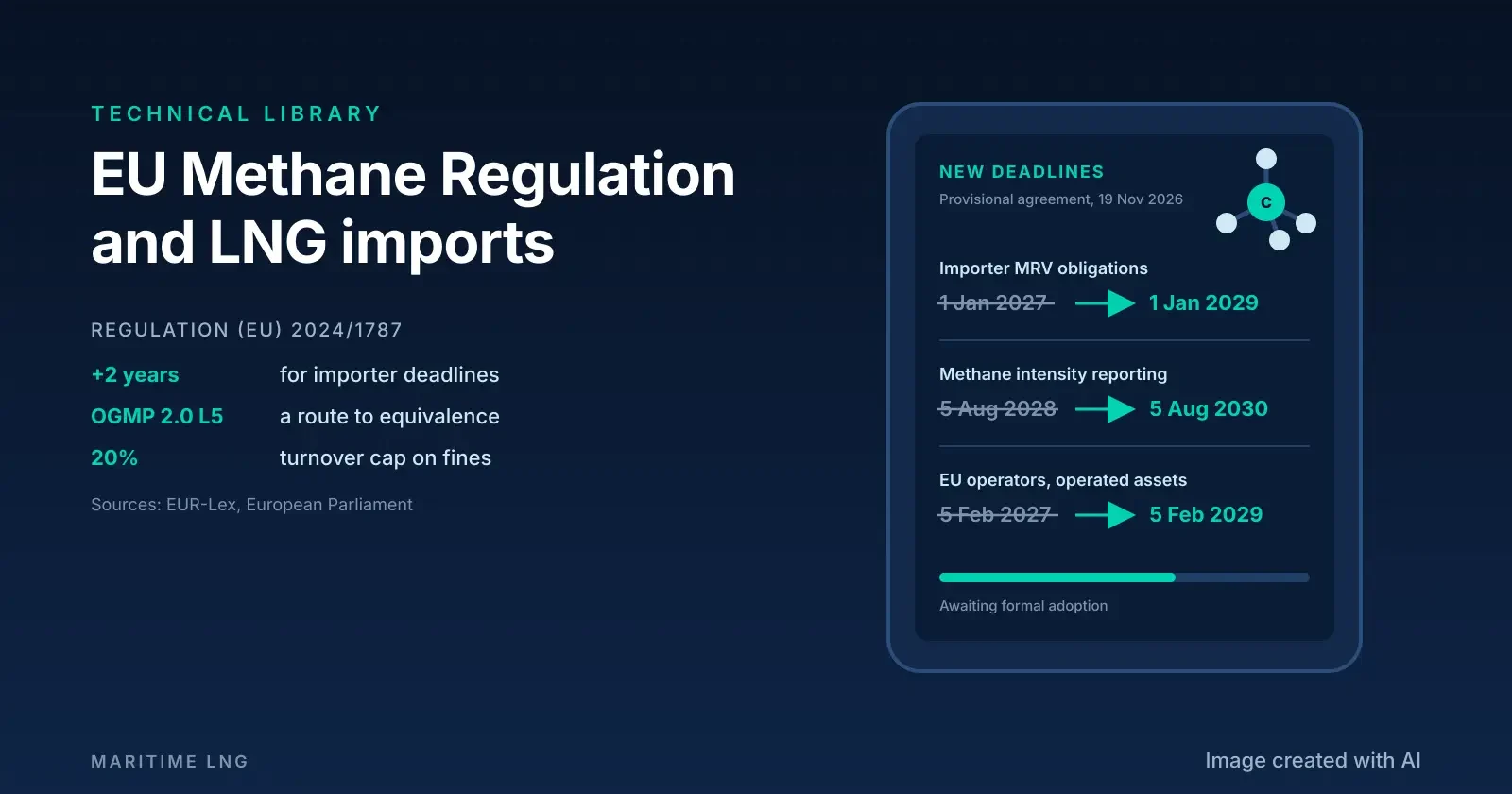
EU Methane Regulation and LNG Imports: Obligations, Deadlines and the 2026 Postponement
What the EU Methane Regulation requires of LNG importers: Annex IX reporting, MRV equivalence, methane intensity and the provisional two-year postponement.

LNG Safety and International Regulations: IMO, IGC Code and IGF Code
A structured guide to the IMO framework for LNG at sea: SOLAS, the IGC Code for gas carriers, the IGF Code for gas-fuelled ships, STCW training, MARPOL Annex VI and the role of class and industry guidance.