EU Ban on Russian LNG: What Changes on 1 January 2027 for Imports, Terminals and Ships
From 1 January 2027, the EU ends long-term Russian LNG imports, bans terminal services to Russian-controlled customers and widens the services ban on LNG carriers. The rules, dates and data, from official sources.
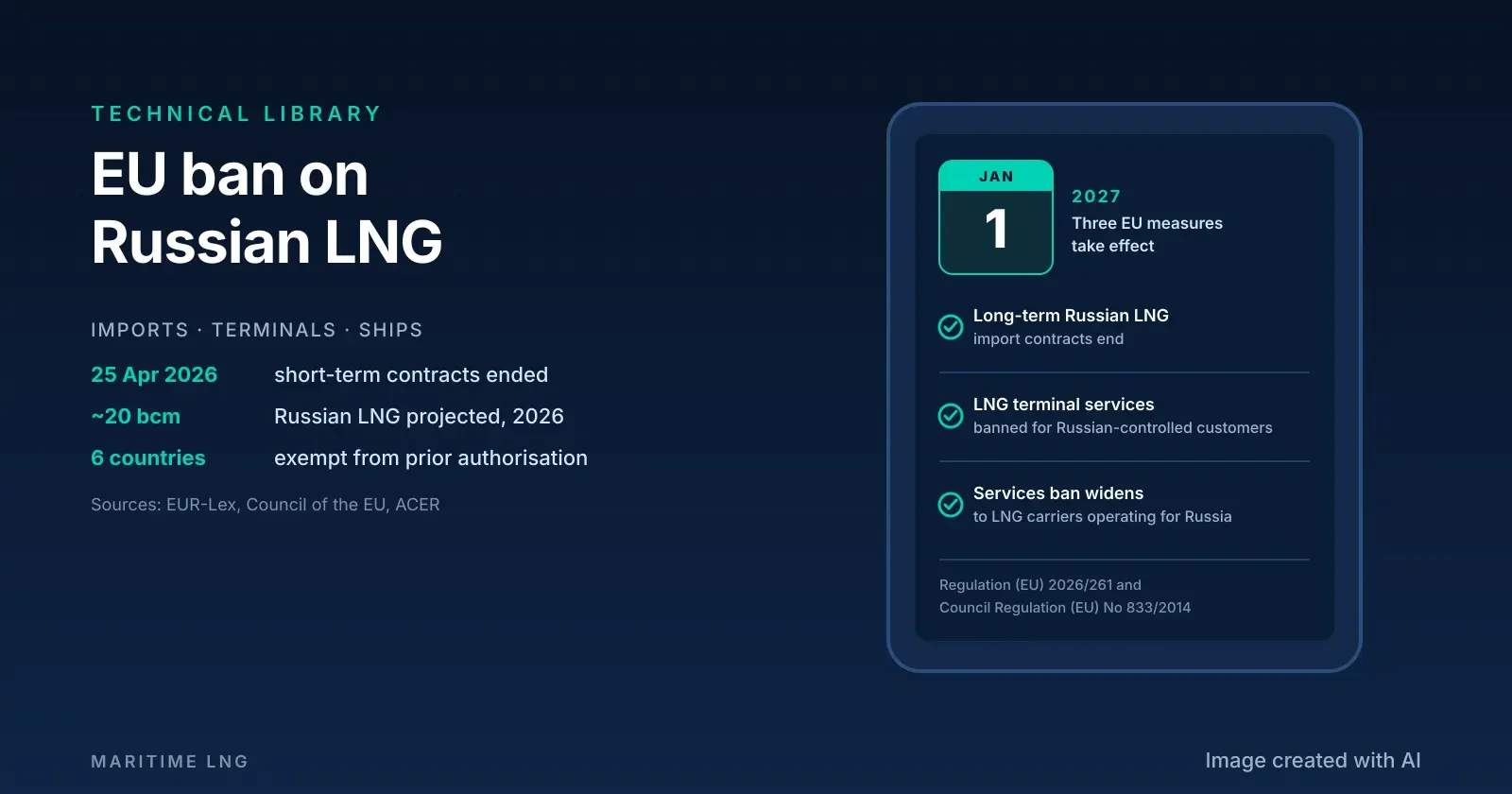
On 1 January 2027, three separate EU measures on Russian liquefied natural gas take effect on the same day. Imports under the remaining long-term contracts end, EU terminals must stop serving Russian-controlled customers, and the ban on services to LNG carriers linked to Russia widens to non-Russian ships trading in or for Russia. For terminal operators, traders, shipowners, ship managers, repair yards and financiers, the date marks the end of a phase-out that began with port restrictions in 2025.
This guide explains the two legal tracks behind the ban, the full timeline, the proof-of-origin rules for every LNG cargo entering the EU, and what the official data show about the remaining Russian volumes.
Legal status checked on 25 November 2026. This guide summarises EU law for information. It is not legal advice, and operators should check the current texts and national guidance.
Two legal tracks
The EU is phasing out Russian LNG through two different instruments:
- The REPowerEU Gas Regulation: Regulation (EU) 2026/261 was adopted by the European Parliament and the Council on 26 January 2026, published in the Official Journal on 2 February and entered into force on 3 February 2026. Its import prohibition applies from 18 March 2026, with transitional periods for existing contracts.
- The Russia sanctions regulation: Council Regulation (EU) No 833/2014 has been amended several times to target Russian LNG. The 14th package (June 2024) restricted the use of EU ports, the 19th package (23 October 2025) added an import ban, and the 20th package (23 April 2026) covered LNG terminal services, LNG carriers and icebreakers.
Regulation (EU) 2026/261 states that the LNG prohibition under the sanctions regulation continues to apply in its own right.
The timeline
- Late March 2025: the ban on reloading Russian LNG in EU territory for transshipment to third countries took effect. The 14th package also restricted imports of Russian LNG through EU terminals that are not connected to the natural gas system.
- 3 February 2026: Regulation (EU) 2026/261 entered into force.
- 18 February 2026: the prior authorisation and proof-of-origin rules began to apply.
- 18 March 2026: the import prohibition began to apply, subject to transitional periods.
- 25 April 2026: imports under short-term LNG contracts concluded before 17 June 2025 ended. On the same date, the sanctions ban on services to Russian-flagged, Russian-certified and Russian-owned or managed LNG carriers began.
- 1 January 2027: imports under long-term LNG contracts end, LNG terminal services to Russian-controlled customers become illegal, and the services ban extends to other LNG carriers operating in or for use in Russia.
- 30 September 2027: imports of pipeline gas under long-term contracts end, or 1 November 2027 for a Member State where the Commission confirms a risk to its storage filling target.
What the import ban covers
Under Regulation (EU) 2026/261, the prohibition covers LNG that originates in Russia or is exported directly or indirectly from Russia. It also covers LNG obtained from gas extracted in Russia, including when that LNG is part of a mixture with gas from other countries.
The decisive test is the country of production, meaning the country where the gas was extracted. Gas from another country that is liquefied or regasified in Russia is also treated as Russian.
The transitional periods applied only to contracts concluded before 17 June 2025 and not amended afterwards. A short-term contract is one of up to one year, and a long-term contract one of more than one year. Contracts concluded on or after 17 June 2025 never benefited from a transition. A limited list of amendments did not cancel the transition, for example lower quantities or prices, or changes to operational procedures. Imports could never exceed the contracted quantities.
Proving that a cargo is not Russian
The Regulation applies proof-of-origin rules to all gas imports, not only Russian ones:
- Russian gas under a transitional exemption: requires prior authorisation, with contract details, the place of liquefaction, the first loading port, documentation of any mixture and the delivery points submitted at least one month before the gas enters the EU customs territory.
- Non-Russian gas: information on the country of production must be provided at least five working days before entry, unless the gas comes from an exempt country.
- Exempt countries: the exemption covers countries that exported more than 5 billion cubic metres of gas to the EU in 2024 and either prohibit imports of Russian gas or have no infrastructure to import it. Commission Implementing Decision (EU) 2026/335 of 9 February 2026 lists Algeria, Nigeria, Norway, Qatar, the United Kingdom and the United States. The Commission can update the list and revoke an exemption if it detects circumvention.
- Verification: authorities may request further information, including the contract text without price information, and may use sources such as satellite tracking of LNG cargoes. If the information is not conclusive, customs must refuse release for free circulation.
The Commission has issued implementation guidance, updated on 18 March 2026 with the stated aim of maximising the flexibilities for the prior authorisation of non-Russian gas imports, and again in August 2026.
Penalties and emergency suspension
Member States must set penalties that are effective, proportionate and dissuasive:
- Companies: the maximum penalty must be at least the highest of 3.5% of total worldwide annual turnover, EUR 40 million, or 300% of the estimated turnover of the transaction.
- Individuals: the maximum penalty must be at least EUR 2.5 million.
If a gas emergency is declared under the EU security of supply rules and supply is seriously threatened, the Commission may suspend the import provisions for one or more Member States. A suspension lasts no more than four weeks at a time, and only short-term supply contracts are allowed while it applies.
Terminals and ships: the sanctions measures
Transshipment
Since late March 2025, EU ports may not be used to reload Russian LNG for transshipment to third countries.
LNG terminal services
From 1 January 2027, it is prohibited to provide LNG terminal services, directly or indirectly, to Russian persons or entities, or to EU entities more than 50% owned or controlled by a Russian citizen or entity. LNG terminal services include offloading, storage, regasification and berthing. Contracts for these services terminate automatically on 1 January 2027.
LNG carriers and icebreakers
The 20th package prohibits technical assistance, brokering services and financing for icebreakers and LNG carriers linked to Russia. The Commission describes the measure as a ban on maintenance services. It applies:
- from 25 April 2026, to LNG carriers registered under the Russian flag, certified by the Russian Maritime Register of Shipping, or owned or managed by Russian persons;
- from 1 January 2027, to other LNG carriers operating in Russia or for use in Russia.
The prohibition does not apply to vessels in need of assistance, to emergency port calls for reasons of maritime safety, or to saving life at sea.
What the official data show
The EU Agency for the Cooperation of Energy Regulators (ACER) published its first monitoring report under the Regulation on 1 July 2026:
- Remaining contracts: authorised Russian LNG contracts amount to 20 to 32 billion cubic metres a year, delivered to Belgium (7.5 to 12 bcm), France (6 to 9.5 bcm), Spain (5 to 8 bcm) and other points including the Netherlands (1.5 to 3 bcm).
- Flows: physical imports of Russian LNG rose by 11% from January to May 2026 compared with the same period of 2025, and by 17% after 18 March 2026. ACER links the increase to frontloading, contract adjustments, the closure of the Strait of Hormuz and the end of transshipment flows.
- Share: ACER projects Russian LNG imports of about 20 bcm in 2026, over 15% of EU LNG imports and about 5 to 6% of EU gas consumption.
- Outlook: ACER expects the more significant impacts from 1 January 2027 and from the pipeline cut-off in September 2027.
What it means for the LNG chain
- Terminals must screen customers. By 1 January 2027, terminal operators must end services to Russian-controlled customers and stop receiving Russian LNG. According to ACER, the remaining contracted volumes are delivered mainly in Belgium, France and Spain.
- Service providers must screen ships. Shipyards, brokers and financiers in the EU must check whether an LNG carrier is Russian-flagged, certified by the Russian register, owned or managed by Russian persons, or, from 2027, operating in or for Russia.
- Every cargo needs a clear origin. Cargoes from outside the six exempt countries need country-of-production information at least five working days before entry, and mixed cargoes need documentation of each share.
- Records matter. The loading port, the place of liquefaction and any blending can all be checked, including against satellite tracking data.
- The framework will keep moving. The Commission updates its guidance and the exempt-country list, ACER's second report is due by 1 July 2027, and the Commission must review the Regulation by 4 February 2028.
The ban is separate from the EU Methane Regulation, which sets reporting and monitoring duties for importers of LNG from any country. See our guide to the EU Methane Regulation and LNG imports.
This guide was prepared with AI assistance from the official sources listed above and reviewed by the Maritime LNG Editorial Desk.
Related guides
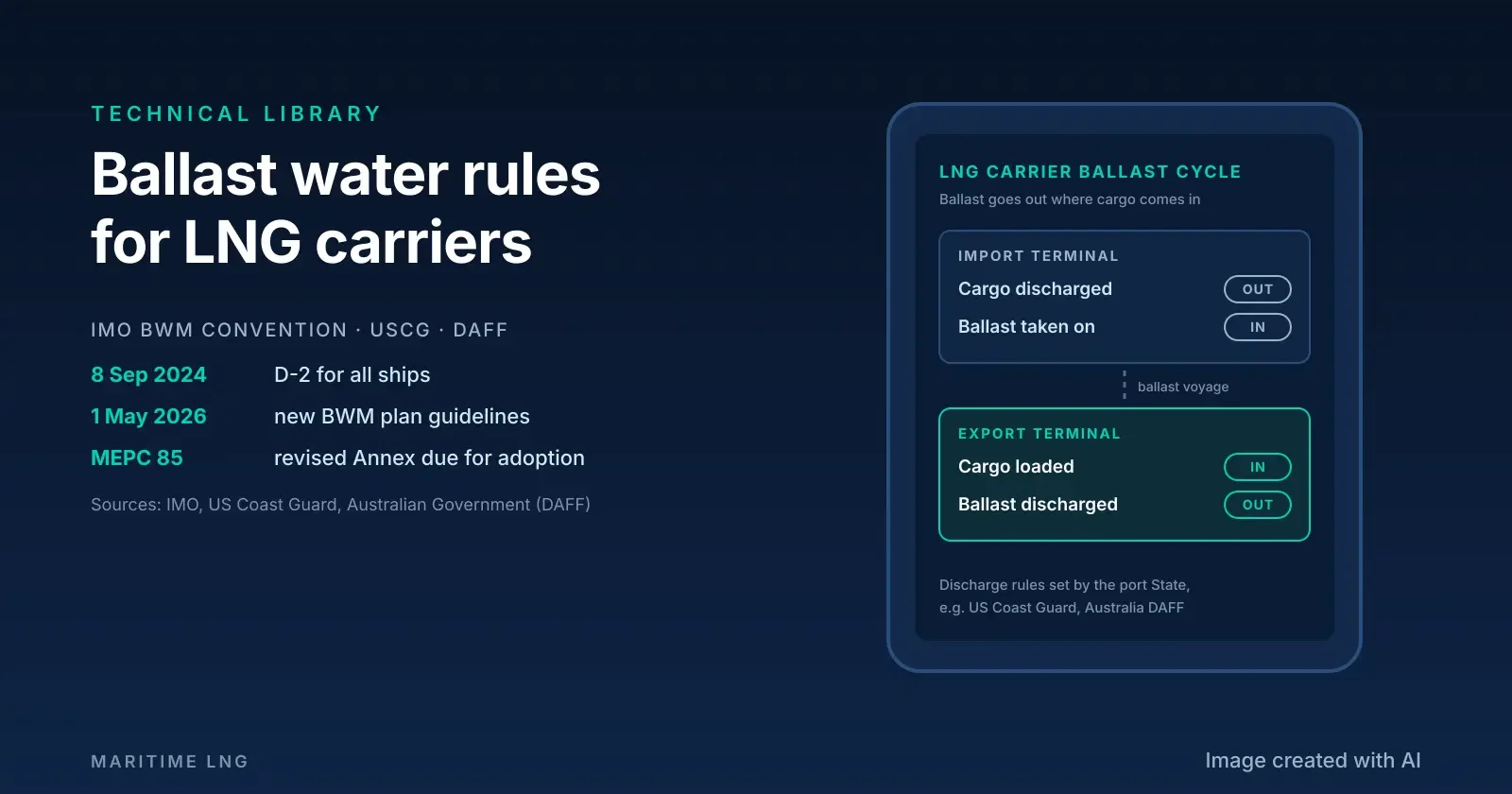
Ballast Water Management for LNG Carriers: D-2, Port Rules and the 2026 IMO Review
IMO BWM Convention, D-2, the 2026 G4 guidelines, 2025 inspection results and US and Australian ballast water rules for LNG carriers at export terminals.
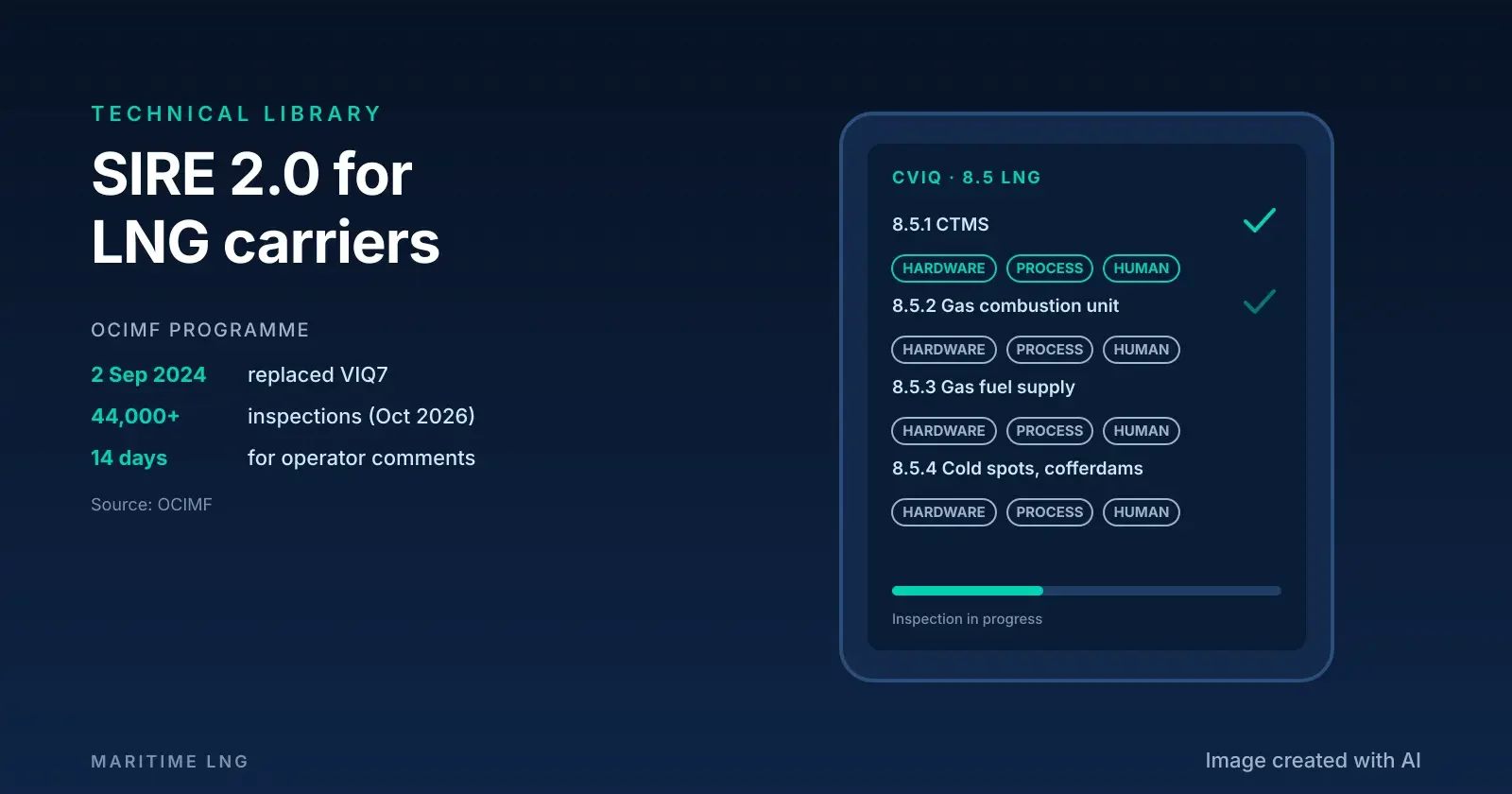
SIRE 2.0 for LNG Carriers: How the OCIMF Inspection Regime Works
How OCIMF's SIRE 2.0 works for LNG carriers: HVPQ, PIQ, the CVIQ, core and rotational questions, LNG-specific questions and report timelines.
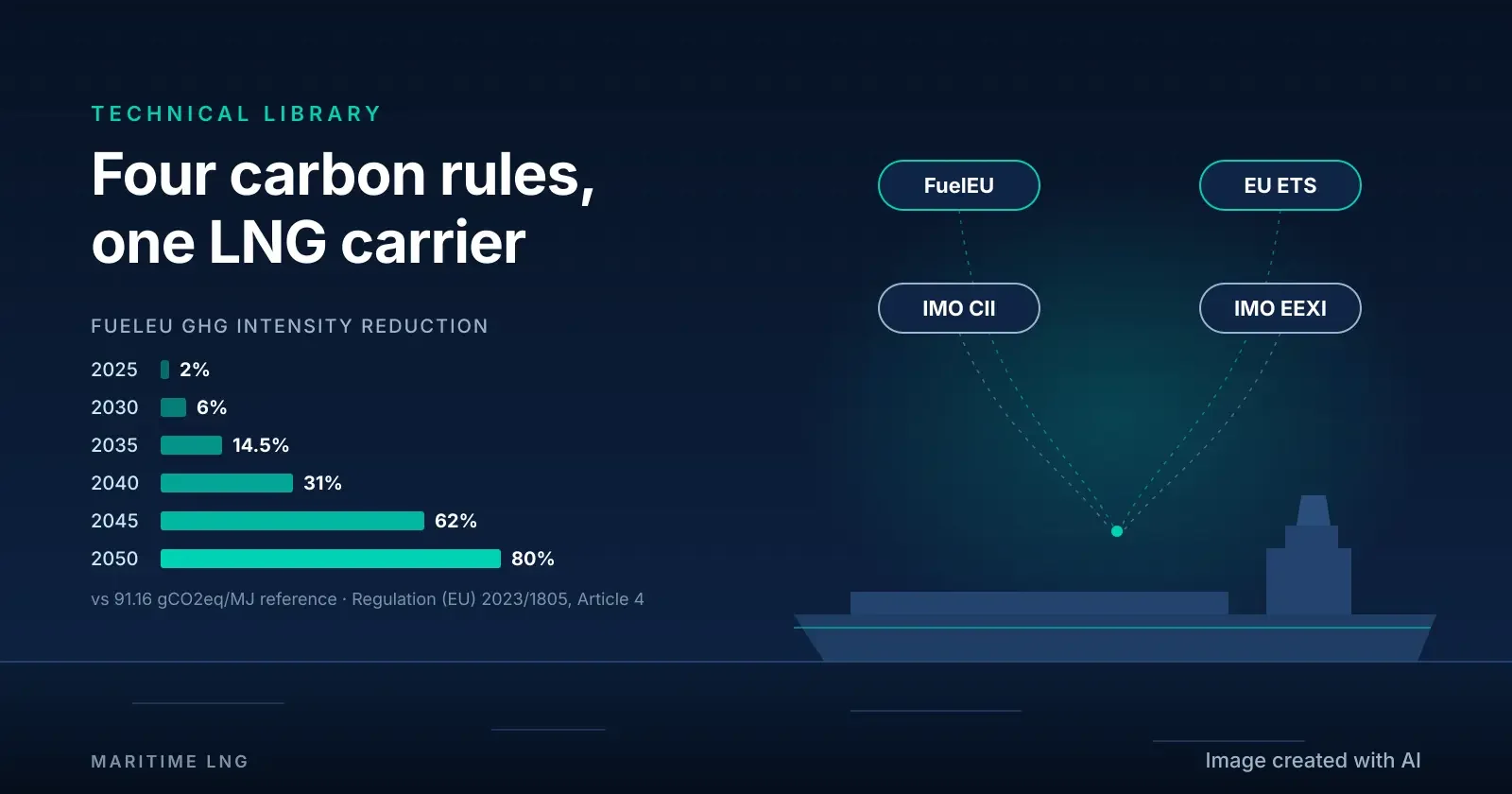
FuelEU Maritime, EU ETS, CII and EEXI: What They Mean for LNG Carriers
How FuelEU Maritime, the EU ETS, IMO CII and EEXI apply to LNG carriers: targets, LNG-specific rules, penalties, ratings and what changes next.