Gas Carrier Accidents in Official Investigation Reports: Data and Lessons
How marine casualties are investigated and published, what EMSA's 2016–2025 statistics show, and what four official reports involving LNG and LPG carriers found about navigation, mooring and chemicals.
Official information on accidents involving LNG carriers and other gas carriers comes from two kinds of source. The first is statistics compiled by EMSA and IMO from national reports. The second is the individual reports of national investigation bodies and flag administrations. Neither gives a complete count of gas carrier accidents, but the reports show where the risks lie in practice.
This guide explains how marine casualties are investigated and published, what the latest EU statistics show, and what four recent official reports involving gas carriers found.
Data checked on 26 November 2026. EU statistics cover ships flagged in EU Member States and accidents in their waters, as reported to EMSA.
How marine casualties are investigated
- IMO Casualty Investigation Code: adopted by resolution MSC.255(84) and mandatory under SOLAS regulation XI-1/6 since 1 January 2010. It requires a marine safety investigation into every very serious marine casualty, such as the total loss of a ship or a death. The final report must be sent to IMO and made public.
- Purpose: safety investigations aim to prevent future accidents. They do not apportion blame or liability, and some bodies, such as Germany's BSU, state that their reports should not be used in court proceedings.
- IMO database: investigation reports are published in the Marine Casualties and Incidents module of IMO's GISIS platform, which anyone can access with a free public account.
- EU database: under Directive 2009/18/EC, Member States have had to report marine casualties and investigation data to the European Marine Casualty Information Platform (EMCIP) since 17 June 2011. EMSA publishes an annual overview based on this data.
What the EU statistics show
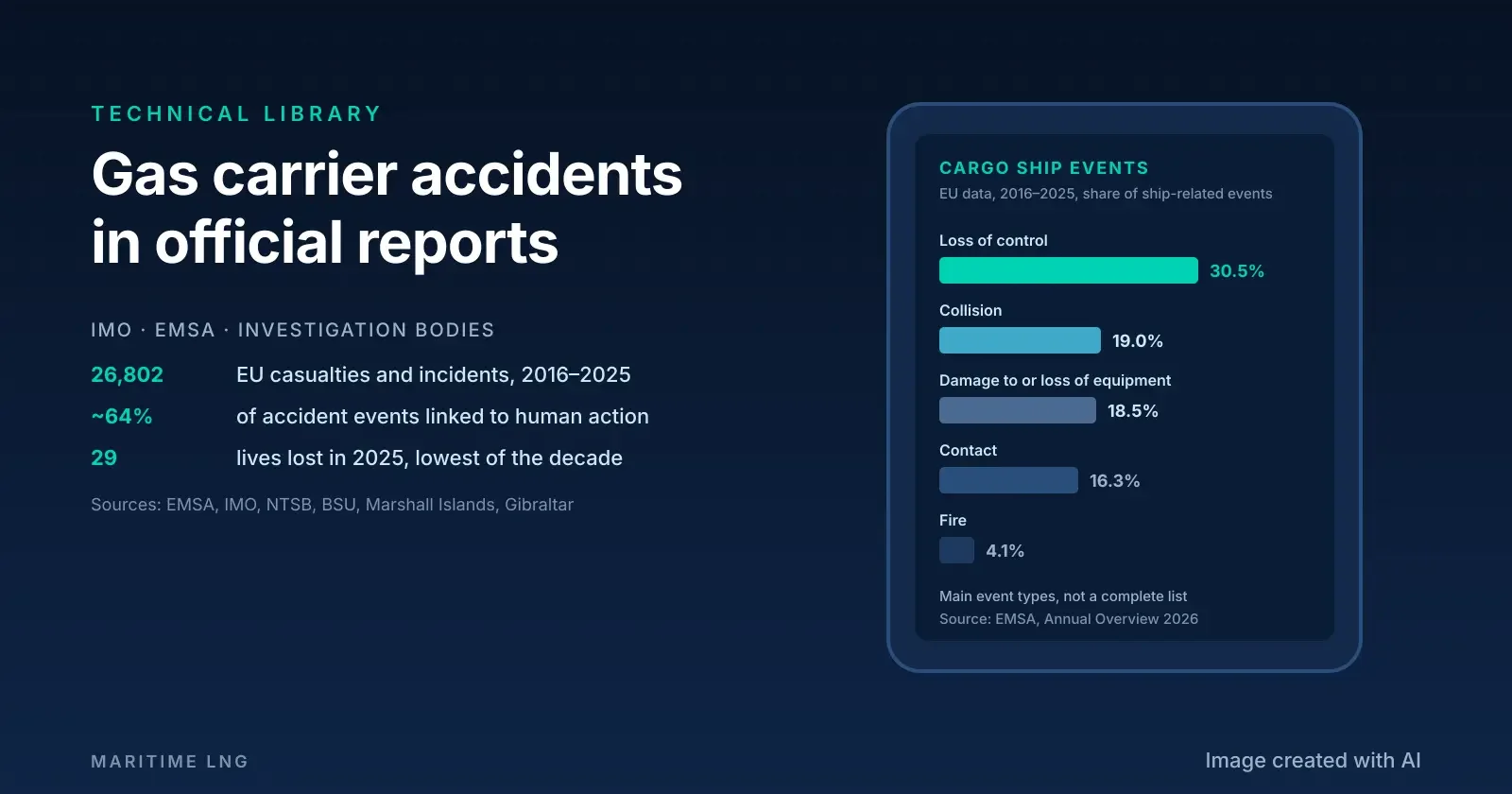
EMSA's Annual Overview of Marine Casualties and Incidents 2026 covers 2016 to 2025:
- Ten-year totals: 26,802 marine casualties and incidents, 692 very serious casualties, 556 lives lost, 7,560 people injured and 188 ships lost.
- 2025: 2,630 occurrences, 52 very serious casualties, 29 lives lost, the lowest annual figure of the period, 813 people injured and 16 ships lost.
- Liquid cargo ships: this ship group accounted for about 10% of occurrences. EMSA does not publish separate figures for gas carriers, and the published report does not list which ship types the group includes.
For cargo ships, EMSA reports these main types of event over the ten years:
- Loss of control: 30.5% of events, including loss of propulsion power at 20.5%.
- Collisions: 19.0%.
- Damage to or loss of equipment: 18.5%.
- Contact with other objects: 16.3%.
- Fire: 4.1%.
In 914 completed investigations, human action accounted for about 64% of the classified accident events and system or equipment failure for about 23%. Investigation bodies in the EU carried out 1,099 investigations over the period and issued 1,316 safety recommendations.
Four official reports involving gas carriers
Collision in the Houston Ship Channel, 2019 (NTSB)
On 10 May 2019, the 754-foot liquefied gas carrier Genesis River, outbound on the Houston Ship Channel, collided with a tank barge pushed by the towing vessel Voyager.
- Probable cause: the US National Transportation Safety Board found that the pilot's decision to transit at sea speed, out of manoeuvring mode, increased the hydrodynamic effects of the channel banks. After meeting another deep-draft vessel, this reduced his ability to keep control, and the ship sheered across the channel towards the tow.
- Consequences: over 11,000 barrels of reformate, a gasoline blending stock, spilled from the barge into the waterway. No injuries were reported. NOAA reported that the gas carrier, which was carrying butane and propane, took on water but did not spill any fuel or cargo.
- Report: NTSB Marine Accident Report MAR-21/01, adopted on 10 March 2021.
Bulk carrier OS 35 and LNG carrier ADAM LNG, Gibraltar, 2022
On 29 August 2022, the 20,947 GT bulk carrier OS 35 collided with the LNG carrier ADAM LNG while departing the Bay of Gibraltar anchorage.
- Consequences: holds 2 and 3 of OS 35 were breached, and the bulk carrier was deliberately run aground east of Gibraltar and later dismantled. There was no loss of life.
- Lesson: announcing the report on 4 February 2025, the Government of Gibraltar said the accident showed the need for the master and bridge team to monitor the effects of the ship's movements effectively.
Mooring fatality on the LNG carrier YENISEI RIVER, Pyeongtaek, 2024 (Marshall Islands)
On 2 May 2024, the 155,000 m³ LNG carrier YENISEI RIVER was berthing at the LNG terminal in Pyeongtaek, Republic of Korea.
- What happened: a mooring winch was not paying out properly, and the ship was moved ahead and astern while the lines were adjusted. An able seafarer went to a fairlead to adjust chafing sleeves before the ship was in its final position, out of sight of the supervising officer. When the ship moved ahead, he was caught between the fairlead roller and the mooring line, pulled through the fairlead into the water, and died.
- Findings: the report found ineffective communication between the bridge, the supervising officers and the mooring crew. The adjustment of chafing sleeves had not been covered in the risk assessment or the toolbox talk, and the mooring crew was not kept in visual contact with the supervisor. After the accident, the winch's brake band supporting arrangement was found to be loose.
- Recommendations: the company should cover the positioning of chafing sleeves in its mooring risk assessment, and include warnings about ship movements in its mooring communication procedures.
- Report: published by the Republic of the Marshall Islands Maritime Administrator on 17 December 2025.
Chemical accident on the LNG tanker CORALIUS, Travemünde, 2024 (BSU)
On 5 August 2024, the small LNG tanker CORALIUS (5,921 GT) was alongside a ro-ro ship in the port of Travemünde, Germany.
- What happened: a motorman refilling the dosing tank of the sewage treatment plant used sodium bisulphite instead of sodium hypochlorite by mistake. The two chemicals reacted, released toxic gases and burst the plastic tank.
- Consequences: the motorman suffered chemical burns and eye exposure and was taken to hospital, where a full recovery was expected. Other crew members felt unwell after inhaling the gases.
- Findings: the plant had to be filled by hand and was installed close to a wall, which limited access. Neither the crew, the company nor the manufacturer's manual identified the hazard of mixing the two chemicals. The safety data sheets were hard to use, the colour coding was inconspicuous, and the protective equipment did not protect against the splash.
- Report: BSU Investigation Report 385/24, published on 13 August 2026, with safety recommendations addressed to the plant manufacturer and to the bodies that prepare the International Chemical Safety Cards.
What the four reports have in common
- The cargo was not the cause. In none of the four cases did the gas carrier's cargo or cargo system cause the accident.
- Ship handling in confined waters: two of the cases were collisions in a ship channel and an anchorage, where speed and the monitoring of a ship's movements were central.
- Routine work on board: the other two occurred during mooring and while handling ship's chemicals, both everyday tasks.
- People and procedures: each report centres on human decisions and procedures, from the choice of speed and the monitoring of manoeuvres to mooring communication, supervision and the handling of chemicals. This is consistent with the large share of human action in EMSA's data.
Four reports are not a statistical sample, but they show the type of lessons that official investigations draw.
Where to find the reports
- IMO GISIS: the Marine Casualties and Incidents module, with a free public account.
- EMSA: the annual overview of marine casualties and incidents, published each autumn.
- National investigation bodies: for example the NTSB in the United States, the MAIB in the United Kingdom, the BSU in Germany and the Swedish Accident Investigation Authority, which also hosts the CORALIUS report.
- Flag administrations: some flag States publish their own reports, such as the Republic of the Marshall Islands and Gibraltar.
Our guides to port State control and SIRE 2.0 explain how inspections check many of the same issues.
What it means for gas carrier operators
- There is no published official statistic for gas carrier accidents. EMSA's annual overview does not show gas carriers separately, so individual reports are the main official source of detailed lessons.
- Mooring risk assessments should cover every step. The YENISEI RIVER report shows the danger of tasks done before the ship is in its final position, and the need to tell mooring stations about ship movements.
- Speed and monitoring matter in confined waters. The Houston and Gibraltar cases both involved ship handling close to other ships.
- Ship's chemicals need the same care as cargo. The CORALIUS report shows how an incompatible mix of everyday chemicals can injure crew.
- Reports are for learning, not blame. Their purpose is prevention, which makes them useful material for safety meetings and training on board.
This guide was prepared with AI assistance from the official sources listed above and reviewed by the Maritime LNG Editorial Desk.
Spotted an error or an outdated figure? Report an error · Corrections policy
Related guides
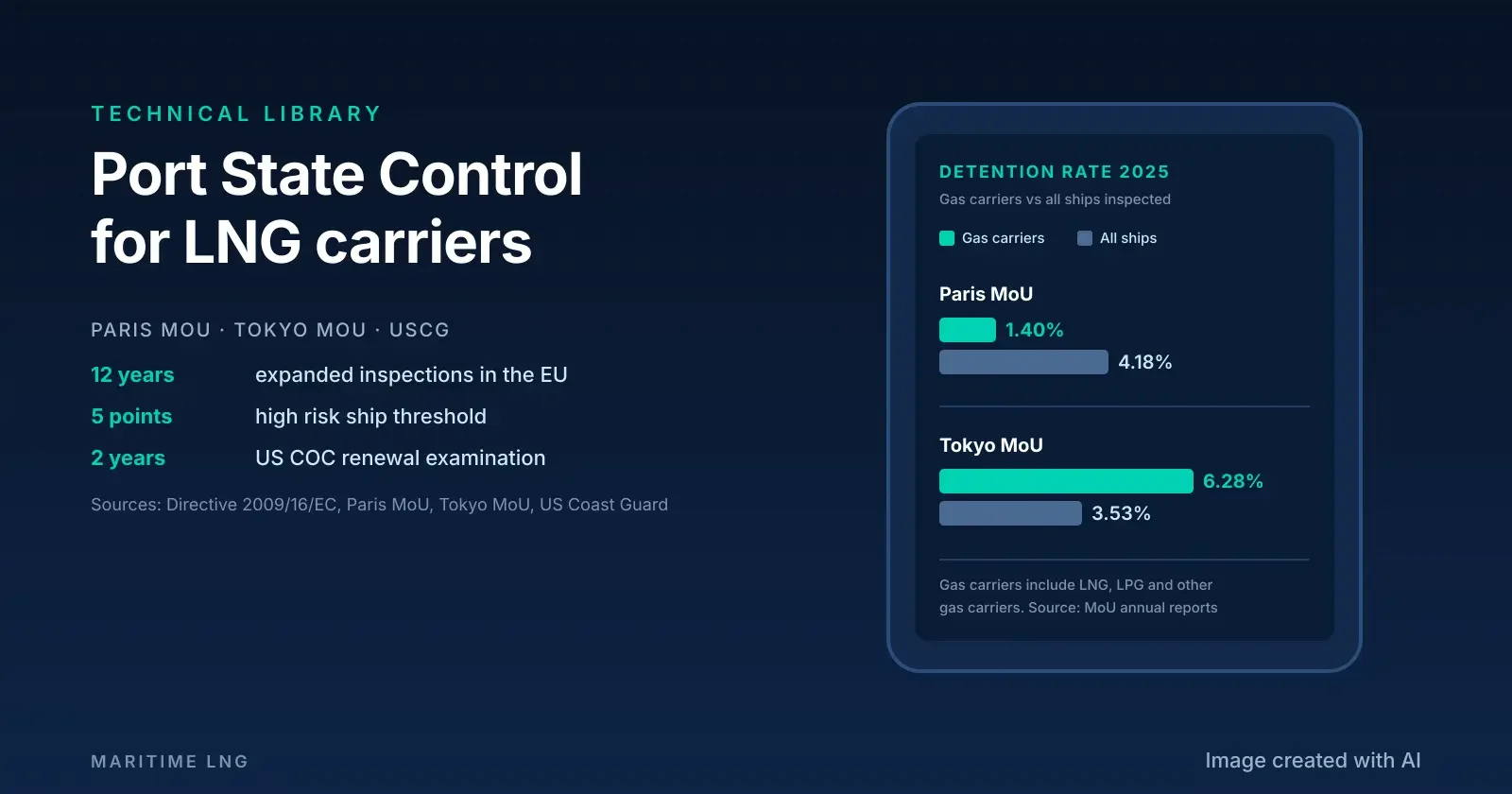
Port State Control for LNG Carriers: Targeting, Inspections and 2025 Detention Data
How LNG and gas carriers are targeted and inspected by the Paris MoU, Tokyo MoU and US Coast Guard, with 2025 detention rates and new COC rules.
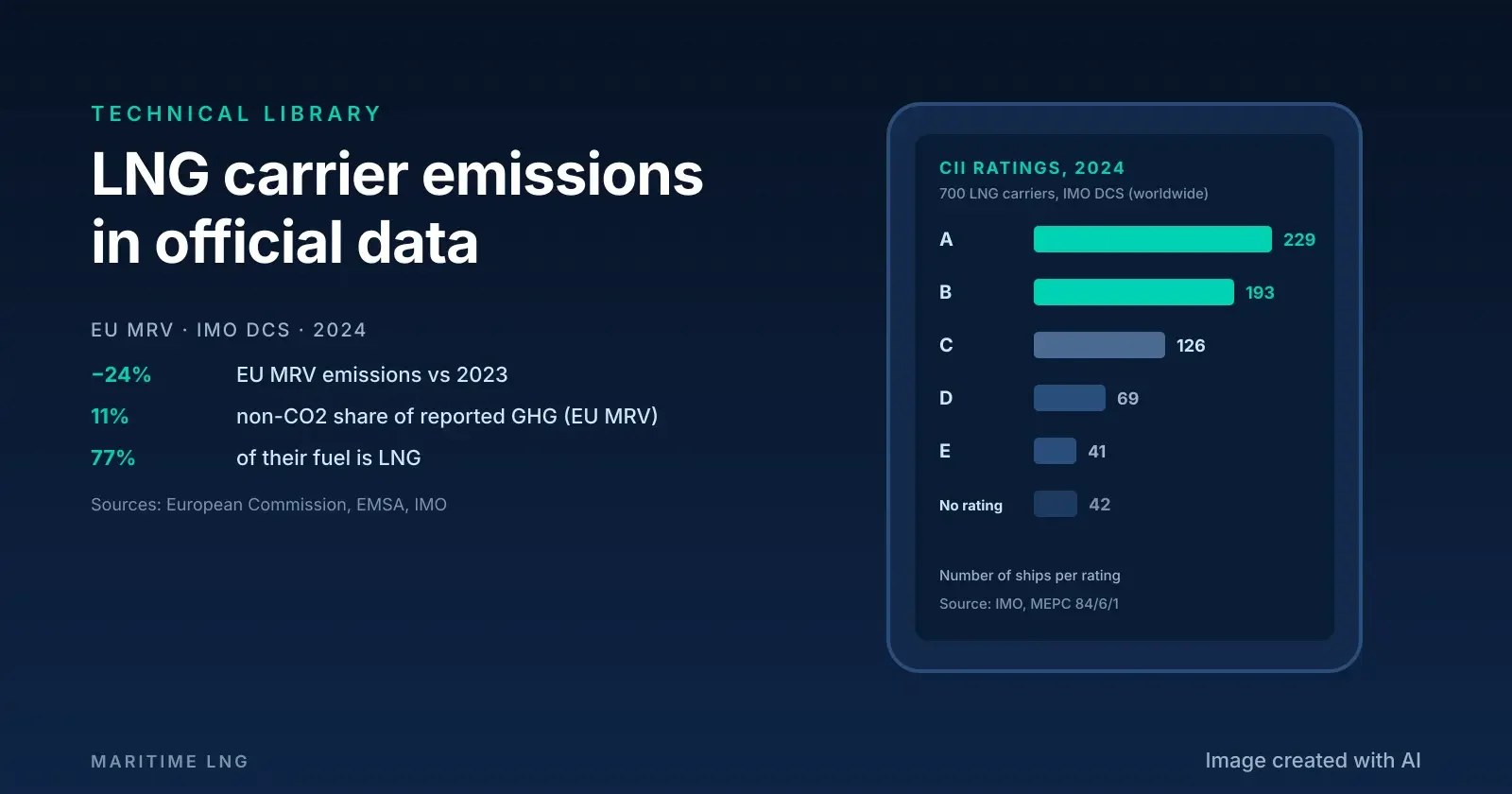
LNG Carrier Emissions in Official Data: What EU MRV and IMO DCS Show
Official 2024 data on LNG carrier emissions: EU MRV CO2 and methane figures, IMO DCS fuel use and CII ratings, and where to find ship-level data.
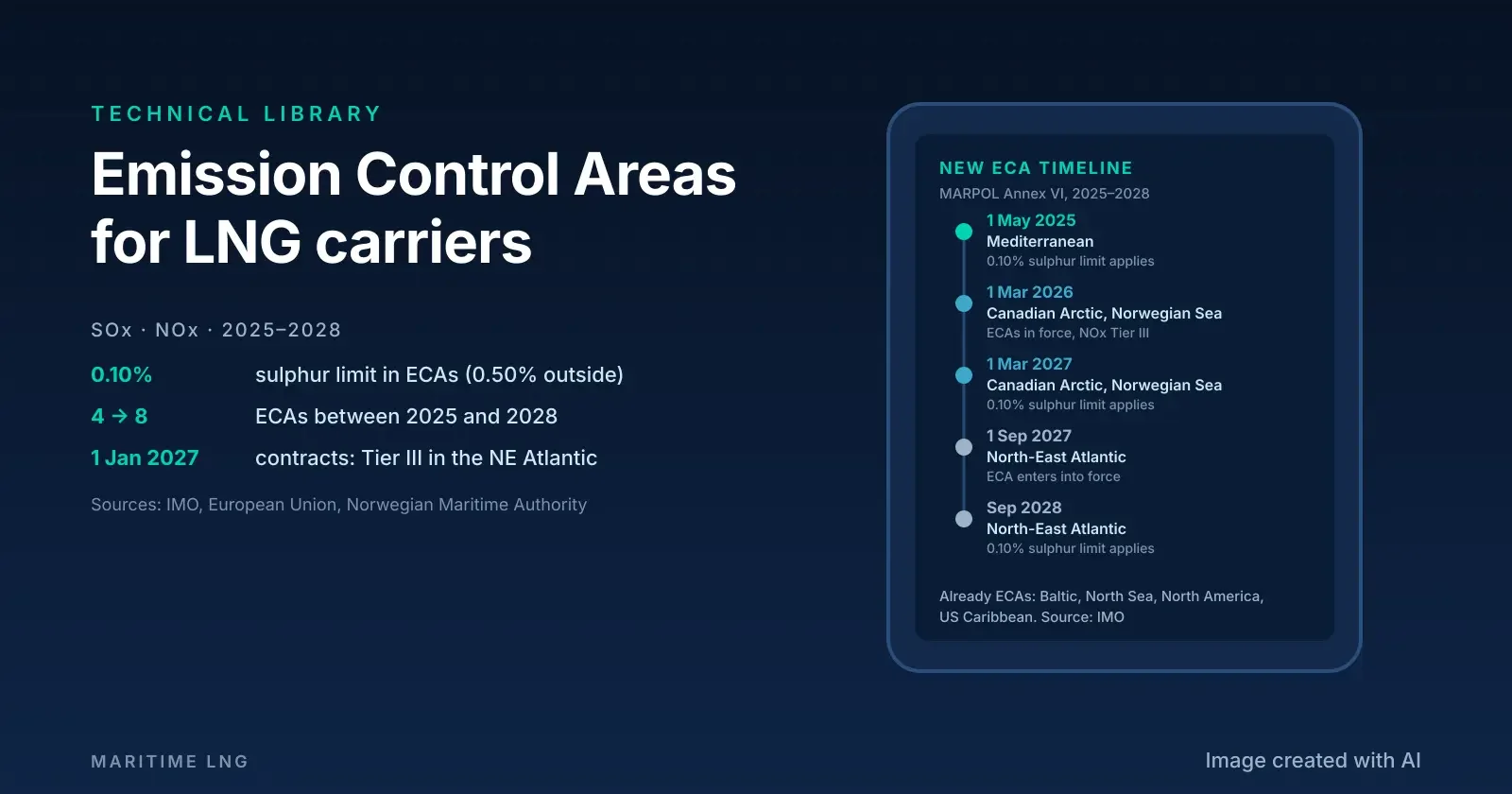
Emission Control Areas 2025–2028: What the New ECAs Mean for LNG Carriers
Official guide to the new ECAs: Mediterranean, Canadian Arctic, Norwegian Sea and North-East Atlantic dates, sulphur and NOx Tier III rules for LNG carriers.