IGU: India Has a Window to Scale LNG Trucking Before the Global Supply Wave
A new IGU policy brief says India's LNG trucking market has moved beyond pilots, with more than 1,300 trucks and over 30 stations, but still lacks a national framework. It urges action before new global LNG supply arrives later this decade.
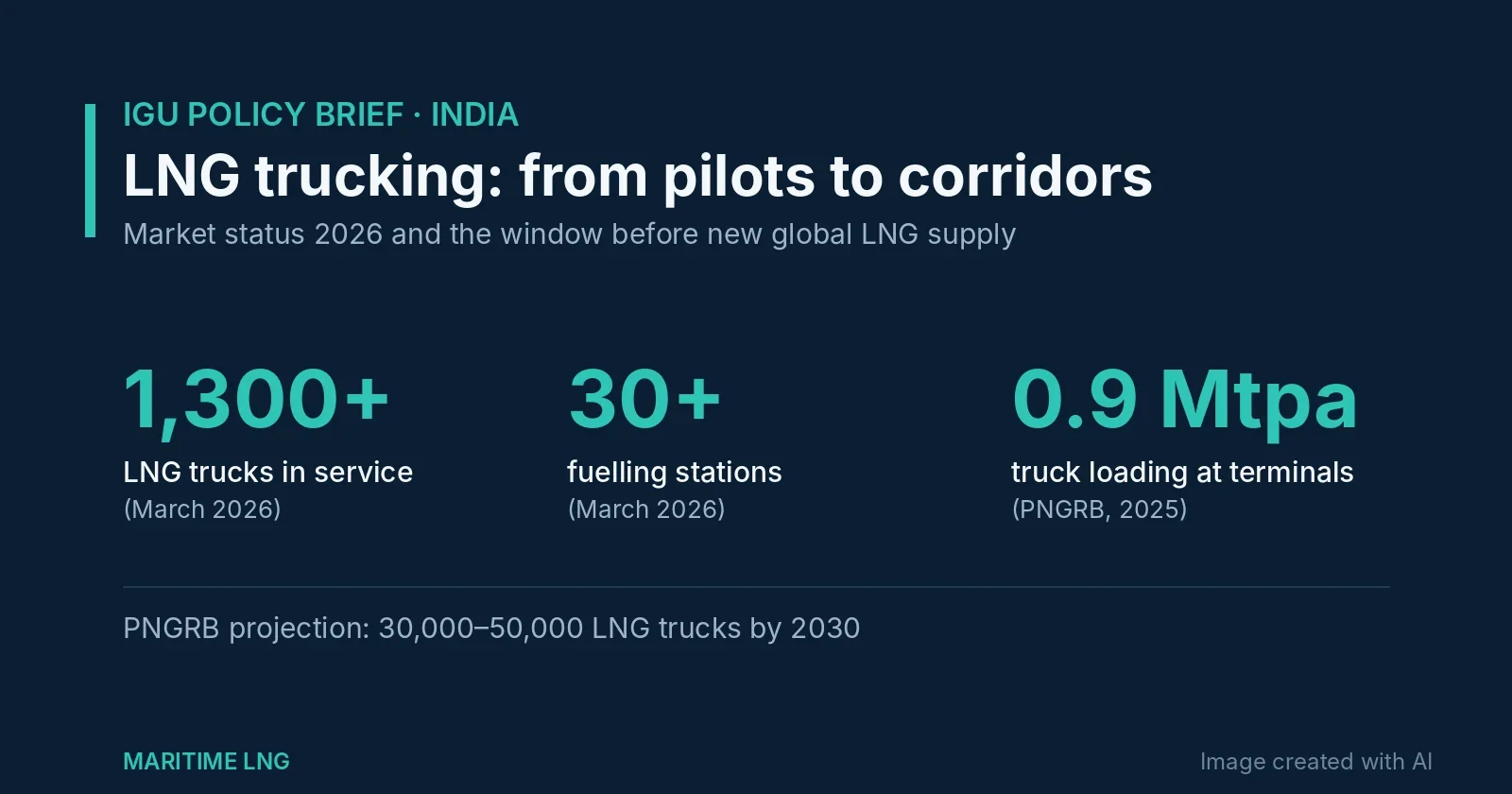
India's LNG trucking market has moved beyond isolated pilots, but it still lacks the national framework, financing and fuel-price stability it needs to scale. That is the conclusion of a new policy brief from the International Gas Union (IGU), From pilots to corridors: The opportunity to scale LNG trucking in India, published in November 2026.
The brief argues that the timing matters. A wave of new global LNG supply is due later this decade, and India will only benefit in road freight if trucks, stations and supply contracts are in place before it arrives.
Where the market stands
- Trucks and stations: in March 2026, the Indian government reported more than 1,300 LNG trucks in service and more than 30 LNG fuelling stations along the Golden Quadrilateral, which links India's four largest cities, and other national highways. An industry assessment cited in the brief counted 39 LNG retail outlets.
- Growth from a low base: LNG truck numbers rose by about 75% in 2025, from 747 to around 1,309. The brief notes that this is still well below official expectations.
- Policy still in draft: the 2021 draft LNG Policy and the 2024 draft Scheme for Promotion of LNG Based Mobility have not been implemented. The 2021 draft envisaged 1,000 LNG stations; the 2024 draft proposed allocating 0.5 million cubic metres per day of domestic gas, enough for around 50,000 trucks.
- Private investment: Ultra Gas & Energy committed INR 9 billion (about US$95 million) in September 2025 to 100 LNG outlets on high-density corridors. Ten were operational by August 2026.
- Official projections: India's Petroleum and Natural Gas Regulatory Board (PNGRB) projects 30,000 to 50,000 LNG trucks by 2030 and 200,000 to 500,000 by 2040, depending on the growth scenario.
The economics and the caveats
The brief cites NITI Aayog's 2024 analysis, which found a slightly lower 10-year total cost of ownership for an LNG heavy truck than for diesel: INR 34.88/km against INR 35.61/km. The margin is narrow and depends on the fuel price. NITI Aayog estimates that delivered LNG must be 20–30% cheaper than diesel for the business to work, and fleet operators typically want to recover the extra cost of the truck in about three years.
On emissions, PNGRB figures quoted in the brief show LNG trucks emitting up to 91% less particulate matter, 59% less nitrogen oxides and up to 28% less CO2 than comparable diesel trucks. The IGU also notes that upstream methane leakage and methane slip can erode the climate benefit, which makes methane-intensity standards for LNG supply and low-slip engines central to the case.
Why the timing matters
The brief links the case for LNG trucking to the 2026 disruption around the Strait of Hormuz. Asian spot LNG prices reached about US$30.4/MMBtu in October 2026, the highest in four years, and India's gas demand fell. Even so, LNG imports covered 51.7% of India's gas consumption between April and July 2026.
Looking ahead, the IGU cites IEA estimates that around 330 bcm per year of new LNG export capacity, from projects already past final investment decision, is scheduled to come online between 2025 and 2030, with annual additions peaking at about 90 bcm in 2028. In the brief's view, this could move the market from the tight conditions of 2026 towards greater supply, which would improve the economics of LNG trucking.
Five recommendations
- One framework: merge the 2021 draft policy and the 2024 draft scheme into a single, time-bound plan with clear approvals, and create a national LNG mobility dashboard with station locations, availability and prices.
- Bankable stations: give station developers demand visibility, faster approvals and access to highway sites.
- Lower fleet risk: use credit guarantees, longer loans and leasing, supported by lower GST and VAT. NITI Aayog has proposed 5% GST on an initial 5,000 LNG trucks and 5% VAT on automotive LNG.
- A temporary price bridge: use the government's proposed three-to-five-year allocation of domestic gas to LNG retailers as a transition measure, alongside diversified sourcing, storage and longer-term contracts.
- Anchor fleets: build station throughput through public procurement and early adopters in mining and industrial logistics on priority corridors.
What it means for LNG terminals and shipping
For the maritime side of the chain, the most relevant figures concern India's import terminals:
- Regasification capacity: India has 57.7 Mtpa of operational regasification capacity across eight terminals, following the Dahej expansion in March 2026.
- Truck loading is the bottleneck: PNGRB reported in 2025 that cumulative LNG truck-loading capacity at Indian terminals was about 0.9 Mtpa. Eight additional loading bays under construction would raise it to around 1.3 Mtpa.
- Terminal data: Petronet's Dahej terminal recorded a high of 1,251 truck fillings in January 2026, and its Kochi terminal recorded 3,236 fillings in FY2025-26, up 17.3% year on year. Petronet expects LNG transportation demand to reach 8–10 Mtpa within six to eight years.
- Underused terminals: the brief notes that higher gas demand would improve the economics of India's underutilised LNG terminals, and highlights Tamil Nadu and Kerala, which already host import terminals, as places to strengthen refuelling networks.
As an indicative estimate by Maritime LNG, PNGRB's projected 2030 truck demand of 3.9–6.5 million cubic metres of gas per day corresponds to roughly 1.0–1.7 Mtpa of LNG, or about 14 to 23 cargoes a year on a standard 174,000 m³ carrier. Petronet's 8–10 Mtpa outlook for LNG transportation would correspond to roughly 105 to 135 cargoes a year. These conversions assume about 1,360 cubic metres of gas per tonne of LNG and about 75,000 tonnes per cargo.
The other side of the debate
The IGU itself frames LNG as one option among several. Its comparison places CNG in urban and regional transport, LNG in high-utilisation long-haul freight, and battery-electric trucks on predictable routes where charging or battery swapping can be planned. Critics go further. The Institute for Energy Economics and Financial Analysis (IEEFA) argued in 2025 that volatile LNG prices can wipe out the narrow cost advantage, and that LNG station investment risks becoming stranded under India's goal of 100% zero-emission trucks by 2050.
Note on sources: all figures are taken from the IGU policy brief "From pilots to corridors: The opportunity to scale LNG trucking in India" (2026) and the official sources it cites, unless marked as a Maritime LNG estimate. The IEEFA view is from its April 2025 brief.
Related news
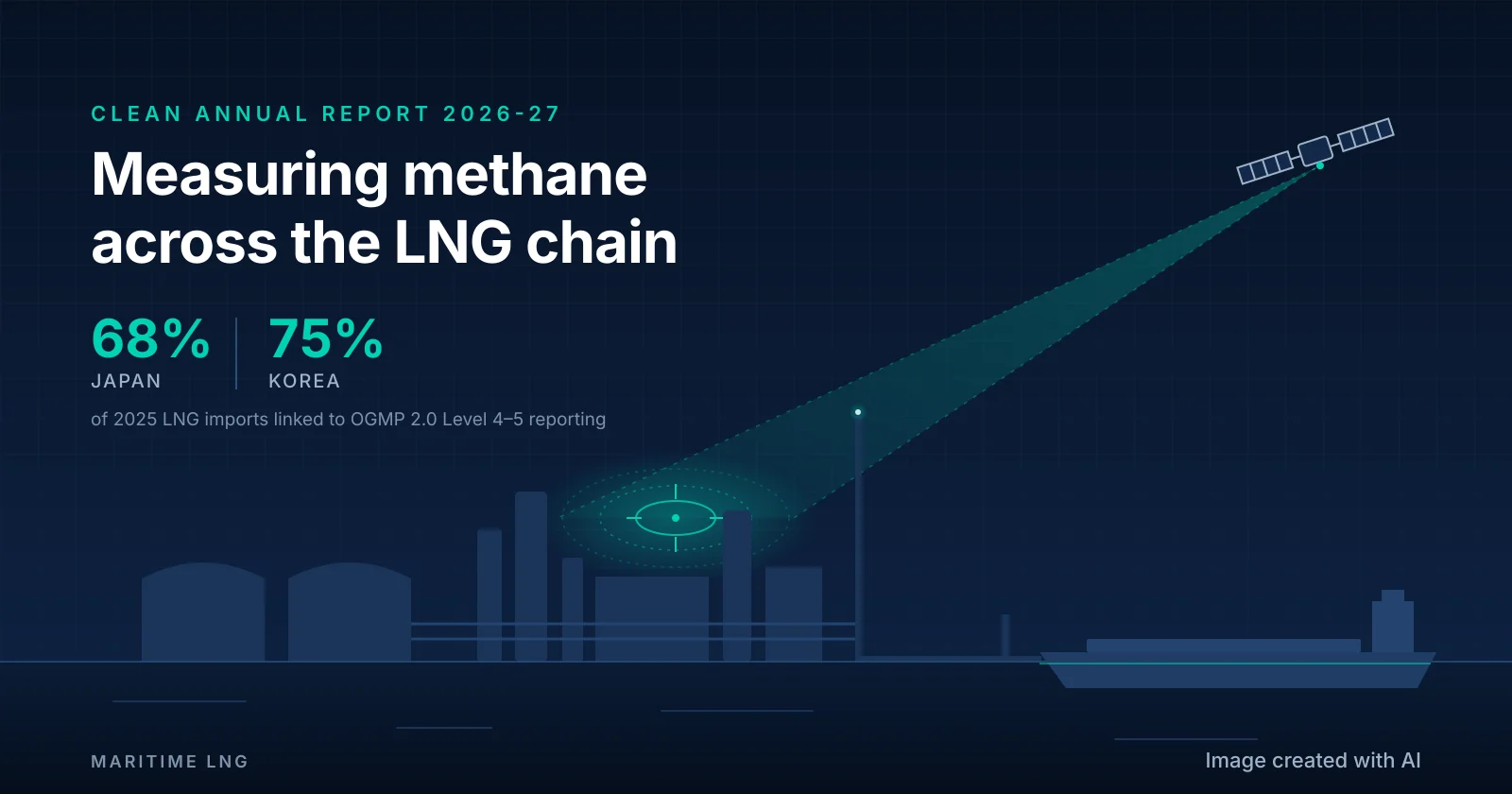
CLEAN Report 2026-27: 68% of Japan's and 75% of Korea's LNG Now Under Top-Tier Methane Reporting
CLEAN Annual Report 2026-27: OGMP 2.0 Level 4–5 reporting at 68% of Japan's and 75% of Korea's LNG imports, methane intensity 0.088%, 8 best practices.
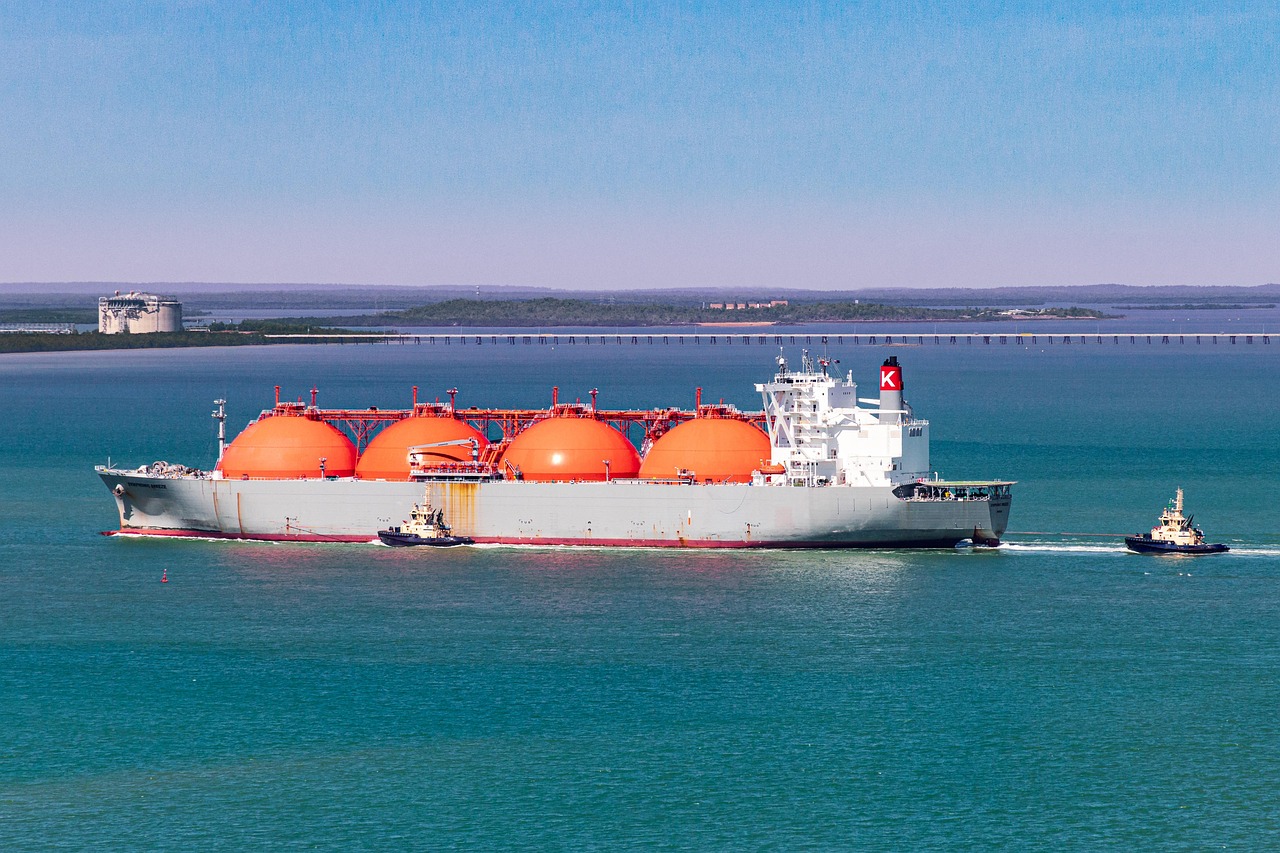
Fluxys Offers Regasification and Truck Loading Slots at Zeebrugge Terminal
Belgian operator Fluxys offers new regasification and LNG truck loading slots at the Zeebrugge import terminal in Europe.
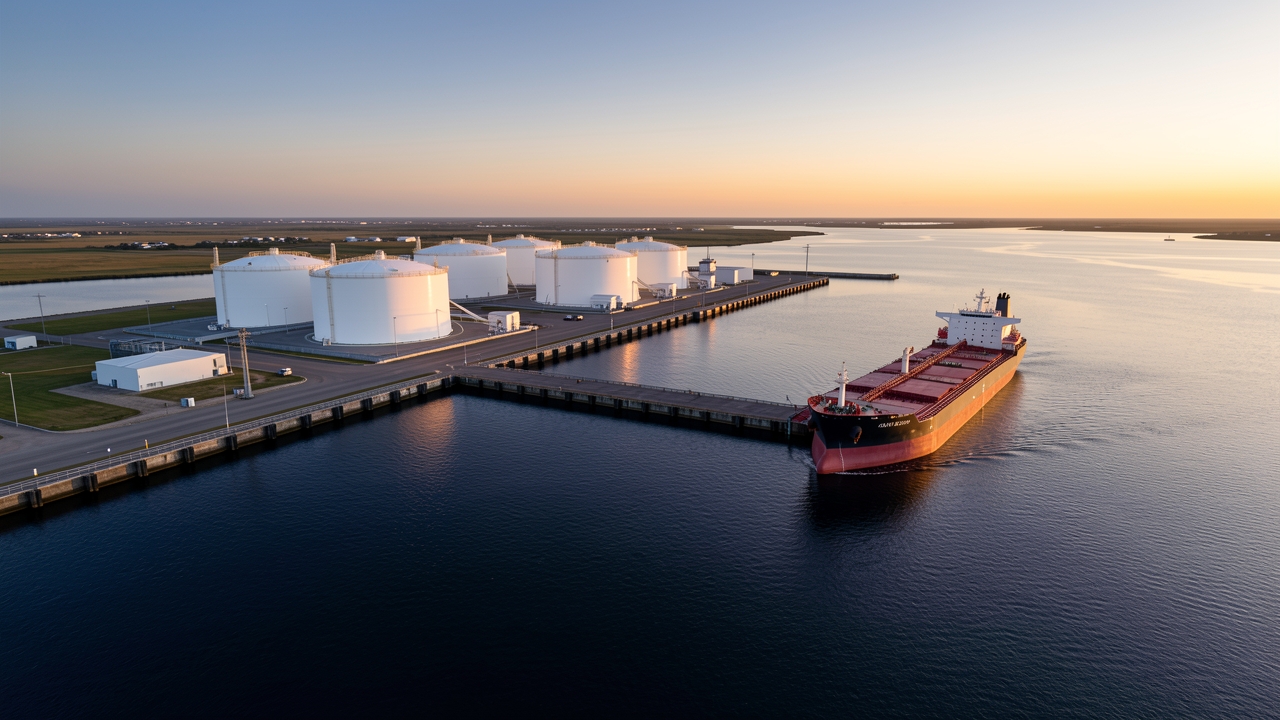
Germany Completes Federal Floating LNG Terminal Program with Stade Commissioning
Deutsche Energy Terminal commissions its fourth floating LNG terminal in Stade using the FSRU Energos Force, completing Germany's federal energy security program.