LNG Bunkering Operations: Ship-to-Ship Transfer, Equipment and Safety
How LNG fuel is delivered to gas-fuelled ships, the equipment involved and the safety framework that governs each transfer.
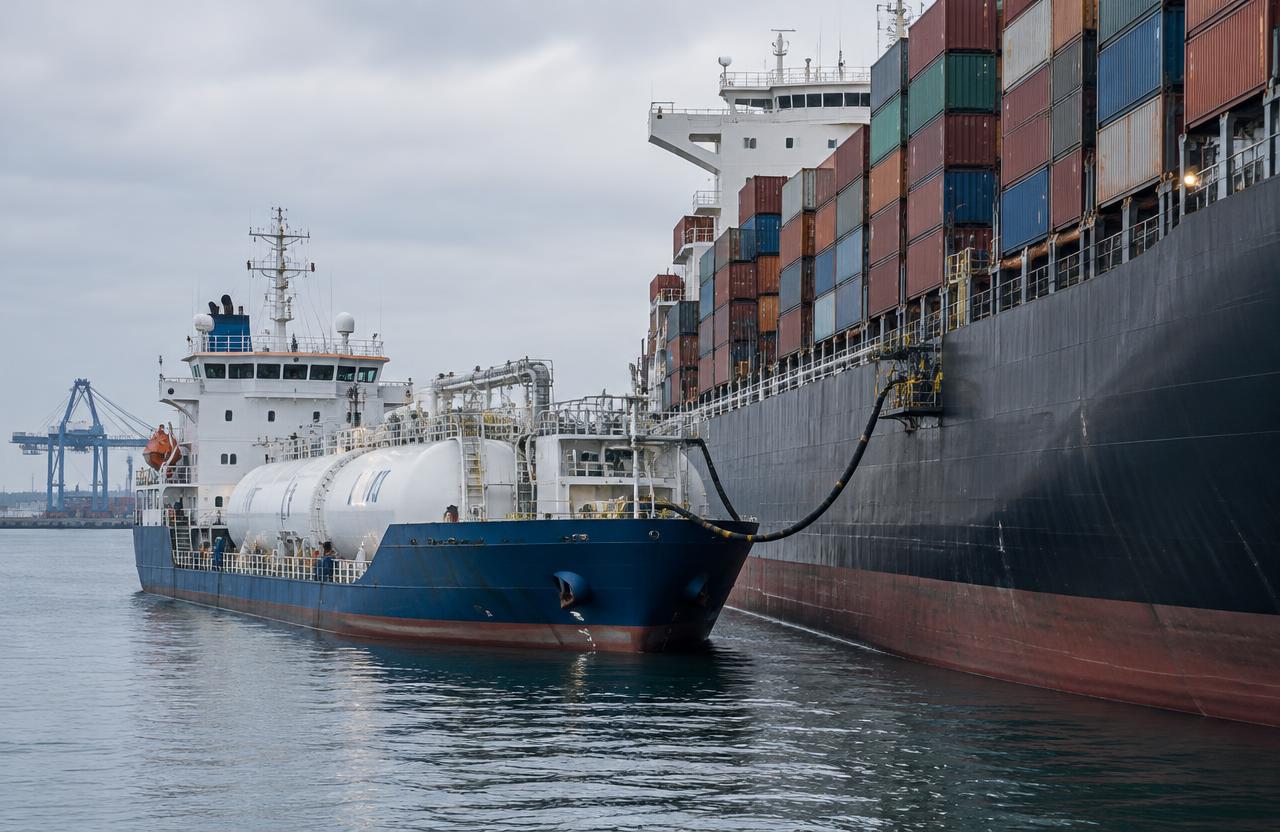
LNG bunkering is the transfer of liquefied natural gas as fuel to a ship. It differs from conventional bunkering in almost every respect: the fuel is cryogenic, it generates vapour, and the receiving ship’s fuel tanks and systems are designed to the IMO IGF Code rather than to the rules for oil fuels. As more gas-fuelled ships enter service, bunkering has moved from a niche activity in a handful of ports to an established operation in many major bunkering hubs.
This guide describes the main bunkering methods, equipment and safety principles. It draws on publicly available descriptions of the international framework, including ISO 20519 and guidance from the Society for Gas as a Marine Fuel (SGMF). Port-specific rules always take precedence and vary considerably.
Bunkering methods
Truck-to-ship (TTS). LNG is delivered from road tankers on the quay through flexible hoses. TTS requires little infrastructure and suits smaller volumes, such as ferries and harbour craft, but transfer rates are limited and multiple trucks may be needed.
Terminal- or pipe-to-ship (PTS). The ship bunkers directly from a shore tank or terminal through fixed piping and hoses or arms. It allows larger volumes but requires the ship to come to a specific berth.
Ship-to-ship (STS). A dedicated LNG bunker vessel comes alongside the receiving ship, often while it is working cargo at berth or at anchor. STS offers flexibility and high transfer rates and has become the main method for large ships such as container ships, car carriers and cruise ships.
Portable tanks. In some trades, ISO-type LNG tank containers are loaded on board and connected as fuel tanks. This is uncommon for large ships.
Key equipment
Transfer is made through cryogenic hoses or loading arms supported by cranes or hose-handling systems on the bunker vessel. Typical equipment includes:
Dry-disconnect couplings, which allow connection and disconnection with minimal release of liquid or vapour.
Emergency release couplings (ERC) or breakaway couplings, which separate safely if the ships move beyond the safe working envelope, closing valves on both sides.
A ship–ship emergency shutdown (ESD) link, which allows either party to stop the transfer and close valves in a controlled sequence.
A vapour return line, where needed, to manage displaced vapour from the receiving tank, and arrangements for pressure management on both vessels.
Insulating flanges or other means to manage electrical continuity and prevent sparks between ships, plus gas detection, water curtains to protect hull steel from cryogenic spills, and drip trays.
Mass flow meters or other custody-transfer measurement, so that the quantity delivered can be documented accurately.
Compatibility and planning
Before a first bunkering between a supplier and a receiving ship, the parties assess compatibility: mooring and fendering, manifold location, hose size and reach, coupling types, ESD link compatibility, communication, transfer rates, tank pressure and temperature conditions, and the receiving ship’s ability to accept the LNG composition and temperature. Many operators use checklists derived from industry guidance.
Planning also addresses simultaneous operations (SIMOPS), such as cargo handling, passenger embarkation or provisioning during bunkering. Whether SIMOPS are allowed, and under what conditions, is usually determined by port authorities based on risk assessment.
Safety and security zones
LNG bunkering guidance distinguishes a hazardous or safety zone around the transfer point, in which potential sources of ignition are controlled, and a wider monitoring and security zone, in which traffic and activities are managed so that they do not interfere with the operation. The size of these zones is determined by risk assessment and local regulation rather than by a single universal distance. ISO 20519 and SGMF publications describe approaches to defining them.
The bunkering sequence
A typical STS operation follows a sequence: pre-arrival exchange of information and checklist; mooring and fendering; connection of the ESD link and communication; connection of hoses or arms; leak testing and inerting of transfer lines, often with nitrogen; cool-down of lines; start-up at a reduced rate; transfer at agreed rate while monitoring tank pressures, levels and temperatures; topping-off at a reduced rate; draining, purging and inerting of lines; disconnection; and completion of documentation, including the bunker delivery note.
Tank pressure on the receiving ship is a practical constraint. Warm tanks or high-pressure conditions can limit the transfer rate or require vapour return or top-spray filling. In our interpretation, pressure management is the operational area where crew experience makes the greatest difference to bunkering efficiency.
Regulatory and standards framework
The receiving gas-fuelled ship is subject to the IGF Code, made mandatory through SOLAS. The LNG bunker vessel, as a ship carrying liquefied gas in bulk, is subject to the IGC Code. ISO 20519:2021 specifies requirements for LNG bunkering transfer systems and equipment not covered by the IGC Code, including hardware, operational procedures, the requirement for a bunker delivery note, personnel training and qualifications, and facility requirements. Port authorities add local requirements, including permits, operational limits and approval of bunker suppliers.
Crew on ships subject to the IGF Code must meet STCW training requirements for service on such ships. Bunker vessel crews must meet the requirements for liquefied gas tankers.
Frequently asked questions
Can LNG bunkering take place during cargo operations?
In many ports, yes, subject to a risk assessment and port approval of simultaneous operations. Conditions differ by port and by ship type.
What is a bunker delivery note for LNG?
It is the document by which the supplier records the quantity and properties of LNG delivered. ISO 20519 includes a requirement for the LNG provider to supply one.
Why are transfer lines purged with nitrogen?
Purging removes air before transfer, preventing a flammable mixture, and removes natural gas after transfer so that lines can be disconnected safely.
Related articles
What makes a port ready for LNG bunkering?
Illustrative look at ship-to-ship, truck-to-ship and terminal-to-ship bunkering. Demonstration content only.
How safety zones are defined during LNG bunkering
Illustrative explainer on hazard zones and simultaneous operations. Demonstration content only.
Design features of LNG bunker vessels
Illustrative look at tank types, transfer systems and manoeuvrability. Demonstration content only.