LNG Terminals Explained: Liquefaction, Storage and Regasification
How natural gas is liquefied for export, stored at cryogenic temperatures and returned to gas at import terminals — onshore and floating.
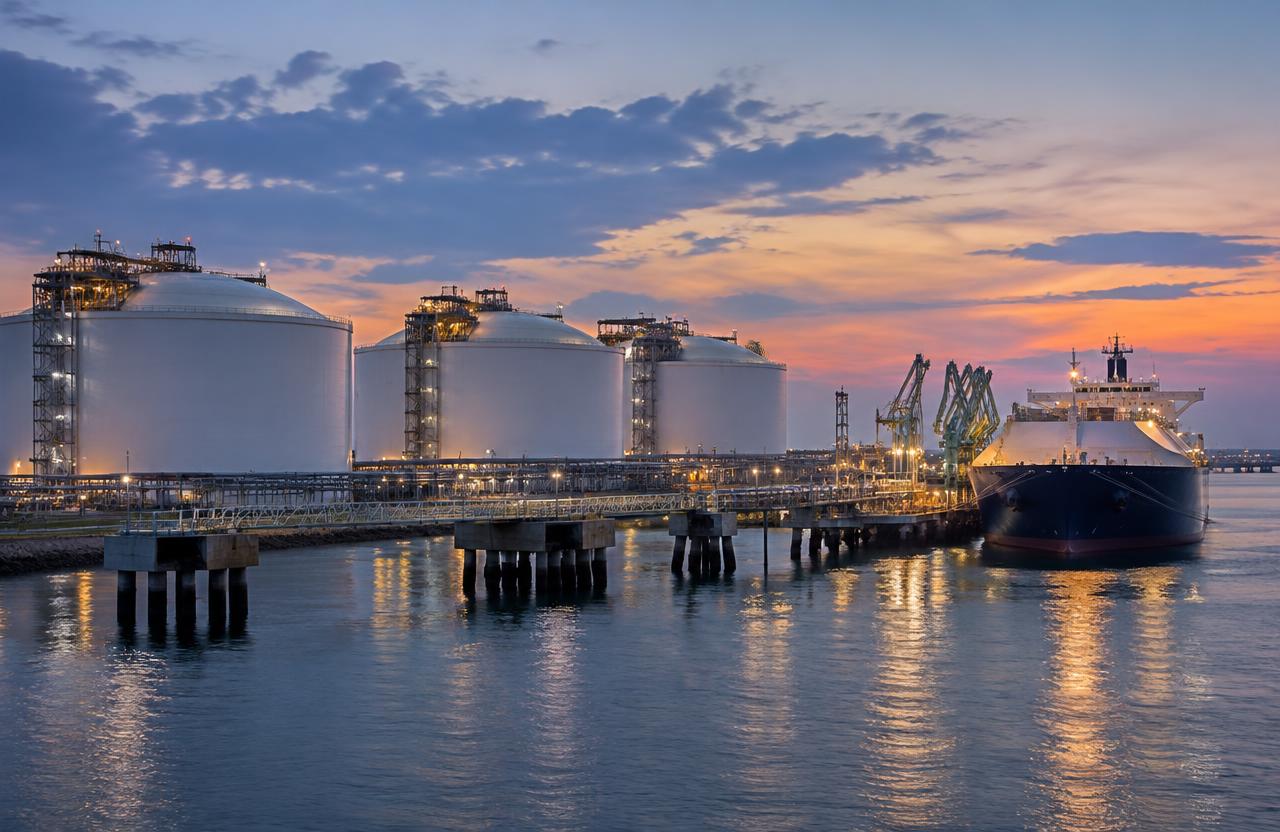
LNG terminals are the fixed points of the LNG value chain. Export terminals receive pipeline gas, remove impurities and cool it to approximately −162 °C. Import terminals receive LNG from ships, store it and convert it back to gas for distribution. Between these two ends sit storage tanks, marine jetties and a set of operating disciplines that are distinct from both shipping and conventional gas processing.
This guide explains the main process blocks and design choices. It is general and educational; project-specific design depends on gas composition, site conditions, regulation and commercial requirements.
The export terminal: from feed gas to LNG
An export or liquefaction terminal is built around one or more liquefaction trains — parallel process units that each convert a stream of feed gas into LNG. The total capacity of a plant is usually expressed in million tonnes per annum (mtpa).
Gas pre-treatment
Before gas can be liquefied, components that would freeze or damage equipment at cryogenic temperatures must be removed. Typical steps include acid-gas removal (carbon dioxide and hydrogen sulphide), dehydration to remove water, mercury removal to protect aluminium heat exchangers, and extraction of heavier hydrocarbons, which may be sold separately as natural gas liquids or used to adjust LNG heating value.
Liquefaction processes
Liquefaction removes heat from the gas using refrigeration cycles. Several licensed process families exist. Propane pre-cooled mixed-refrigerant processes use propane to pre-cool the gas and a mixed refrigerant to complete liquefaction. Cascade processes use a sequence of pure refrigerants such as propane, ethylene and methane. Other designs use dual mixed refrigerants, or nitrogen expander cycles that are often favoured for smaller or floating plants because of their simplicity. Each represents a trade-off between efficiency, equipment count, operational complexity and suitability for the site.
Liquefaction is energy-intensive: the plant consumes a portion of the feed gas, or imported electricity, to drive refrigerant compressors. Efficiency and emissions intensity are therefore important design and regulatory considerations.
Floating liquefaction (FLNG)
Floating LNG production units place pre-treatment, liquefaction, storage and offloading on a moored hull. They can allow development of offshore fields without long pipelines, but impose space, weight and motion constraints that influence process selection.
LNG storage
Both export and import terminals store LNG in large, insulated, above-ground or in-ground tanks at close to atmospheric pressure. Common onshore designs, in ascending order of containment capability, are single containment, double containment and full containment tanks. A full containment tank typically consists of an inner tank of 9% nickel steel holding the liquid and an outer tank, often pre-stressed concrete, able to contain the liquid and control vapour if the inner tank leaks.
As with ships, heat ingress causes boil-off. At import terminals, BOG is commonly compressed and either sent to the gas grid or recondensed by mixing with cold, pressurised LNG before vaporisation. At export terminals, BOG is typically recovered as fuel or returned to the process. During ship loading, vapour displaced from the ship’s tanks is returned to the terminal.
Marine facilities
The jetty is where the terminal meets the ship. It includes the berth and mooring structures, loading or unloading arms with emergency release systems, vapour return arms, the ship–shore emergency shutdown link, gangway, fire protection and gas detection. Many terminals publish a terminal information or port information booklet describing accepted vessel sizes, mooring requirements and operating limits. Ship–shore compatibility is assessed before a vessel’s first call, typically using SIGTTO guidance as a reference.
In our interpretation, marine interface issues — mooring, manifold arrangement and weather limits — are among the most common practical causes of delay for new trades, so operators benefit from engaging early with terminal marine departments.
The import terminal: regasification
An import terminal unloads LNG into storage, pumps it to the required pipeline pressure using in-tank and high-pressure send-out pumps, and vaporises it. The choice of vaporiser depends on climate, environmental permits and energy cost.
Open rack vaporisers (ORV) use seawater flowing over panels of finned tubes as the heat source. They have low operating cost but depend on suitable seawater temperatures and require permits for the cooled water discharged.
Submerged combustion vaporisers (SCV) burn a small share of gas to heat a water bath in which LNG tubes are immersed. They are independent of seawater temperature but consume fuel.
Intermediate fluid vaporisers (IFV) use an intermediate fluid, such as propane or a glycol-water mixture, between seawater or another heat source and the LNG, reducing freezing risk.
Ambient air vaporisers use atmospheric heat and are typically used at smaller scale.
Some terminals use LNG cold energy for other purposes, such as air separation or cooling, where an industrial user is nearby.
Floating storage and regasification units
An FSRU is a ship-shaped unit that stores LNG and regasifies it on board, delivering gas to shore through a jetty or subsea pipeline. FSRUs can often be deployed faster and with less onshore construction than a land-based terminal, and some can be redeployed or trade as conventional carriers. Their limitations include dependence on marine conditions, constraints on storage volume and the need for robust mooring and gas export arrangements. Whether onshore or floating is preferable depends on the market’s expected duration of demand, site conditions, financing and permitting.
Project development stages
Terminal projects typically pass through concept and feasibility studies, site selection, front-end engineering design (FEED), environmental and safety permitting, commercial contracting for capacity or offtake, a final investment decision (FID), engineering, procurement and construction (EPC), commissioning and first cargo. The sequence is iterative in practice. Up-to-date information on operating and planned terminals worldwide is published annually by GIIGNL; readers should consult the latest edition rather than rely on figures that change every year.
Frequently asked questions
What is the difference between an LNG train and a terminal?
A train is one liquefaction process unit. A terminal or plant may contain several trains plus shared storage, utilities and marine facilities.
Why do import terminals still produce boil-off gas when not receiving ships?
Heat continuously enters storage tanks and piping. The resulting BOG must be handled continuously, which is why a minimum send-out or a recondenser and compressors are part of normal design.
Is an FSRU always cheaper than an onshore terminal?
Not necessarily. FSRUs can reduce upfront construction and lead time, but charter costs over a long period, site conditions and required capacity can favour an onshore solution. The comparison is project-specific.
Related articles
From concept to first cargo: the stages of an LNG import terminal
Illustrative overview of feasibility, permitting, FID and commissioning phases. Demonstration content only.
Redeploying an FSRU: the questions that come first
Illustrative discussion of mooring, jetty compatibility and permitting. Demonstration content only.
Small-scale LNG distribution, explained
Illustrative look at break-bulk terminals, feeder vessels and trucking. Demonstration content only.