LNG Shipping: Complete Industry Guide
How liquefied natural gas moves by sea — the vessels, the voyage cycle, the commercial structures and the rules that govern them.
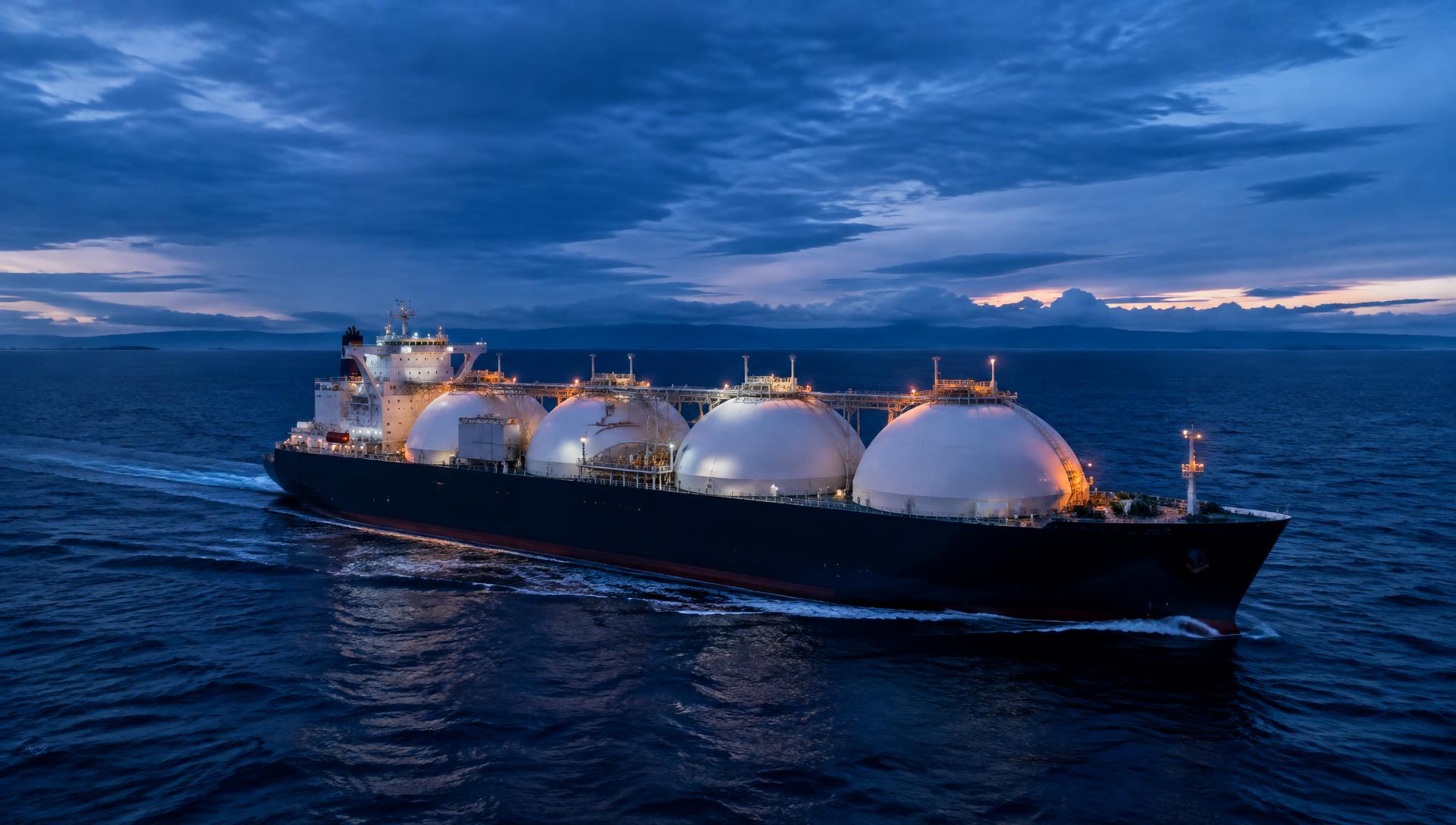
Liquefied natural gas is natural gas cooled to approximately −162 °C, the temperature at which it condenses into a liquid at near-atmospheric pressure. Liquefaction reduces the volume of the gas by a factor of roughly 600, which is what makes long-distance seaborne transport economically possible where pipelines are impractical (U.S. EIA).
LNG shipping is the link between liquefaction plants in exporting regions and regasification terminals in importing markets. It is a specialised, capital-intensive segment with demanding technical, safety and crew-competency requirements. This guide explains how the system works in practice. Where we offer interpretation rather than established fact, we say so.
What makes LNG shipping different
Three physical properties shape almost every aspect of LNG shipping. First, the cargo is cryogenic: ordinary ship steels become brittle at LNG temperatures, so cargo containment and piping use materials such as stainless steel, aluminium alloys, 9% nickel steel or Invar. Second, heat inevitably leaks into the cargo, so a small fraction continuously evaporates as boil-off gas (BOG) that must be used, reliquefied or safely disposed of. Third, natural gas is flammable within a defined concentration range in air, so cargo systems are designed to exclude air and to detect and contain any leak.
Because of these properties, the international design and construction requirements for gas carriers are set out in a dedicated instrument, the IMO International Code for the Construction and Equipment of Ships Carrying Liquefied Gases in Bulk (IGC Code), made mandatory under SOLAS. Our companion guide on LNG safety and international regulations covers the framework in detail.
Types of LNG carrier
LNG carriers are usually described by their cargo containment system and their size. The two broad containment families are membrane systems, in which a thin metallic barrier is supported by insulation and the inner hull, and independent tank systems, which are self-supporting structures. Our technology guide explains each design in depth.
Conventional large-scale carriers
The majority of the deep-sea fleet consists of large carriers designed for long-haul trades between export projects and major import terminals. Hull dimensions are typically chosen with terminal compatibility and, for some trades, canal transits in mind. Owners and charterers pay close attention to cargo capacity, boil-off performance, fuel consumption and the range of terminals a vessel is cleared to call at.
Small-scale and specialised vessels
Smaller gas carriers distribute LNG to coastal terminals, island grids and industrial users, and LNG bunker vessels supply fuel to gas-fuelled ships. These vessels frequently use pressurised independent tanks (IGC Type C), which tolerate pressure build-up and simplify boil-off management on short voyages.
Floating units
Floating storage and regasification units (FSRUs) and floating LNG production units (FLNG) apply marine LNG technology to terminal functions. They sit at the boundary between shipping and infrastructure and are discussed in our guide to LNG terminals.
The LNG carrier voyage cycle
An LNG carrier’s operating cycle is more complex than that of an oil tanker because cargo tanks must be thermally and chemically prepared before they can receive cargo. The sequence below is typical; exact procedures depend on the containment system, the cargo-handling plant and the operator’s safety management system.
Inerting and gassing-up. After a dry-dock or a period out of service, tanks containing air are first inerted, commonly with inert gas or nitrogen, to bring oxygen content below a safe limit. Inert gas is then displaced with natural gas vapour, a step known as gassing-up, so that the tanks contain no non-condensable gases that could interfere with cooling and cargo handling.
Cool-down. Tanks are progressively cooled by spraying small quantities of LNG until temperatures fall to the level specified by the containment system designer. Controlled cool-down limits thermal stresses in the containment structure.
Loading. LNG is transferred through the terminal’s loading arms into the ship’s cargo tanks while displaced vapour is returned to shore. The operation is governed by agreed ship–shore procedures, a linked emergency shutdown (ESD) system and continuous monitoring of tank pressure, temperature and level.
Laden voyage. During the voyage, boil-off gas is managed according to the vessel’s design: burned as fuel in the propulsion plant, reliquefied and returned to the tanks, or, when neither is possible, burned in a gas combustion unit. Tank pressure management is a core watchkeeping task.
Discharge and heel. At the receiving terminal, cargo pumps deliver LNG ashore. Operators often retain a quantity of LNG on board, known as heel, to keep tanks cold for the ballast voyage and to supply fuel, avoiding a full warm-up and repeat cool-down.
Warm-up and gas-freeing. Before dry-dock or tank entry, the process is reversed: tanks are warmed, vapour is displaced with inert gas, and inert gas is then replaced with air until the atmosphere is verified safe for entry.
Ship–shore compatibility
Before a carrier calls at a terminal for the first time, the parties typically carry out a ship–shore compatibility assessment. This covers mooring arrangements, manifold position and size, loading arm envelopes, ESD and communication links, gangway access, cargo-handling rates and vapour return. Industry guidance published by SIGTTO is widely used as the reference point for these assessments. Incompatibility found late can delay a commercial programme, so many operators treat compatibility as a commercial as well as a technical issue.
Commercial structures in LNG shipping
Historically, many LNG carriers were built against long-term charters tied to specific liquefaction projects, giving owners predictable revenues and giving project sponsors secure transport capacity. Over time the market has become more diverse, with portfolio players, traders and shorter-term chartering alongside long-term project shipping. The balance between these models changes with market conditions; readers should rely on dated market reports, such as GIIGNL’s annual report, rather than assume any particular split.
Common charter arrangements include time charters, where the charterer pays hire for the use of the vessel for a period and the owner remains responsible for operation and crewing, and voyage or spot arrangements for single cargoes. Sale contracts also determine who controls shipping: under a free-on-board (FOB) sale the buyer arranges transport, while under a delivered ex-ship (DES) sale the seller does.
For time-chartered LNG carriers, boil-off and fuel consumption warranties are commercially significant because cargo that evaporates or is consumed represents value. Charter parties therefore typically address maximum boil-off rates, fuel consumption, speed and heel arrangements. In our interpretation, the efficiency of a vessel’s containment and propulsion system is one of the main drivers of its commercial competitiveness over its trading life.
Crew competence and operational safety
LNG shipping depends on highly trained crews. The STCW Convention sets mandatory training and certification requirements for officers and ratings on liquefied gas tankers, from basic to advanced level, and operators commonly add company-specific training on cargo systems, simulators and emergency response.
The segment has a strong safety record, which the industry attributes to conservative design rules, mature operating procedures and a culture of shared learning through bodies such as SIGTTO. Maintaining that record as the fleet and the number of operators grow is, in our view, the defining operational challenge for the sector.
Environmental regulation and fleet efficiency
LNG carriers are subject to the same IMO energy-efficiency and greenhouse-gas measures as other ship types, including requirements adopted under MARPOL Annex VI. In July 2023 the IMO adopted a revised strategy on the reduction of greenhouse-gas emissions from ships that includes reaching net-zero emissions by or around 2050. These measures influence decisions on propulsion choice, operational speed, retrofits and the future of older, less efficient tonnage. Methane slip — unburned methane released from some engine types — is an issue the industry and regulators are actively addressing.
Frequently asked questions
Why is LNG carried at around −162 °C rather than under pressure?
At near-atmospheric pressure, natural gas must be cooled to approximately −162 °C to remain liquid. Large-scale carriers use this fully refrigerated approach because containing very large volumes at high pressure would require extremely heavy tanks. Smaller vessels with pressurised Type C tanks can tolerate some pressure rise, which helps on short voyages.
What happens to boil-off gas during a voyage?
Depending on the vessel, BOG is used as fuel, reliquefied and returned to the cargo tanks, or burned in a gas combustion unit. Releasing natural gas to the atmosphere is not part of normal operations.
Who decides which ship carries a cargo?
That depends on the sale terms. Under FOB terms the buyer arranges shipping; under DES terms the seller does. Portfolio companies may also allocate cargoes across their own chartered fleet.
Related articles
What fleet renewal could mean for steam-turbine LNG carriers
An illustrative look at the commercial questions facing owners of older tonnage. Demonstration content only.
Understanding common LNG charter contract structures
Illustrative overview of time charters, voyage charters and their typical clauses. Demonstration content only.