EU Methane Regulation and LNG Imports: Obligations, Deadlines and the 2026 Postponement
The EU Methane Regulation reaches methane emitted outside the EU when LNG is produced. This guide explains importer obligations, OGMP 2.0 equivalence, methane intensity rules and the provisional two-year postponement agreed in November 2026.
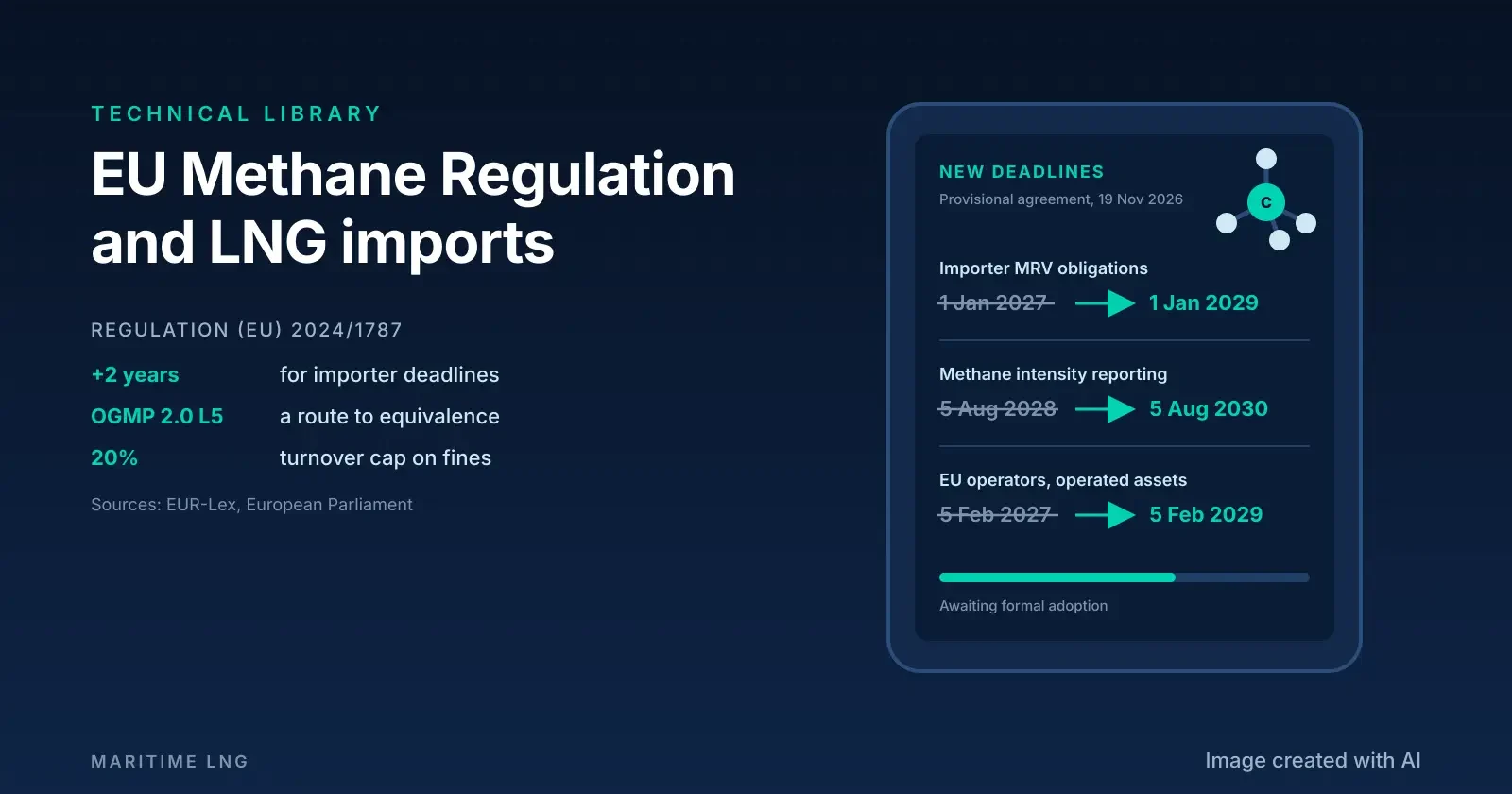
Regulation (EU) 2024/1787, the EU Methane Regulation, reaches beyond the Union's borders to the methane emitted when the oil, gas and coal the EU imports are produced. For LNG, it creates reporting duties for importers, data requirements that travel up supply contracts to producers, and future methane intensity limits. On 19 November 2026, the European Parliament and the Council reached a provisional agreement to postpone the importer deadlines by two years.
This guide explains what the Regulation requires of LNG importers, how the deadlines are changing, and which official tools exist to meet them.
Legislative status checked on 25 November 2026. The two-year postponement is a provisional agreement. It still has to be formally adopted by Parliament and Council and published in the Official Journal before it changes the law.
What the Regulation covers
The Regulation entered into force on 4 August 2024. Inside the EU, it applies to oil and gas exploration and production, gas gathering and processing, natural gas transmission, distribution and underground storage, operations in LNG facilities, and coal mines. Article 1(3) extends it to methane emitted outside the EU in the production of crude oil, natural gas and coal placed on the EU market. That provision is where importers come in.
What LNG importers must do
Annual information (Article 27)
Importers send the information listed in Annex IX to the competent authority of the Member State where they are established, by 31 May each year. The first report was due by 5 May 2025. For natural gas, Annex IX asks for:
- the name and address of the exporter and, if different, the producer;
- the exporting and transit countries and regions;
- whether the producer measures methane at source and site level, whether the data are independently verified, and whether reporting follows UNFCCC or OGMP 2.0 standards;
- the regulatory or voluntary controls applied, such as leak detection and repair (LDAR) surveys and restrictions on venting and flaring;
- the name of any independent verifier;
- evidence of MRV equivalence, whether model contract clauses are used, and methane intensity information.
Where an importer cannot provide some or all of this information, it must give the authority a sound justification and describe what it did to obtain it.
MRV equivalence (Article 28)
For contracts concluded or renewed on or after 4 August 2024, importers must demonstrate that the supplies are subject to monitoring, reporting and verification (MRV) at producer level equivalent to the Regulation. For older contracts, importers must make "all reasonable efforts" to secure equivalent MRV, which may include amending the contracts, and report each year on the results.
Article 28(5) recognises two routes to equivalence:
- Producer level: independent third-party verification equivalent to the Regulation, combined with either quantification equivalent to Article 12 or OGMP 2.0 Level 5 monitoring for oil and gas.
- Country level: a third-country MRV framework at least equivalent to the EU's, with source- and site-level quantification, independent verification, and effective supervision and enforcement.
The Commission recognises country-level equivalence through implementing acts and can revoke it. Importers buying from a country recognised as equivalent are exempt from the reporting under Article 28(1) and (2).
Methane intensity (Article 29)
Importers and EU producers must report the methane intensity of the production of the fuels they place on the EU market. The calculation methodology is to be set by a Commission delegated act by 5 August 2027. In a later step, under contracts concluded or renewed after 5 August 2030, they must show that this intensity is below maximum values, also to be set by delegated acts. Those values are to reflect the best performing class or classes of production, while taking account of energy security and EU competitiveness.
Penalties (Article 33)
Member States set penalties that must be effective, proportionate and dissuasive. For companies, administrative fines may not exceed 20% of annual turnover in the preceding business year. In a December 2025 information note, the Commission stressed that authorities must not endanger security of supply when applying penalties.
The 2026 postponement
Why
The Commission's proposal of 14 October 2026, COM(2026) 569, points to the energy shock in the Middle East. Since 27 February 2026, disruption around the Strait of Hormuz has affected about 20% of global LNG supply and 25% of seaborne oil trade. According to the proposal, importers indicated they might not be able to secure enough compliant energy supplies.
How the positions moved
- 14 October 2026: the Commission proposed a one-year postponement of the importer and methane intensity deadlines.
- 22 October 2026: the European Parliament adopted its position, backing a three-year postponement.
- 6 November 2026: the Council adopted its negotiating mandate, keeping a one-year postponement and adding a mechanism that would let the Commission postpone the import obligations by a further year if key implementation elements were not in place.
- 19 November 2026: Parliament and Council negotiators reached a provisional agreement on a two-year postponement.
The new deadlines in the provisional agreement
- Importers' MRV obligations: apply from 1 January 2029 instead of 1 January 2027. According to Parliament, importers must show by May 2030 that contracts concluded or renewed since 4 August 2024 cover only fuel subject to equivalent monitoring. That first demonstration covers supplies in calendar year 2029.
- Methane intensity reporting: starts on 5 August 2030, instead of 5 August 2028 in the original Regulation and 5 August 2029 in the Commission's proposal.
- EU operators: verified reports combining source-level and site-level measurements move from 5 February 2027 to 5 February 2029 for operated assets, and from 5 August 2028 to 5 August 2030 for non-operated assets.
- Review: the Commission must report to Parliament and Council by 1 January 2028 and every five years after that, with a legislative proposal where appropriate.
- Sanctions: the Regulation remains without prejudice to EU restrictive measures against sanctioned countries.
The official announcements do not give a new date for the later obligation to stay below maximum methane intensity values (Article 29(2)). The Commission had proposed moving it to 5 August 2031. Readers should check the final adopted text.
Next steps
Parliament's Environment and Industry committees were scheduled to vote on the agreement on 23 November 2026, with a plenary vote planned for the same week. The Council must then formally adopt the text, and the amending regulation must be published in the Official Journal. Until then, the original deadlines remain the law, including the start of importer obligations on 1 January 2027.
Official tools for importers
- Model clauses: Commission Recommendation (EU) 2026/1834 of 20 July 2026 sets out optional, non-binding model contract clauses. They cover crude oil, natural gas, LNG and coal, and address importer obligations, disclosure of information to authorities, and proof that producers apply equivalent MRV.
- Implementation solutions: in its December 2025 note, the Commission explained that evidence can be passed through contracts where the importer has a direct or identifiable link to the producer. Where supplies are mixed and that link is hard or impossible to establish, the Network of Competent Authorities identified two options: a certification method or a "trace-and-claim" method.
- Transparency database: Article 30 requires the Commission to run a public methane transparency database and to publish performance profiles of Member States, producers, importers and exporters.
- Satellite monitoring: Article 31 requires a public global methane monitoring tool based on satellite data, including Copernicus, and a rapid reaction mechanism for super-emitting events.
What it means for the LNG chain
- Data must travel up the chain. An EU importer's obligations depend on information held by the producer and the liquefaction plant. This is why the Regulation and the Commission's tools focus on contract clauses.
- OGMP 2.0 Level 5 is a named route. It is one of the ways to show producer-level equivalence. Our coverage of the CLEAN Annual Report 2026-27 shows how much LNG supplied to Japan and Korea is already under top-tier methane reporting.
- New contracts carry the full obligations. Equivalence and intensity rules apply in full to contracts concluded or renewed on or after 4 August 2024. Older contracts fall under the "all reasonable efforts" standard.
- The timetable is changing, not the rules. The Commission's proposal states that it does not amend the substantive rules of the Regulation and keeps its objectives.
This guide was prepared with AI assistance from the official sources listed above and reviewed by the Maritime LNG Editorial Desk.
Related guides
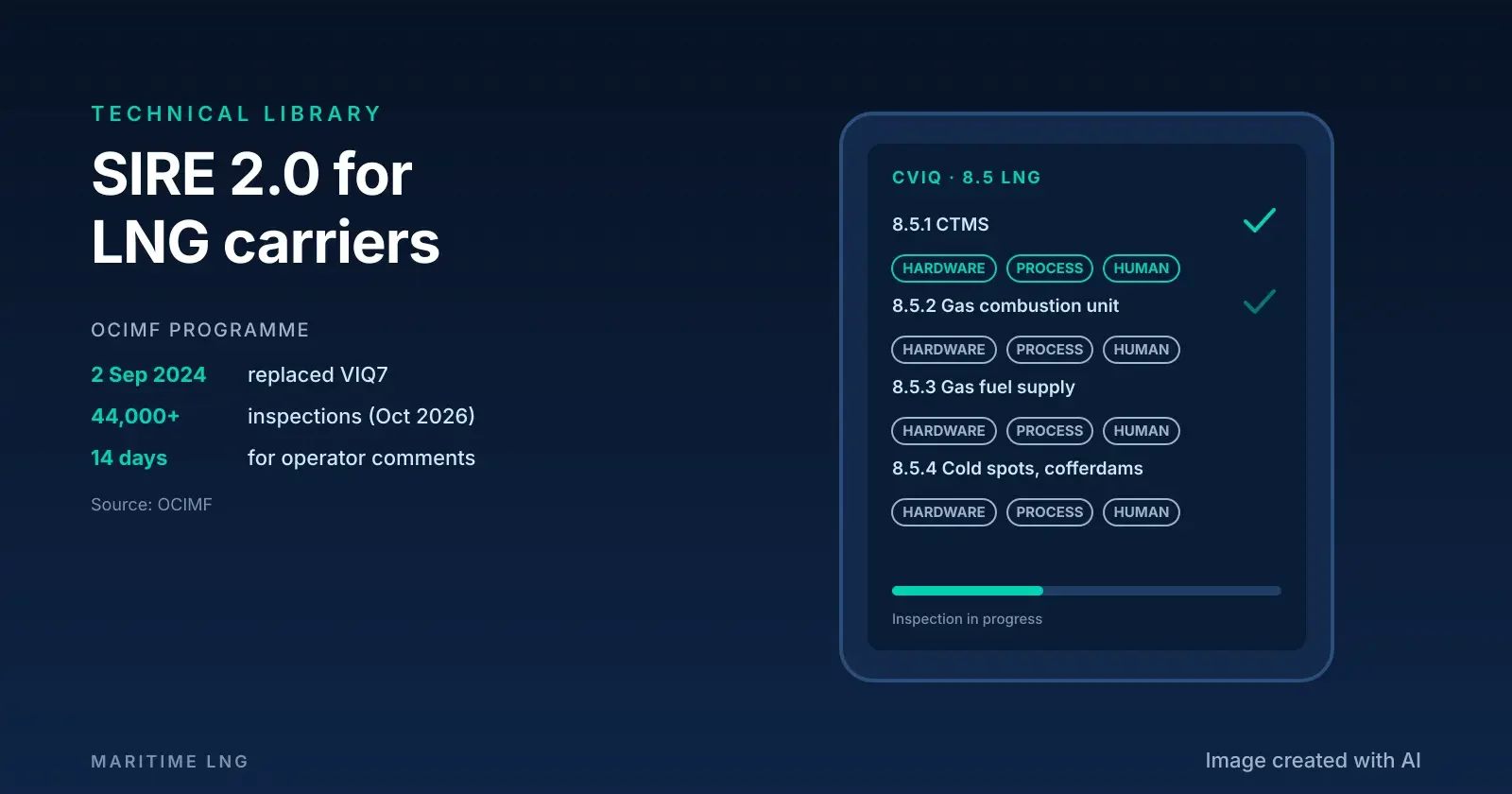
SIRE 2.0 for LNG Carriers: How the OCIMF Inspection Regime Works
How OCIMF's SIRE 2.0 works for LNG carriers: HVPQ, PIQ, the CVIQ, core and rotational questions, LNG-specific questions and report timelines.
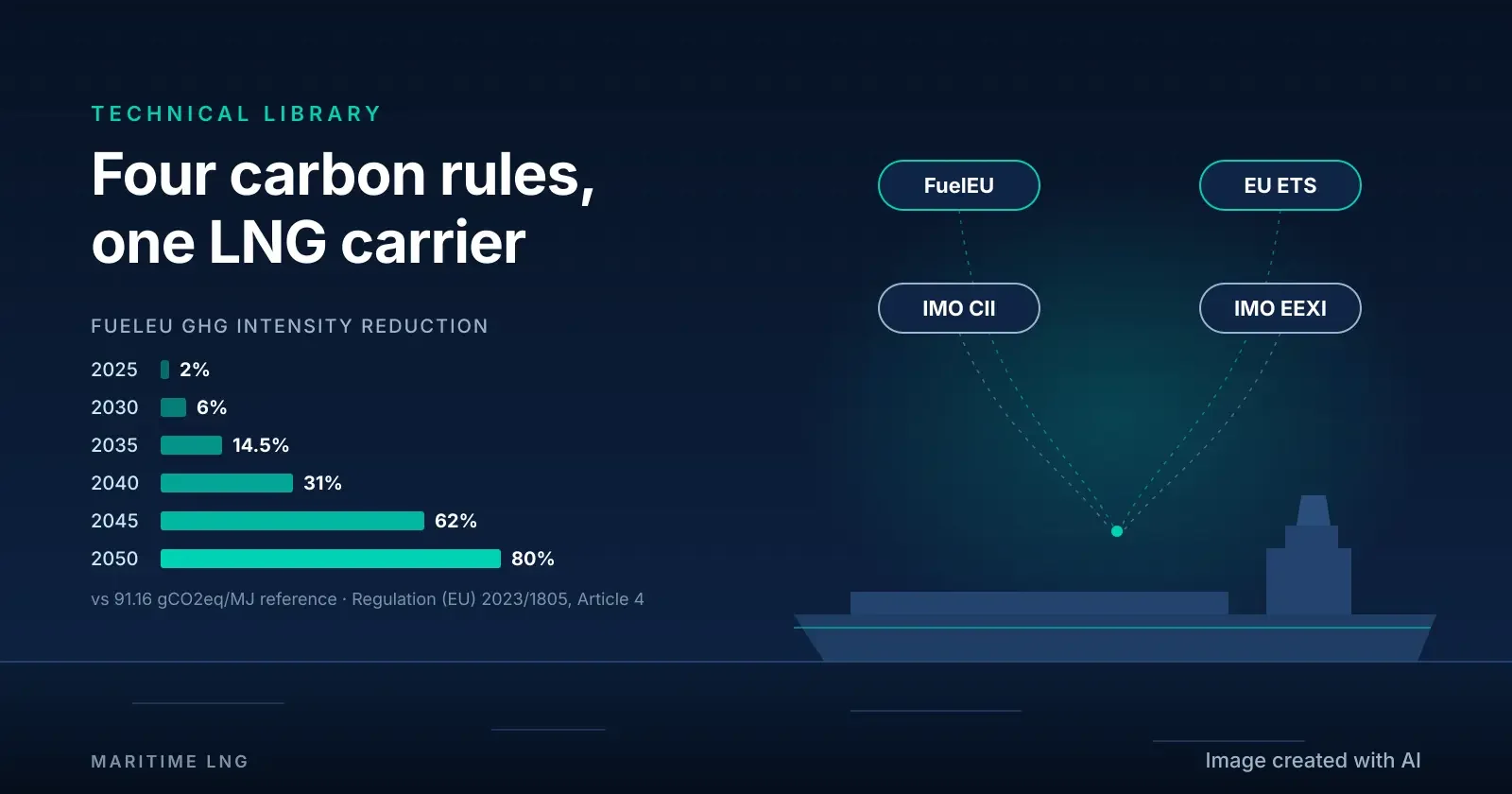
FuelEU Maritime, EU ETS, CII and EEXI: What They Mean for LNG Carriers
How FuelEU Maritime, the EU ETS, IMO CII and EEXI apply to LNG carriers: targets, LNG-specific rules, penalties, ratings and what changes next.
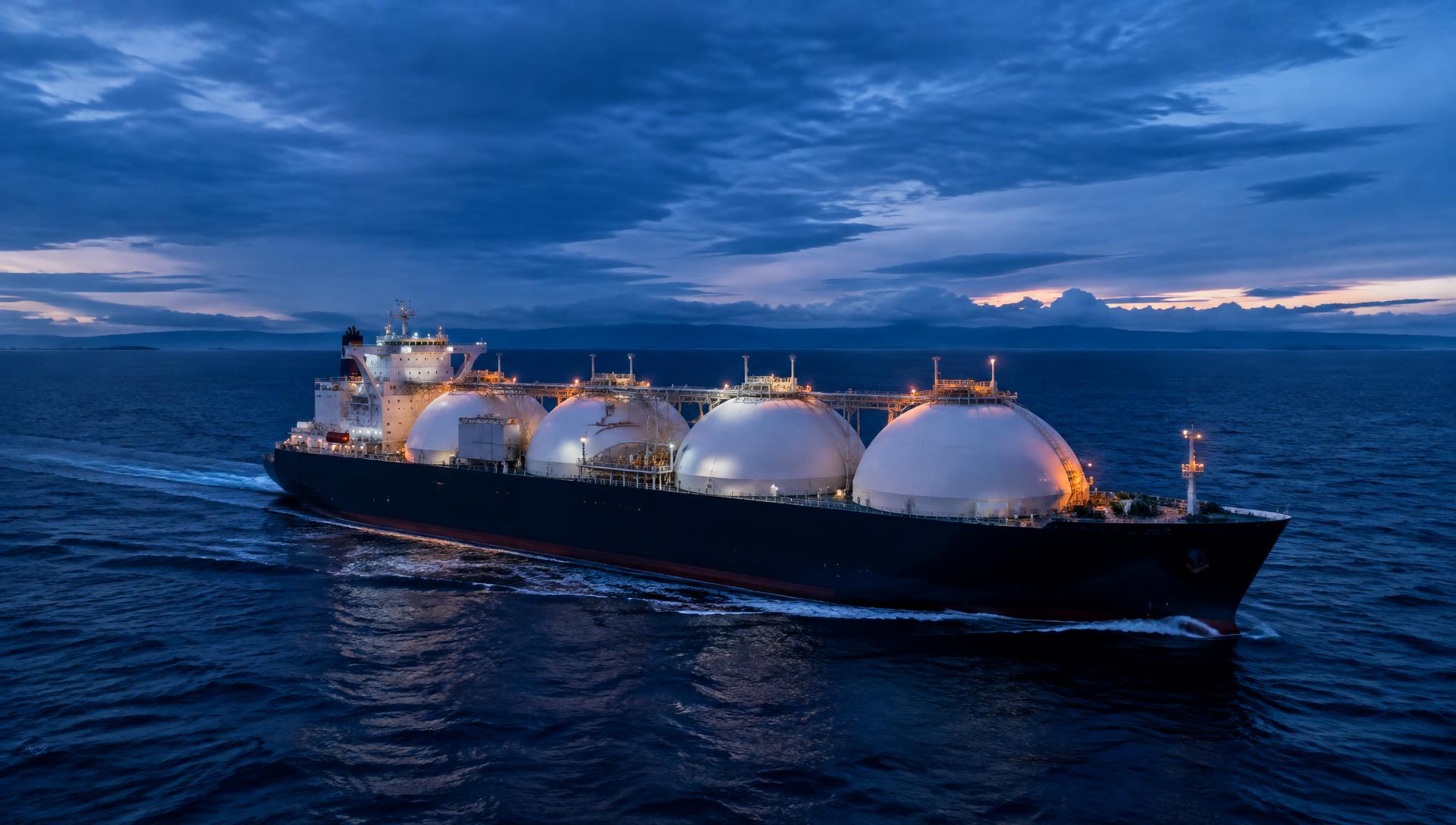
LNG Safety and International Regulations: IMO, IGC Code and IGF Code
A structured guide to the IMO framework for LNG at sea: SOLAS, the IGC Code for gas carriers, the IGF Code for gas-fuelled ships, STCW training, MARPOL Annex VI and the role of class and industry guidance.