European Parliament Approves Two-Year Delay to EU Methane Rules for Energy Importers
After the Environment and Industry committees cleared the deal on 23 November, the European Parliament approved on 26 November a two-year delay to methane obligations for gas, oil and coal importers. Council adoption and publication in the Official Journal are still needed.
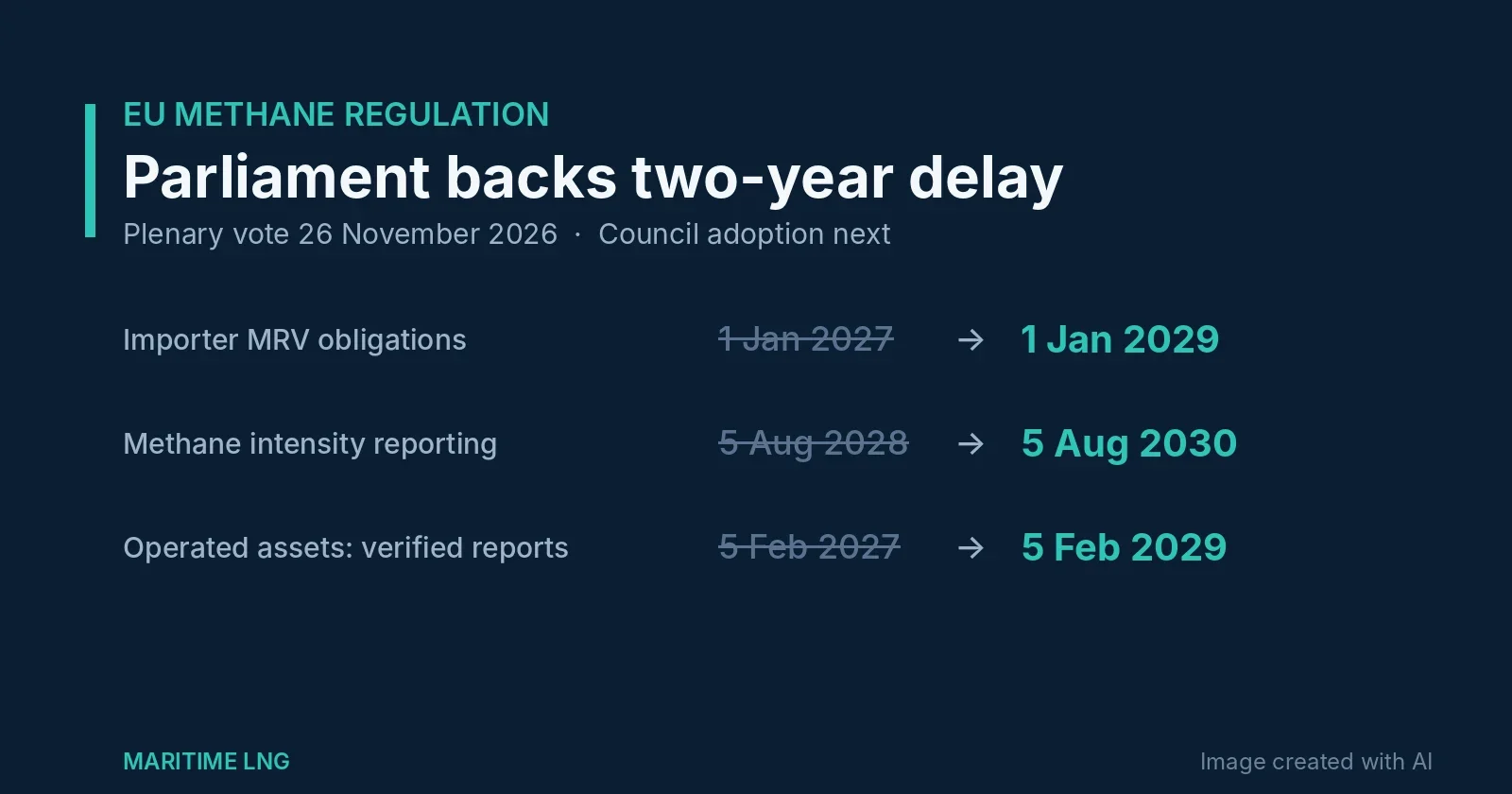
The European Parliament has approved a two-year postponement of key deadlines in the EU Methane Regulation, Regulation (EU) 2024/1787, for importers of natural gas, crude oil and coal and for EU operators. The plenary vote in Strasbourg on 26 November 2026 followed a joint confirmation vote by Parliament's Environment (ENVI) and Industry (ITRE) committees on 23 November.
The amendment is not yet law. The Council must formally adopt it, and the amending regulation must then be published in the Official Journal of the EU. Until then, the original dates apply, including the start of importer obligations on 1 January 2027.
From provisional deal to plenary
- 19 November 2026: Parliament and Council negotiators reached a provisional agreement overnight.
- 23 November 2026: the ENVI and ITRE committees confirmed the agreement in a joint vote, with 99 votes in favour, 60 against and 6 abstentions, according to the ECR Group.
- 26 November 2026: the plenary approved the agreement with 341 votes in favour, 224 against and 31 abstentions, as reported in media coverage of the vote. A motion to reject the text was defeated by 398 votes to 136, with 61 abstentions.
Parliament handled the file under its urgent procedure.
The new timetable
According to the Council and Parliament announcements of 19 November:
- Importers' MRV obligations: apply from 1 January 2029 instead of 1 January 2027. Importers will have until May 2030 to show that supply contracts concluded or renewed since 4 August 2024 cover only fuel subject to monitoring, reporting and verification (MRV) equivalent to EU rules. The same May 2030 date applies to reporting on efforts to bring older contracts into line.
- Methane intensity reporting: EU producers and importers report the methane intensity of the fossil fuels they place on the EU market from 5 August 2030. The original Regulation set 5 August 2028, and the Commission had proposed 5 August 2029.
- Oil and gas operators in the EU: verified reports combining source-level and site-level methane measurements are due by 5 February 2029 for operated assets and by 5 August 2030 for non-operated assets.
- Review: the Commission must report to Parliament and Council on the Regulation's application by 1 January 2028 and every five years after that, with a legislative proposal where appropriate.
- Sanctions: the amendment does not affect EU restrictive measures against sanctioned countries.
The Commission states that the agreement keeps the Regulation's ambition, integrity and scope. The change concerns the timetable for specific obligations.
How the positions converged
The Commission proposed a one-year postponement on 14 October 2026, citing strain in energy markets linked to the conflict in the Middle East. Parliament adopted its position on 22 October, backing a three-year delay. The Council's mandate of 6 November kept one year. The final compromise is two years.
What was said
Dimitris Tsiodras (EPP, Greece), Parliament's lead negotiator for the Environment Committee, said: "We are not suspending the Methane Regulation; we are ensuring that it can be effectively implemented." Borys Budka (EPP, Poland), lead negotiator for the Industry Committee, said that "security of supply comes first". For the Council presidency, Ireland's Minister for Climate, Energy and the Environment, Darragh O'Brien, described the deal as a "pragmatic balance".
The file divided Parliament. When the deal was reached, the Greens accused conservatives of joining forces with the far right to weaken climate rules, according to Euronews. The Clean Air Task Force had criticised Parliament's earlier call for a three-year delay. On the other side, the ECR Group argued that companies could not be asked to comply while key implementing rules and verification systems were not yet in place, and EPP MEPs said the postponement would help keep European homes warm this winter.
What it means for the LNG chain
- More time, same direction: LNG importers into the EU gain two years before the MRV equivalence requirement applies, and producers gain time to put verified measurement in place. The obligations themselves remain.
- Contracts still matter now: the equivalence test applies to supply contracts concluded or renewed since 4 August 2024. LNG contracts signed today will be judged against it from 2029.
- Producer data: measurement-based reporting, such as OGMP 2.0 Level 5, remains one of the routes to show equivalence. Our coverage of the CLEAN Annual Report 2026-27 shows how far some LNG suppliers have already moved.
For importer obligations, the routes to MRV equivalence, methane intensity and penalties, see our Technical Library guide EU Methane Regulation and LNG Imports: Obligations, Deadlines and the 2026 Postponement.
Note on sources: the committee vote of 23 November was reported by GIIGNL on 26 November; the plenary vote took place the same day. New deadlines are taken from the Council and Parliament press releases of 19 November 2026. Committee and plenary vote figures are from the ECR Group's statement and media reports of the vote, pending Parliament's official minutes.
Related news
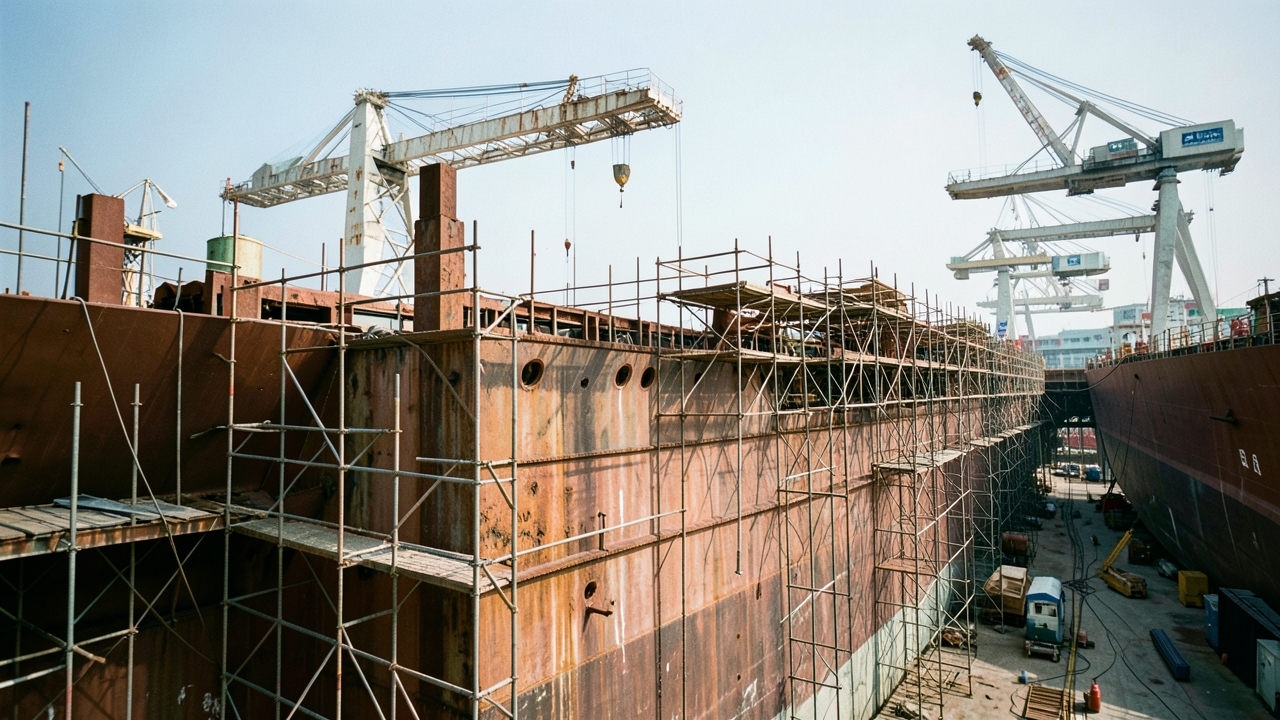
Samsung Heavy Industries and Tesser Atomics Partner on Nuclear LNG Carrier
Samsung Heavy Industries and Tesser Atomics partner to develop a demonstration transatlantic nuclear-powered LNG carrier using molten salt reactor technology.
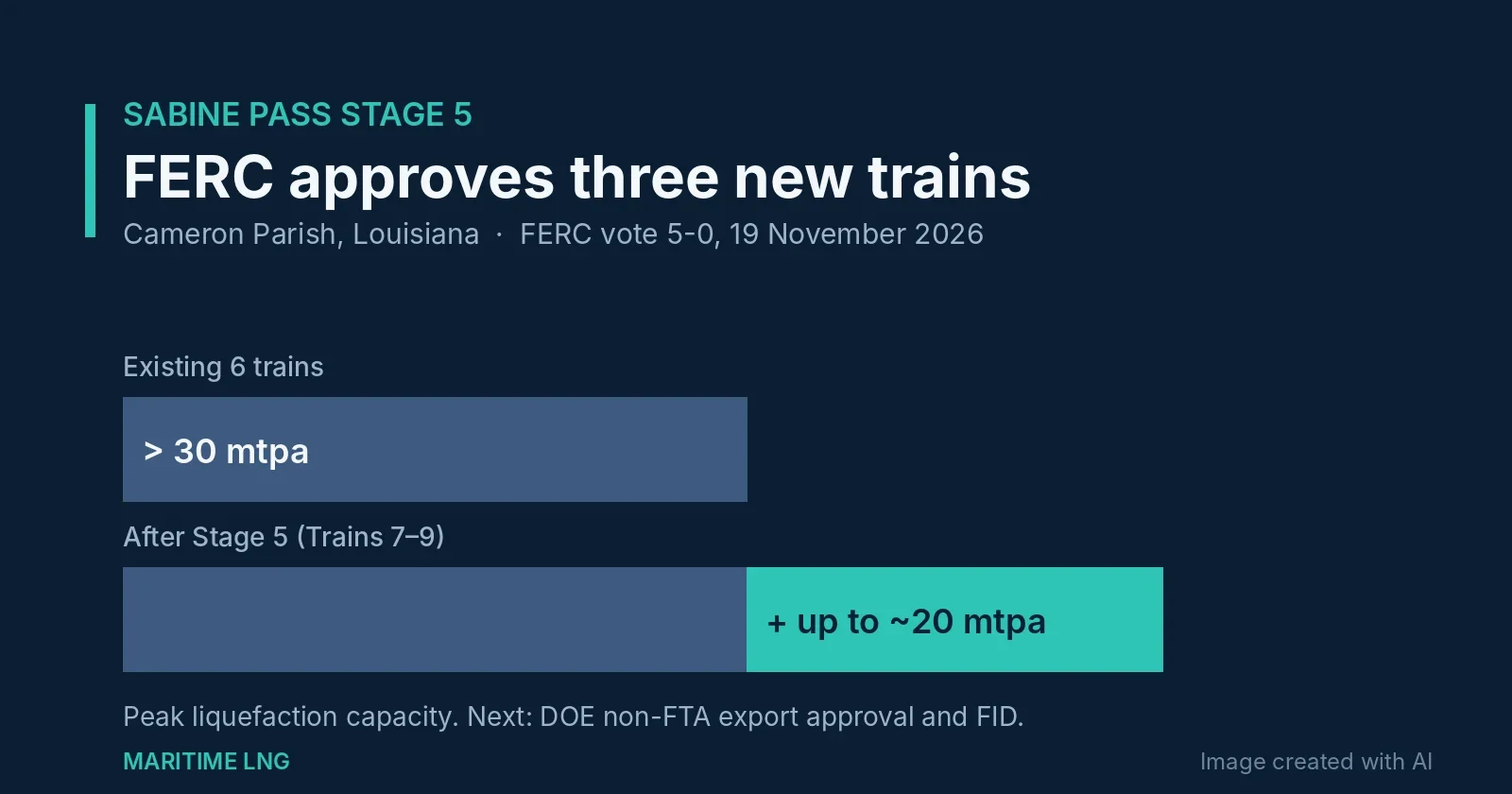
FERC Approves Sabine Pass Stage 5: Three New Trains and Up to 20 Mtpa
FERC approved Cheniere's Sabine Pass Stage 5 on 19 Nov 2026: three trains, up to 20 Mtpa, new feedgas pipelines. DOE non-FTA approval and FID still pending.
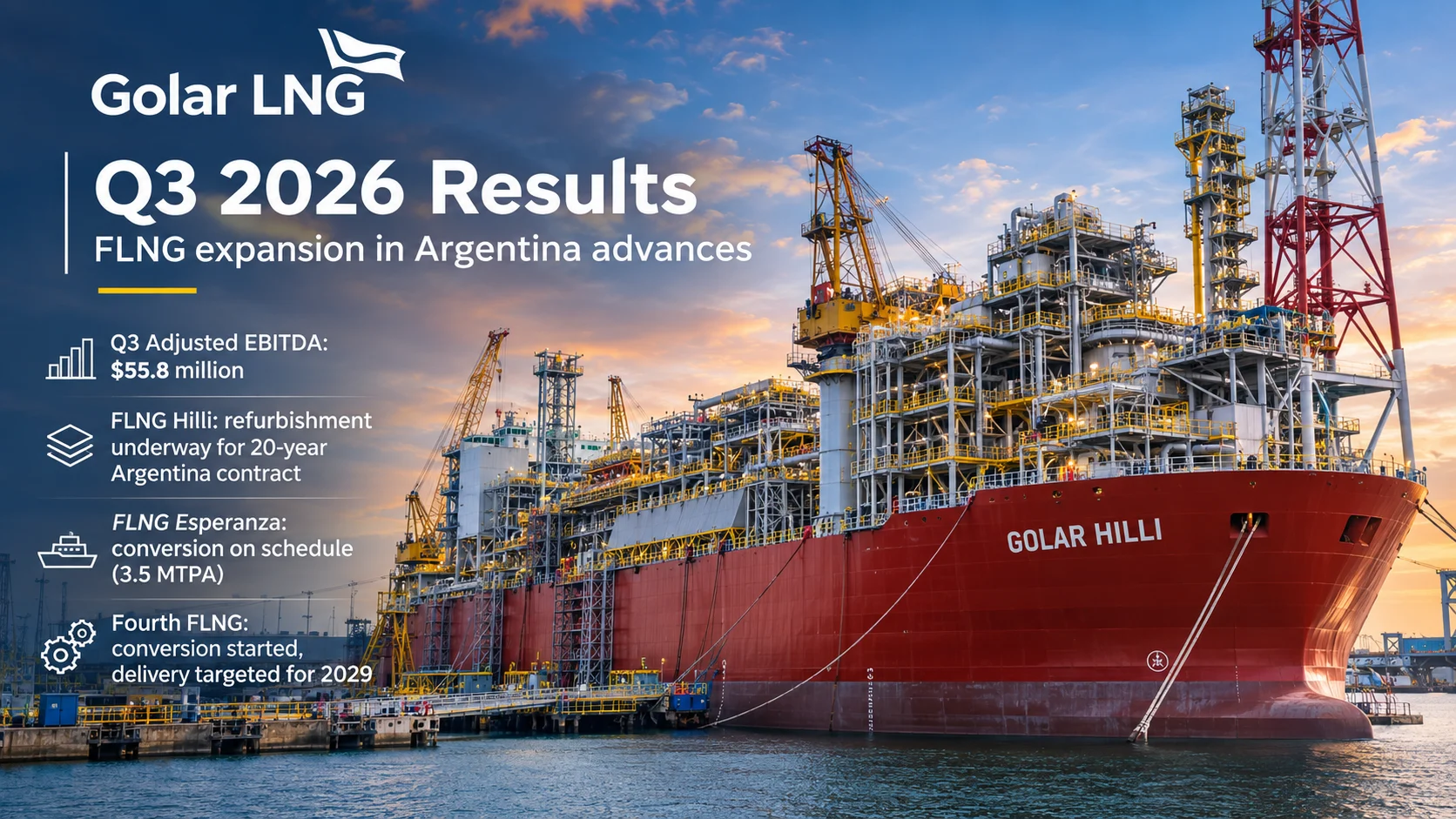
Golar LNG Reports Lower Q3 Earnings as FLNG Expansion in Argentina Advances
Golar LNG reports Q3 2026 results, advances FLNG Hilli and Esperanza projects in Argentina, and progresses its fourth FLNG conversion.