LNG Bunkering Rules and Infrastructure: IGF Code, ISO 20519 and the EU AFIR Targets
Who sets the rules for LNG bunkering: IGF Code requirements on board, including the 2026 manifold changes, ISO 20519, port rules and safety zones, and the EU AFIR targets now under review.
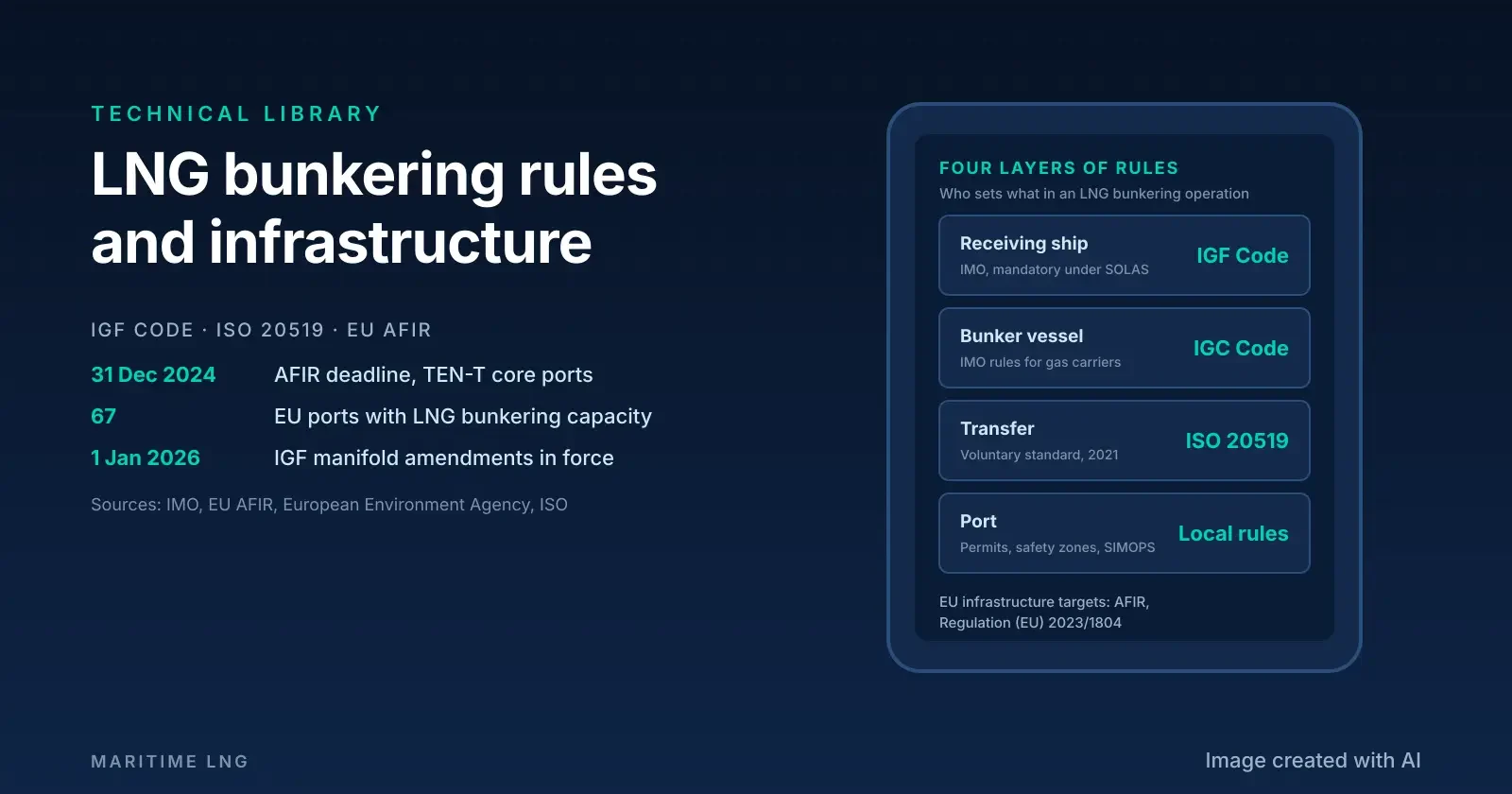
LNG bunkering is covered by several layers of rules rather than by one regulation. IMO sets the requirements for the ship that receives the fuel. An ISO standard covers the transfer equipment and procedures. Port authorities and national administrations decide where and how bunkering may take place. In the EU, a separate regulation sets targets for the infrastructure that supplies the fuel.
This guide explains each layer for ships that use LNG as fuel, using official texts only. It does not cover LNG carriers, which burn part of their cargo and are built to the IGC Code.
Rules checked on 26 November 2026. IMO requirements are those of the IGF Code as amended up to 1 January 2026. EU figures cover the 27 EU Member States.
Four layers of rules
- The receiving ship: the International Code of Safety for Ships Using Gases or other Low-flashpoint Fuels (IGF Code) sets the design and operational requirements for bunkering on board.
- The bunker vessel: an LNG bunker vessel carries LNG as cargo, so it is a gas carrier. Singapore's licensing standards, for example, require the bunkering station of its LNG bunker vessels to comply with the IGC Code.
- The transfer: ISO 20519 specifies requirements for the transfer systems, equipment and procedures used to bunker LNG-fuelled ships.
- The port: port authorities and administrations approve bunkering locations, set safety zones and decide whether other operations may continue during bunkering.
What the IGF Code requires on board
The IGF Code was adopted by resolution MSC.391(95) on 11 June 2015 and became mandatory under SOLAS on 1 January 2017. It defines bunkering as the transfer of liquid or gaseous fuel from land-based or floating facilities into a ship's permanent tanks, or the connection of portable tanks to the fuel supply system.
Chapter 8 of the Code covers the bunkering arrangements:
- Goal: the ship must have suitable systems so that bunkering can be done without danger to people, the environment or the ship.
- Bunkering station: located on open deck with sufficient natural ventilation. The surrounding hull and deck must be protected from unacceptable cooling if fuel leaks.
- Bunkering lines: must be purged with inert gas.
- Valves: a manual stop valve and a remote shutdown valve, in series or combined, at each bunkering line close to the connection. The remote valve must be operable from the bunkering control location or another safe location.
- Emergency shutdown: a ship-shore link or equivalent must give automatic and manual emergency shutdown (ESD) communication with the bunkering source.
- Tank filling: as a general rule, fuel tanks must not be filled to more than 98% of their volume at the reference temperature.
Manifold changes from 1 January 2026
Resolution MSC.551(108), adopted on 23 May 2024, entered into force on 1 January 2026. It rewrites the manifold requirements:
- Dry disconnection: the connection must achieve a dry disconnect in one of three ways. These are a dry-disconnect coupling to a standard acceptable to IMO, a manual or hydraulic connect coupler, or a bolted flange-to-flange assembly.
- Couplers and flanges: the second and third options need operating procedures that ensure a dry disconnect and a risk assessment of the bunkering arrangement. The assessment must be documented in the ship's fuel handling manual.
- Emergency release: an emergency release coupler or system, or equivalent, must allow a quick dry break-away disconnection, unless it is provided on the supply side of the bunkering line.
The resolution does not set a construction date for these bunkering paragraphs, so operators should confirm with their flag Administration how they apply to existing ships.
Bunkering operations under the IGF Code
Chapter 18 of the Code sets out how the operation itself is run:
- Written agreement: before bunkering, the receiving ship's master or representative and the supplier's person in charge (PIC) agree the transfer procedure in writing. Since 1 January 2026 this must cover cool-down and gassing-up, transfer rates, pressure and temperature limits, bunkering line relief valve settings and the volume to be transferred.
- Emergency actions and checklist: the two PICs also agree in writing what to do in an emergency, and complete and sign the bunker safety checklist.
- Pre-bunkering checks: these cover all communication methods, including the ship-shore link if fitted, fixed and portable gas detection, fire detection, remote-controlled valves, and hoses and couplings.
- Communication: the two PICs must stay in contact throughout the transfer. If communication is lost, bunkering stops and does not restart until it is restored.
- During transfer: hoses, transfer arms and piping from the supplier must be electrically continuous and suitably insulated. Only essential personnel, wearing suitable protective equipment, may be in the manifold area.
- Bunker delivery note: on completion, the ship receives a note signed by the supplier. It records the LNG properties, including the methane number, calorific values, Wobbe index, density and delivery temperature and pressure, as well as the composition and the quantity delivered in tonnes, energy and cubic metres.
Seafarers on ships subject to the IGF Code need the STCW training for these ships, which has been mandatory since 1 January 2017. The basic training includes bunkering operations and bunkering systems. Our guide to LNG custody transfer covers how LNG quantities are measured and calculated.
ISO 20519: the transfer standard
ISO 20519:2021, Ships and marine technology – Specification for bunkering of liquefied natural gas fuelled vessels, is the second edition of the standard, published in December 2021. It covers LNG bunkering transfer systems and equipment for vessels that are not covered by the IGC Code, in international and domestic service and regardless of size.
It addresses five elements:
- Hardware: liquid and vapour transfer systems.
- Operational procedures.
- Bunker delivery note: a requirement for the LNG provider to supply one.
- People: training and qualifications of personnel.
- Facilities: a requirement for LNG facilities to meet applicable ISO standards and local codes.
ISO 20519 is a voluntary standard. It becomes binding where a port authority, administration or contract requires it.
Port rules, bunkering modes and safety zones
EMSA's Guidance on LNG Bunkering to Port Authorities and Administrations, published in 2018 and prepared with the European Commission, Member States and industry, is the main EU reference for ports. It is guidance, not law. It describes port authorities as having overall responsibility for the framework for LNG bunkering in their port. That includes reviewing risk assessments, approving bunkering locations and permits, and deciding whether simultaneous operations (SIMOPS) may continue during bunkering.
The guidance describes four bunkering modes:
- Truck-to-ship: road tankers supply the ship from the quay. EMSA notes that a truck typically carries about 50 m³, so several trucks are often needed.
- Ship-to-ship: a bunker vessel or barge comes alongside the receiving ship.
- Terminal-to-ship: the ship is supplied from a shore facility by pipeline.
- Portable tanks: ISO LNG containers are lifted on board.
It also defines the zones around a bunkering operation:
- Safety zone: only essential personnel may enter, and potential ignition sources are controlled.
- Security zone: a wider perimeter set by the competent authority to control access, road traffic and other port activities.
- Hazardous zone: an area defined under IEC 60079-10-1 in which electrical equipment is restricted to limit the risk of ignition.
Example: Singapore
Singapore shows how a port turns these principles into local rules:
- National standard: Technical Reference 56, launched in 2017, was the port's LNG bunkering standard. MPA announced that it would be upgraded into a Singapore Standard in August 2026. Singapore Standard SS 727:2026, a code of practice for LNG bunkering, is now published in four parts: general introduction, custody transfer, procedures and safety distances, and personnel competency.
- Licences: MPA is issuing eight new LNG bunker supply licences for 1 September 2026 to 31 August 2031. Licensees must own or charter at least one LNG bunker vessel for the whole licence period.
- Bunker vessels: MPA's licensing standards require bunkering without venting LNG to the atmosphere except in an emergency, permanently installed LNG leak detection, and a bunkering station that complies with the IGC Code.
EU infrastructure: what AFIR requires
The Alternative Fuels Infrastructure Regulation (AFIR), Regulation (EU) 2023/1804, has applied since 13 April 2024 and replaced Directive 2014/94/EU. For LNG in shipping, its key provisions are:
- Target: Member States must ensure that an appropriate number of liquefied methane refuelling points is deployed at TEN-T core maritime ports, so that seagoing ships can circulate throughout the TEN-T core network, by 31 December 2024.
- Designated ports: each Member State designates the ports concerned in its national policy framework, taking into account port development, existing refuelling points and actual market demand. Neighbouring Member States must cooperate where needed.
- Planning deadlines: draft national policy frameworks were due by 31 December 2024 and final ones by 31 December 2025. The first national progress reports are due by 31 December 2027.
- Direction of travel: AFIR's recitals say that fossil LNG should be phased out in shipping as soon as possible and replaced by alternatives such as liquefied biomethane or synthetic methane. AFIR itself sets no sustainability requirements for the fuel supplied.
Some older official pages still give 31 December 2025 as the deadline for LNG at core maritime ports. That date came from the repealed Directive. AFIR set 31 December 2024.
On the most recent data published by the European Environment Agency in February 2026, 67 ports in the EU had LNG bunkering capacity, 45 of them on the TEN-T core network and 15 on the comprehensive network.
The 2026 AFIR review
- Legal deadline: AFIR requires the Commission to review the Regulation by 31 December 2026, and every five years after that.
- Consultation: the Commission published a call for evidence on 23 March 2026. A public consultation ran from 11 May to 3 August 2026 and received 1,787 contributions.
- Shipping: the consultation asked whether additional targets may be needed for alternative fuels in maritime and inland waterway transport.
- Status: a European Parliament briefing updated on 10 November 2026 states that a Commission proposal is expected shortly. No proposal had been published when this guide was checked.
How much LNG ships use as fuel
Official datasets give a picture of demand:
- IMO DCS, 2024: ships of 5,000 GT and above used about 15 million tonnes of LNG. LNG carriers used about 12.06 million tonnes of it, so other ship types used roughly 2.9 million tonnes.
- EU MRV, 2024: LNG consumption by ships on EU voyages reached its highest level, 7.5% of all fuel reported. The increase came from ships other than LNG carriers.
- Port of Rotterdam, 2025: ships bunkered more than 1 million m³ of LNG in the port for the first time, including 17,644 m³ of bio-LNG.
Our guide to LNG carrier emissions in official data explains the IMO DCS and EU MRV datasets, and our guide to FuelEU Maritime, the EU ETS, CII and EEXI explains how LNG counts under EU climate rules.
What it means for ship operators and ports
- Check every layer before a first bunkering. The IGF Code covers the receiving ship, the IGC Code the bunker vessel, ISO 20519 the transfer, and local rules the port.
- Review the manifold arrangement. Under the amendments in force since 1 January 2026, couplers and bolted flanges need procedures and a risk assessment in the fuel handling manual, and an emergency release system is required unless it is on the supply side. Confirm with the flag Administration how this applies to your ship.
- Keep the paperwork complete. The written transfer agreement, the signed safety checklist and the bunker delivery note with LNG composition and quantity are all required by the IGF Code.
- Expect coverage where there is demand. AFIR requires an appropriate number of refuelling points at core ports, not LNG at every port. National policy frameworks show which ports each Member State has designated.
- Watch for changes. The AFIR review is due by the end of 2026, and ports such as Singapore are updating their standards and licences.
This guide was prepared with AI assistance from the official sources listed above and reviewed by the Maritime LNG Editorial Desk.
Spotted an error or an outdated figure? Report an error · Corrections policy
Related guides
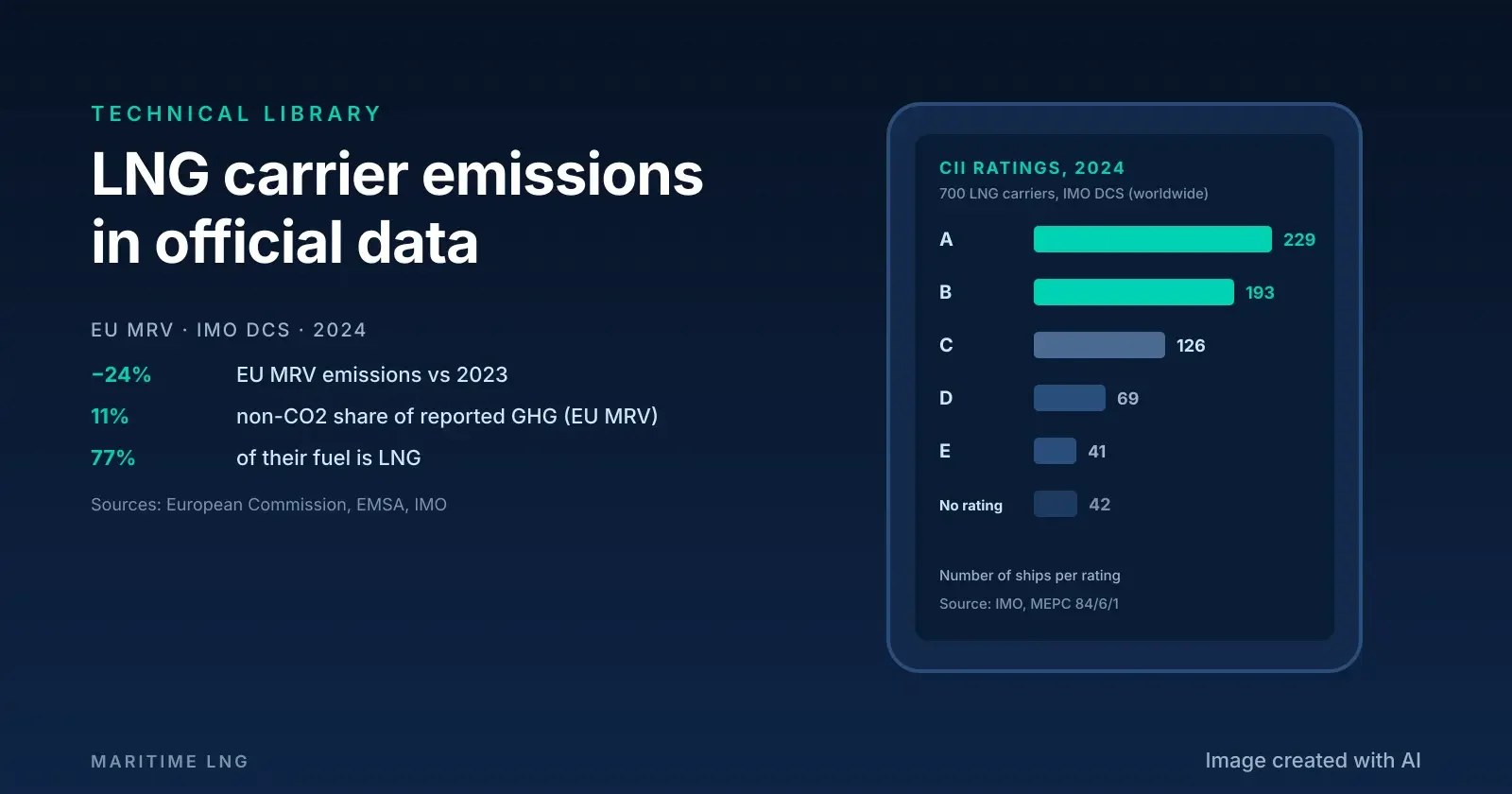
LNG Carrier Emissions in Official Data: What EU MRV and IMO DCS Show
Official 2024 data on LNG carrier emissions: EU MRV CO2 and methane figures, IMO DCS fuel use and CII ratings, and where to find ship-level data.
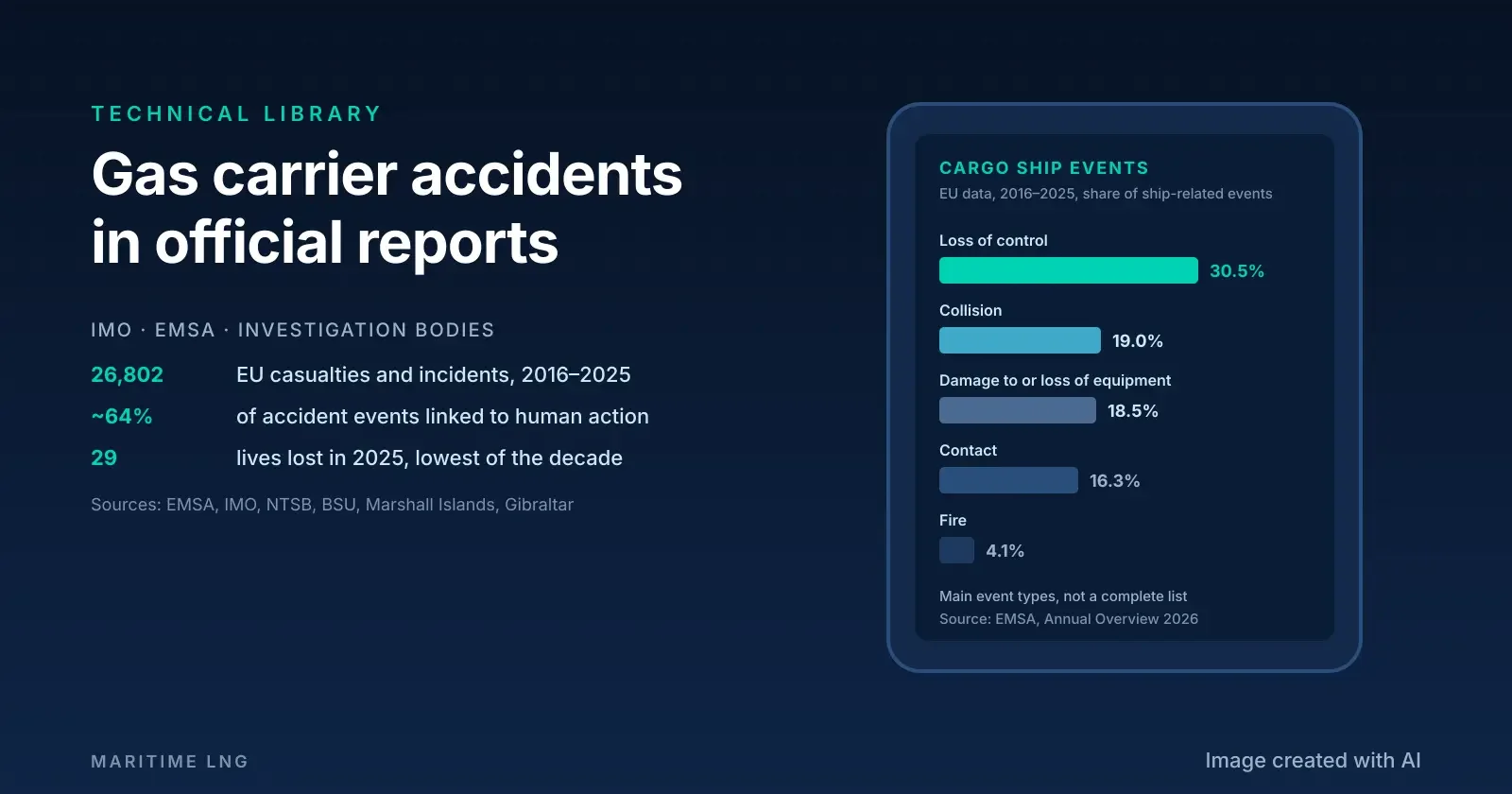
Gas Carrier Accidents in Official Investigation Reports: Data and Lessons
Official data on gas carrier accidents: the IMO Casualty Investigation Code, EMSA statistics for 2016–2025 and lessons from four investigation reports.
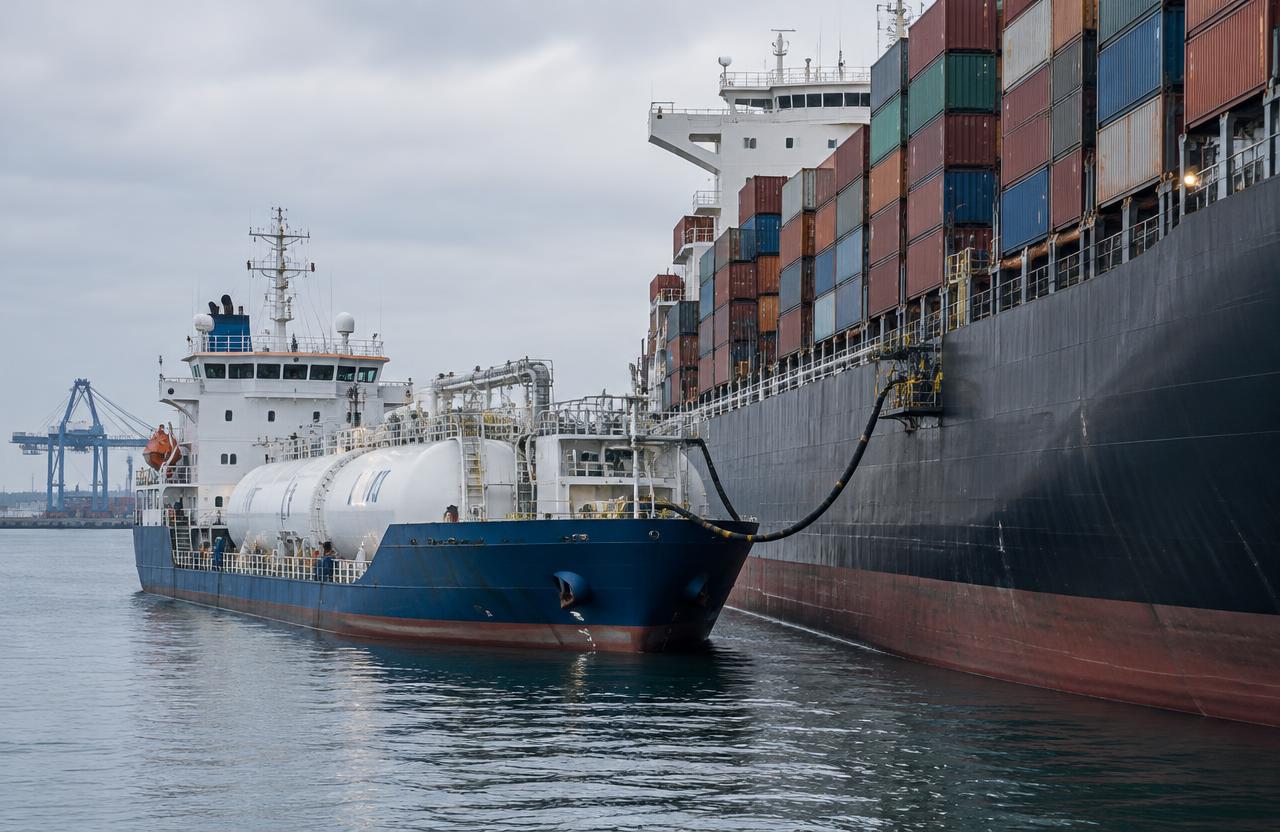
LNG Bunkering Operations: Ship-to-Ship Transfer, Equipment and Safety
Truck-to-ship, terminal-to-ship and ship-to-ship LNG bunkering explained: transfer equipment, compatibility, safety and security zones, ESD, documentation and crew competence.